
Many people know of Arthur Szyk’s prolific WWII and Holocaust era anti-Nazi and anti-Axis political cartoons and illustrations. Others are keenly aware of the many Jewish themed books illustrated by Szyk as well as the postage stamps he designed for Israel and Liberia. Others collect the awareness labels he illustrated for Jewish organizations. Szyk was a staunch Zionist and many of his works addressed his passion for a Jewish Army and an independent Jewish State. In this article I will highlight samples of the artist’s patriotic work created before and during the Holocaust era and show examples of how his illustrations are still being used today.

Prior to the opening of the New York World’s Fair on April 1, 1939 and the beginning of WWII, that started with the German invasion of Poland on September 1, 1939, Szyk produced a series of 20 patriotic drawings called “The Glorious Days of the Polish-American Fraternity”. The series highlighted the relationship between Poland and the United States over many years and the significant contributions made by Poles to the development of America as a free and independent nation.
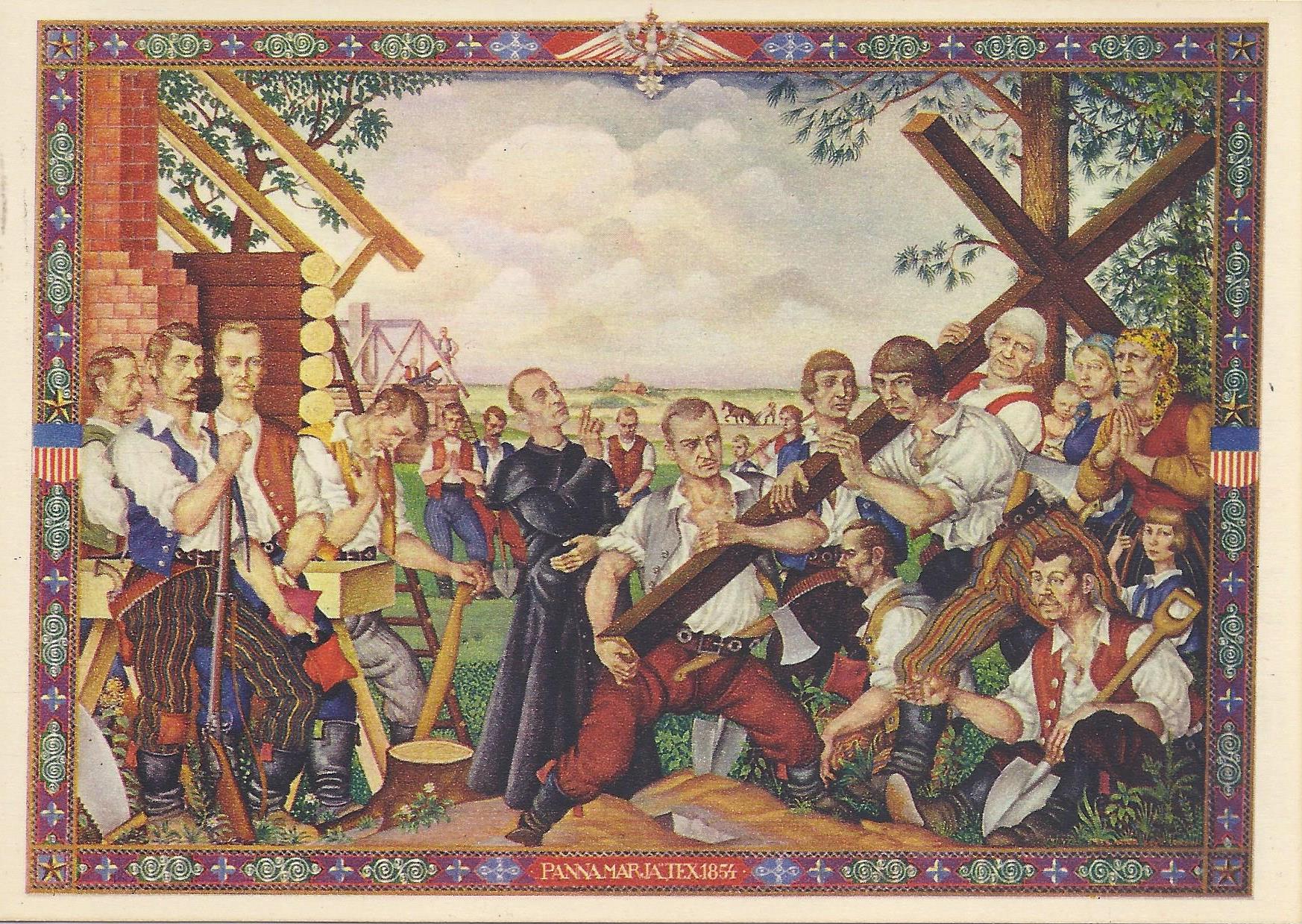
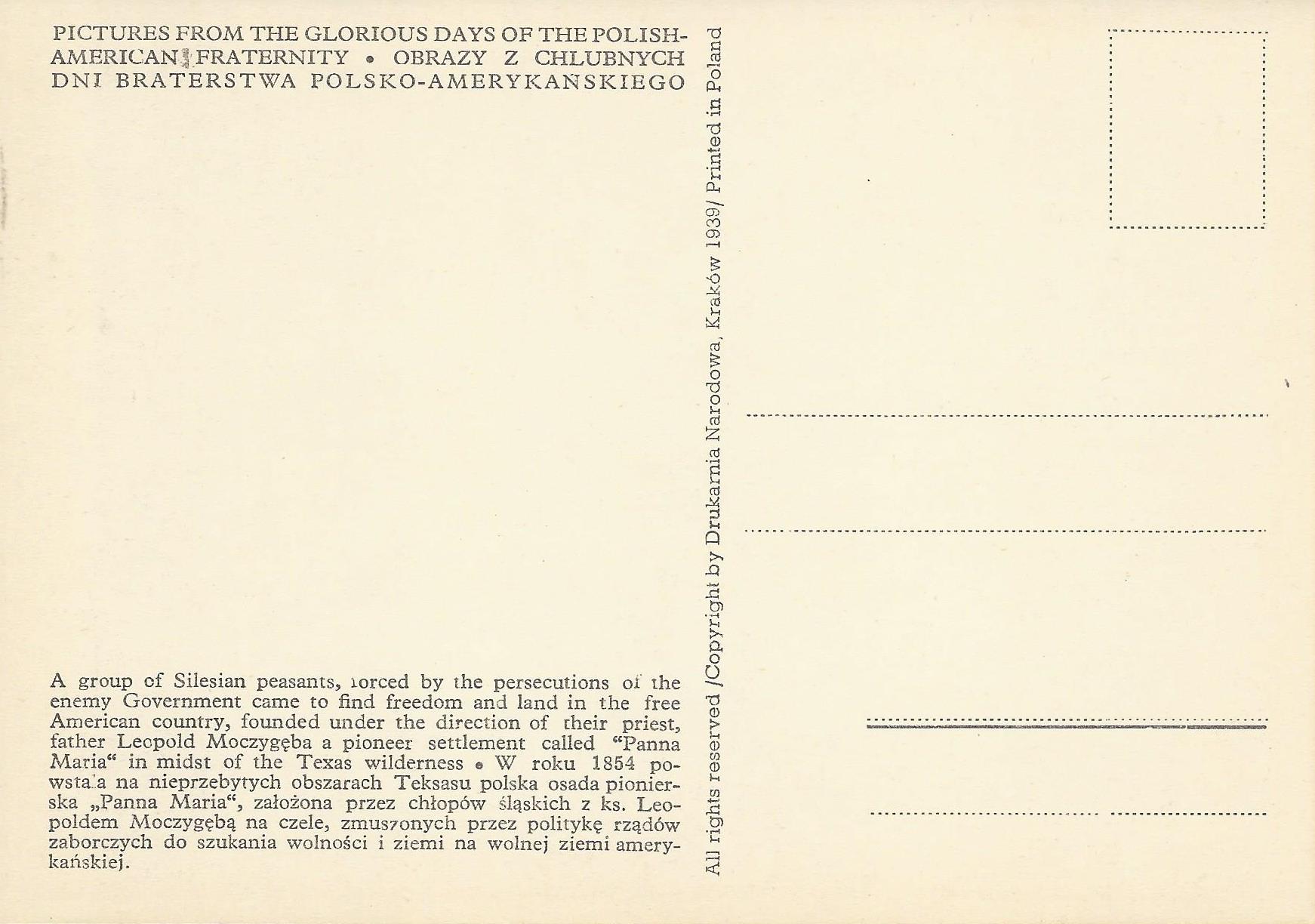
Some of the personalities featured in this series are Woodrow Wilson, Ignacy Jan Paderewski, John Kolno, Kazimierz Pulaski, Tadeusz Kościuszko, Olbracht Zaborowski , Felix Miklaszewicz, Jakub Sadowski, Michael Grabowski and George Washington. As a resident of the Lone Star State, one card this author particularly connects with highlights the settlement of Poles in Panna Maria, Texas in 1854—the oldest permanent Polish settlement in the United States.
The Panna Maria Historical Website recounts the two month journey of the first families from Silesia and Poland that were invited by Fr. Leopold Moczygemba to settle in this area. They settled near the junction of the San Antonio River and Cibolo Creek and celebrated their first Mass on December 24, 1854 under an oak tree. Szyk masterfully recreated this scene.
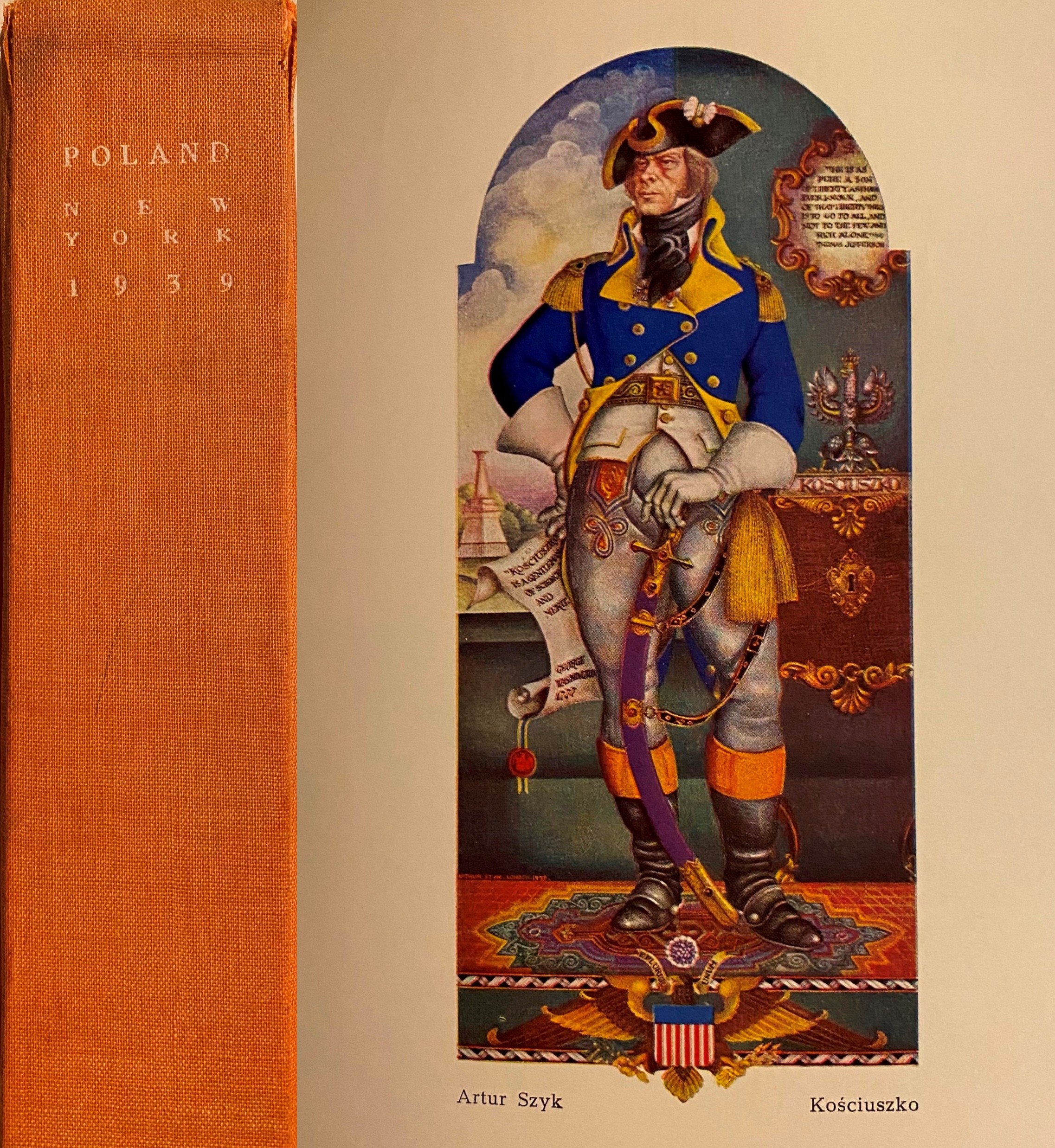
The 503 page 1939 Poland World’s Fair Exhibition Catalog includes a complete inventory of the “Artur Szyk” exhibit at the fair, along with a full page color illustration he created of Tadeusz Kościuszko. Kosciuszko, a Pole arrived in American in 1776. He offered his services to the General Washington and was the planner of the defeat of the British at Saratoga, NY. He also was responsible for the design and building of the fortifications at West Point. Kościuszko was one of many Polish American patriots much like Szyk himself.
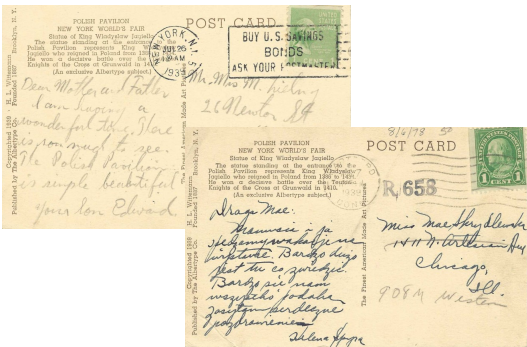
The Polish pavilion featured a statue of Polish King Wladyslaw Jagiello on horseback, celebrating the victory over the Teutonic Knights in 1410. Two souvenir postcards from the fair feature King Jagiello and are postmarked 1939. One has a message written in Polish and the other makes mention of the Polish Pavilion. There was also an official New York World’s Fair poster stamp issued of the Polish Pavilion.
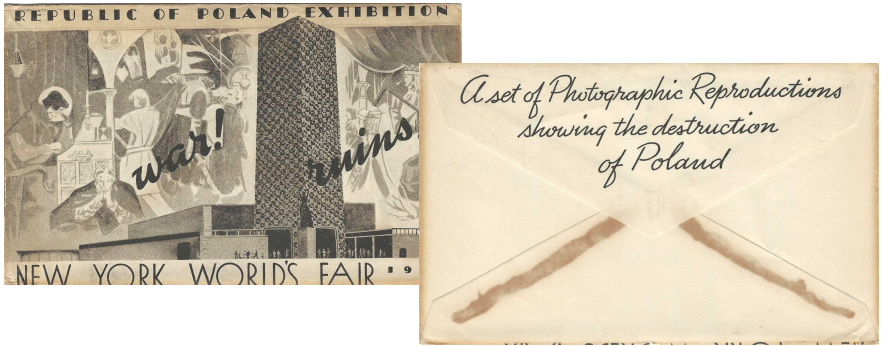
It is ironic that the Szyk images featured at the Polish pavilion of Wilson and Paderewski were focused one stablishing a free and independent Poland. It wasn’t until 1989 that Poland finally became a free nation. The New York World’s Fair was well underway when the Germans invaded Poland in 1939. Sadly, in 1940, there was a new souvenir available at the Polish Pavilion gift shop. This illustrated Republic of Poland Exhibition envelope that stated “War and Ruins!” contained a set of eight postcards showing the destruction of Poland.
Of special note for this article is the friendship between U.S. President Woodrow Wilson (1856-1924) and Poland’s Prime Minister Ignacy Jan Paderewski (1860–1941). One of the twenty Szyk illustrations in the “Polish American Fraternity” series illuminates this relationship. Paderewski, a pianist and composer became a spokesman for Polish independence. In 1919, as the new nation's Prime Minister and foreign minister, he was a signatory at the Treaty of Versailles, which ended World War One. Wilson served in office from 1913 to 1921 and led America through the global conflict. Both are remembered as advocates for democracy, freedom, progressivism and world peace. Paderewski drafted article thirteen of President Wilson’s fourteen point document that was designed to establish a peaceful post World War One world and called for a free and independent Poland.

On December 20, 2019 the Polish Post released a sheet of twelve 3,30 zł (złoty is the Polish currency)stamps to celebrate the 100th anniversary of diplomatic friendship between the United States and Poland. The illustration used for this stamp is a cropped image from the original Szyk drawing featuring Wilson and Paderewski. I only recently discovered this issue while doing research on Ignacy Jan Paderewski. I immediately recognized the image as that of Arthur Szyk.
Credit to the artist, “A. Szyk” is given in vertical line of small black type, below POLSKA 3,30 on the stamp’s grey background. I missed it completely at first, but with the assistance of my friend and fellow collector, Christoph Wendland, it was brought to my attention. The full sheet is beautifully adorned with a traditional Szyk illustrated border.
The first day cover is postmarked Warsaw, Poland and features crossed United States and Polish flags. The cachet features a “blended” American and Polish flag along with a fragment of the Szyk border as seen on the full sheet.

My friend Mieczyslaw, who resides in Poland, was kind enough to find and purchase the full sheet and elusive first day cover for me. He also used some additional “Szyk” stamps on the mailing cover to Austin, TX. Thanks once again to Irv Osterer (Ottawa, Canada) for his help and support with this project. Collecting is such a great way to make lasting friendships around the globe!
During my research I discovered Mieczyslaw Biskupski’s The United States and the Rebirth of Poland,1914-1918 published in 2012 with the “Wilson/Paderewski” illustration on its cover. I also discovered a 2020 book titled Woodrow Wilson and the Reimagining of Eastern Europe by Larry Wolff that has a similar Szyk Polish related Woodrow Wilson image on its cover.
It is a fitting tribute to the artist that many of his illustrations are still being used today!
A version of this article appeared in December 2021 in the Judaica Thematic Society Newsletter