
A famous artist and illustrator, Arthur Szyk is best noted in Jewish circles for his beautiful Passover Haggadah and many other illustrated publications such as the The Song of Songs, The Book of Esther, The Book of Ruth, The Book of Job, The Well of Jacob, and many other Judaic paintings and books too numerous to mention here. Many people know Arthur Szyk for his graphic anti-Nazi and anti-Axis work during WW II. Fewer know him for his philatelic prowess! In this article we would like to focus on the philatelic genius that was Arthur Szyk. In his 2004 book Arthur Szyk, Artist, Jew, and Pole, the late Joseph P. Ansell states,
A Polish Jew whose work was overwhelmingly Jewish in theme and content. In a lifetime of creativity that spanned many of the events of the twentieth century and took him from Poland to France, England, and the United States, the mission he set himself was to use his artistic talents to serve humanity and the Jewish people. He goes on to state that most of Szyk’s work deals with contemporary political themes and social causes, such as freedom, toleration and human dignity, drawing his inspiration from the Bible.
We could use another Arthur Szyk today!
Szyk’s philatelic endeavors appear to begin in 1944. Arthur Szyk was commissioned by his friend and fellow Pole, Kasimir Bileski, the famous Canadian stamp dealer from Winnipeg, Canada, to design a series of plates for various member countries of the United Nations. He completed the United States plate in 1945 and completed nine others by the time of his untimely death in 1951.
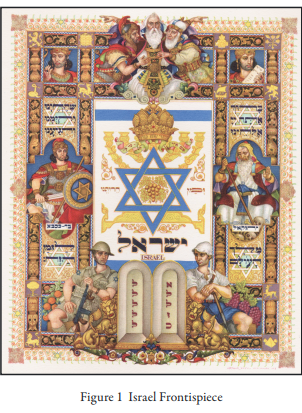
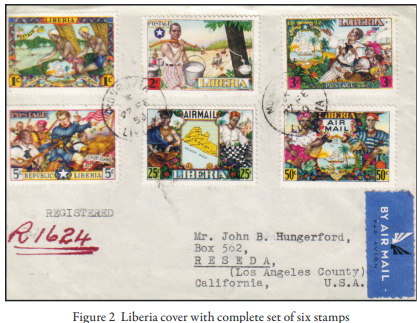
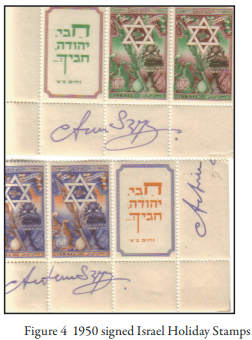
Together they marketed a variety of Szyk designed philatelic material including the six stamps for Liberia (Figure 2), another two for Israel (Figure 4) as well as his United Nations frontis piece series (Figure 1). Many of the items were signed by the artist for added collector appeal.
During 1949 Szyk worked with Frank Bruns, who served as the official advisor to the Liberian Post Office. Bruns later served as the curator at the Smithsonian Institution’s Division of Postal History. Szyk designed a series of six stamps that the Liberian Post Office issued later that year (Scott 309-312, C63-C64). Figure 2 is a rare cover with the complete set of six stamps mailed in 1950 (not a FDC) with both New York and California receiving cancels on the reverse. He also designed a beautiful but unissued Liberian airmail souvenir sheet (Figure 3).

In 1950 The State of Israel accepted the Szyk designed a very beautiful “Festival” stamp set (Scott 35-36). The Hebrew text in the tab is taken from the Book of Nachum, Chapter two Verse one…“My Festivals Judah, are Your Festivals.” Another translation from an English Book of Prophets states, “Keep thy solemn feasts, O Judah….”Figure 4 is a set of full tabbed Szyk designed Israel stamps with his signature. The 5 pruta issue is signed on two sides and is very rare!
Arthur Szyk designed many different poster stamps, labels and cinderellas (stamp like labels) during his career. He used his talents to illuminate the work of many important American, Jewish/Zionist, anti-Nazi, British and Polish organizations of his time. A few specific organizations were the British American Ambulance Service, American Federation for Polish Jews, Emergency Committee to Save the Jews of Europe, ANZAC Club, Jewish War Veterans and the American League for a Free Palestine (Figure 5).

Some of these powerful images helped bring to light the plight of his fellow Jews and their sufferings under Nazi occupation, as well as the heroic resistance in the Jewish ghettos of Europe. Other designs by Szyk were not accepted by the Israel Ministry of Post, but were fine pieces of art nonetheless, an example being Figure 6 (not accepted design with Certificate).

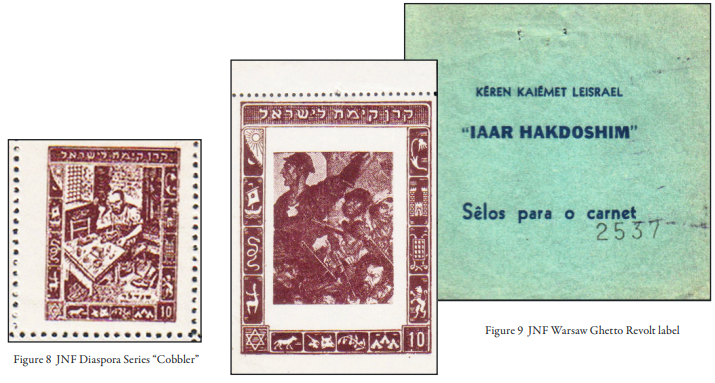
He followed with post WW II images that depicted the struggle for the rebirth of the Jewish State. After Israel’s independence he designed a beautiful Israel Bond label (Figure 7). In 1944 Szyk designed two labels for the Jewish National Fund. They were part of the “Diaspora” series. The most common is that of the “Cobbler” (Figure 8). The other is the rare “Warsaw Ghetto Revolt” label that is the size of four labels together and made a complete booklet pane on its own (Figure 9). This was issued as part of a booklet by “Keren Kaiemet Leisrael” in Brazil. Other artists that contributed to this series were Lillien and Budko.
A version of this article was published in The Israel-Philatelist in April 2009.