
In March 1941, a seventeen-year-old refugee named Marion Renzer locked herself in the sick-bay kitchen of a castle in North Wales. It was the only place she could get a few minutes alone, and she wanted to write to her sister.
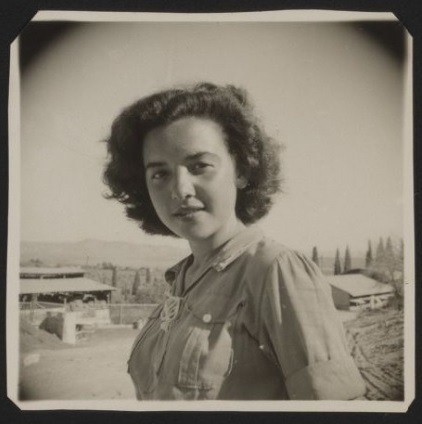
Near the end of the letter, she lamented the distance between them, both physical and emotional: “...you're even farther away than across the sea."
Her sister, Ruth, was in Palestine. The two girls had grown up together in Berlin, and in the winter of 1938/1939, they were sent in opposite directions by two different rescue efforts. They spent the war writing to each other.
Discovering and acquiring this collection felt very personal to us, as Michelle's aunt, Alice Warech, also fled Nazi Germany as a child, making her way to the United States with her family in 1938. Reading these letters from another young person who’d left everything she knew behind felt, in a way, like an opportunity to be closer to Alice. In 2020, we donated the Renzer sisters' papers to the United States Holocaust Memorial Museum in her memory, and we are thrilled that they are now digitized in full for the public to see.
The Kindertransport
The Kindertransport began almost immediately following the violence and terror of Kristallnacht in November 1938.
In the weeks that followed, under pressure from refugee aid groups and the public, Britain agreed to admit unaccompanied Jewish children under seventeen from Germany and the territories it had annexed. There were two conditions: First, parents couldn’t come, and second, Britain would not foot the bill. Private citizens or organizations had to guarantee each child's care, education, and eventual departure from Britain.
The first transport reached the English port of Harwich on December 2, 1938, carrying about 200 children. Jewish organizations in Berlin, Vienna, and Prague chose who would go. They gave priority to children in the most precarious situations: those whose parents were in concentration camps or could no longer support them, and orphans and children without homes.
The children traveled by train to ports in the Netherlands and Belgium, then crossed the North Sea. Those with sponsors went on to foster families. Others waited in a holiday camp near Harwich, then moved into hostels, schools, and farms across Britain. The last transport from Germany left on September 1, 1939, the day the war began. A final ship sailed from the Netherlands in May 1940, as the Dutch army surrendered.
In all, about 10,000 children reached Britain this way, nearly all of them Jewish. Most never saw their parents again.
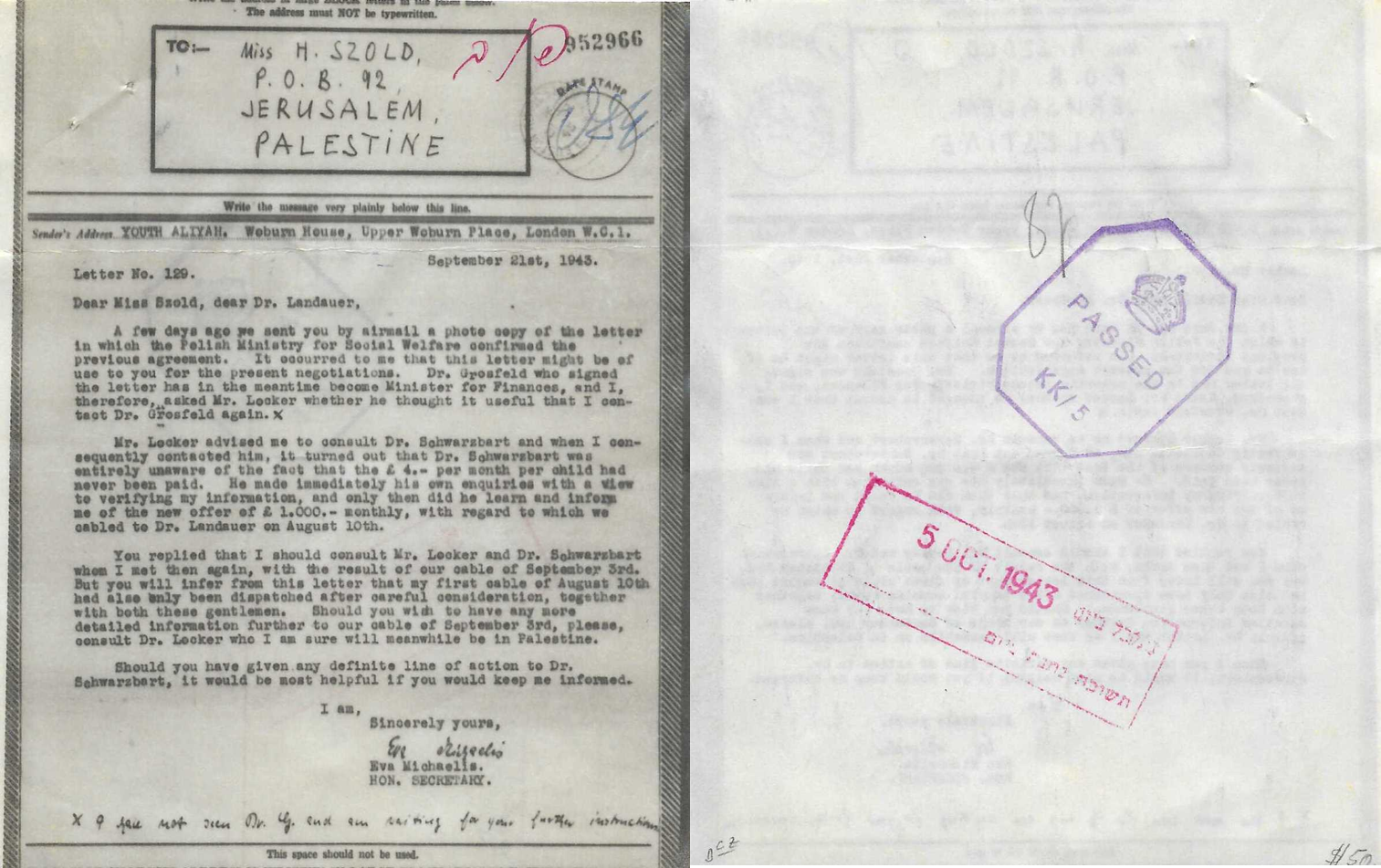
The Kindertransport was not the only route out. Youth Aliyah, a Zionist organization developed by Hadassah (the Women’s Zionist Organization of America) and its founder Henrietta Szold, brought thousands of Jewish teenagers from Germany to Palestine, where they lived in kibbutzim and children's homes. The Renzer Sisters took both routes.
The Renzer Sisters
Ruth Golda Renzer was born in Berlin on August 4, 1922. Her sister, Marion, followed fifteen months later, on November 8, 1923. Their parents were divorced, and we don’t know anything about their father. In 1936, when the girls were thirteen and twelve, their mother, Frieda, was admitted to the Wittenau state psychiatric hospital in Berlin. Over the next few years she was moved from one institution to the next, and the sisters were placed in a Berlin children's home.
Ruth and Marion were exactly the kind of children the rescue organizations prioritized: Jewish, in Nazi Berlin, and with no parents able to care for them.
The sisters left Germany within weeks of each other, but not together. (We don’t know why.) In December 1938, Marion, then fifteen, boarded a Kindertransport to London, where her mother's brother, Willy Bock, was also living. By January 1939, sixteen-year-old Ruth had reached Palestine. She lived at the Ahava children's home in Kiryat Bialik, near Haifa.
Neither girl would see their mother again. The sisters never learned what became of her.
The Letters
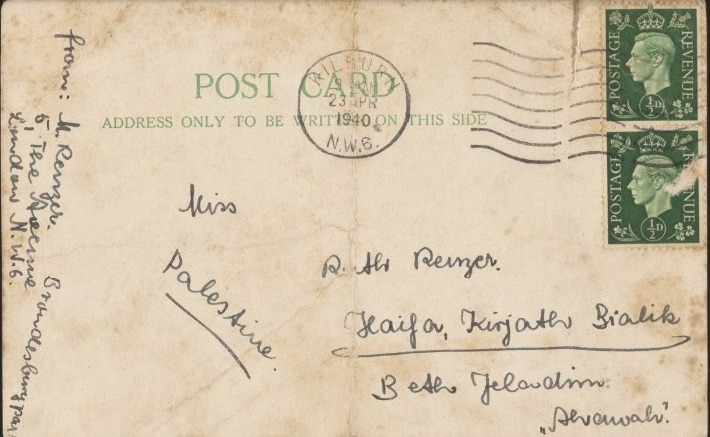
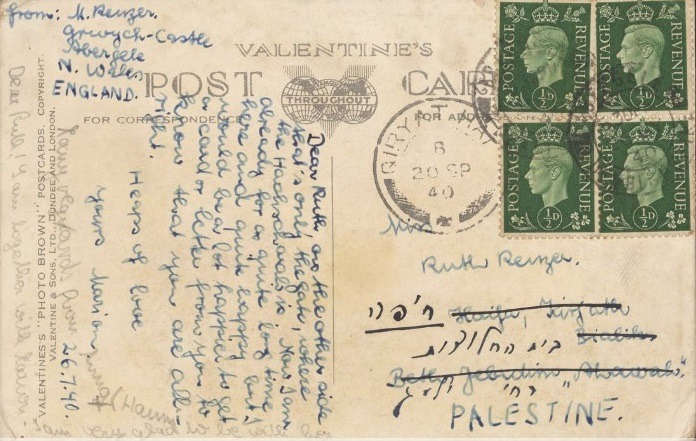
The collection consists of letters to Ruth from Marion, who wrote in German sprinkled with Hebrew. Her earliest letters are short and dutiful. A postcard from March 1940 is typical: no mail from Ruth this week, nothing special to report, a proper letter next week, God willing. Many open with the same complaint. Ruth hasn't written, and Marion has been imagining the worst.
But her personality comes through quickly as, presumably, Ruth joins the conversation. In January 1940, evacuated from London with her school and living with a host family, she apologizes for writing to everyone else first. "What a sister I am!" She writes that the radio has just announced that a thousand Russians died of cold and that Germany is short of coal, and it's bitterly cold where she is, too. Her roommate has gone to London for medical treatment, and Marion is lonely. There is no one to keep her warm at night and talk with her until midnight.
That spring, on a long walk through the English fields with some of the older girls, she wrote, she kept thinking how wonderful it must be to walk through the fields of Palestine, under that blue sky.
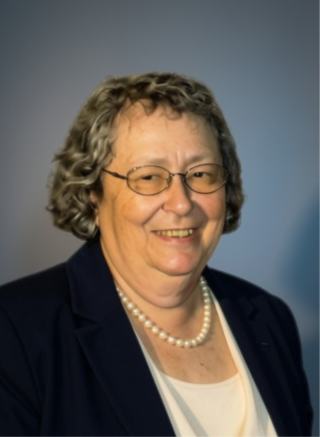
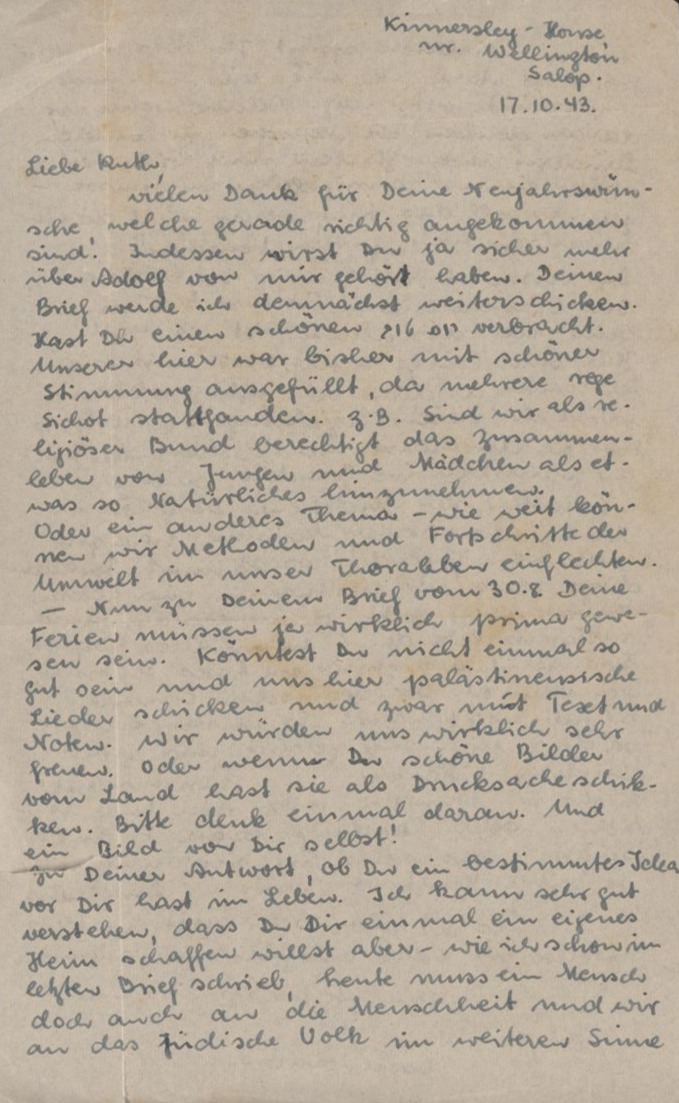
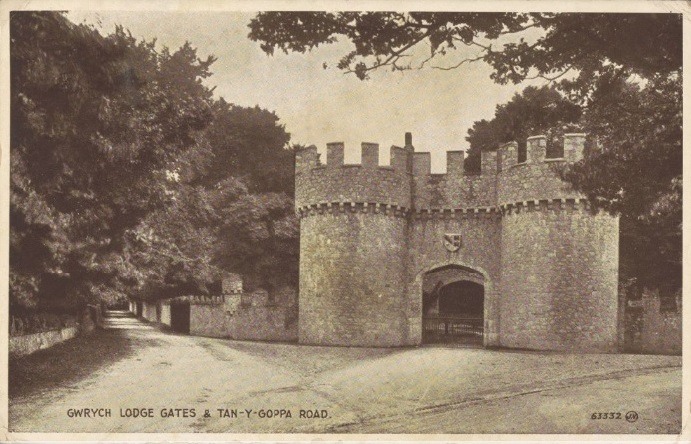
By early 1941, Marion was at Gwrych Castle in North Wales, one of the training centers for young Jewish refugees. Her letters from there are her most candid. She was assigned to care for the sick. Most of the people there, she noticed, needed care for their souls. She wished she knew how to give it. She tells Ruth that her letters mean more than she can know, and that if they were together now, they would be very close. Then she admits that after six months of training she is already disappointed and tired of everything. Most of the 120 young people around her, she writes, didn't come out of conviction. She questions whether Palestine would be any different.
The letters also show a wider family scattered by the war. A cousin serving with the British Army in the Middle East sent Ruth money in 1943 and told her firmly to spend it on herself: theater, opera, or cabaret.
As the war went on, the sisters' letters deepened. In June 1943, Marion wrote that she was glad Ruth could speak to her so openly: "Finally, things between us have become completely different." Ruth had confided in her about a difficult decision over a suitor, and Marion, the younger sister, answered with careful questions and one firm piece of advice. "In your decisions, you mustn't put yourself last."
That fall, writing from another training farm in Shropshire, Marion sounds like a different person from the disillusioned teenager at Gwrych. She describes lively debates among the young people about faith, modern life, and how to live together. She asks Ruth to send Palestinian songs, with words and sheet music, and pictures of the country. She tells her sister that wanting a home of one's own is understandable, but that a person today must also think of humanity, and Jews of the Jewish people as a whole.
After the War
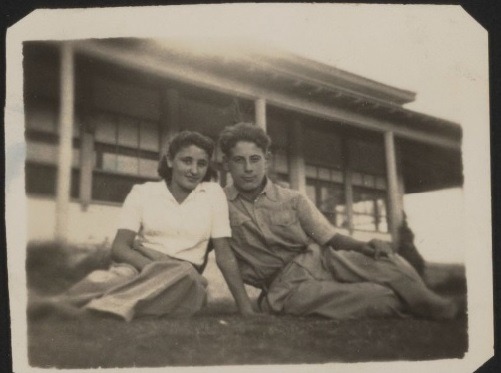
By 1946, Marion was living in Salford, near Manchester, and writing by airmail to Ruth, now married and living in Haifa as Ruth Zatzkis. The letter is full of plans. Marion had just taken a two-week course in Froebel early-childhood education with about 300 people from around the world. She had cooked for 350 at a summer camp as one of only three cooks, and walked the hills of the Lake District. In London she stayed with their Uncle Willy and his family, and told bedtime stories to his young son.
She had three job offers, and a letter calling her back to the kibbutz. She hoped to study for her teaching exam by correspondence and take piano lessons. "Castles in the air," she called it. She also worried about Ruth. The news from Palestine was grim, and she wondered what life there felt like.
After the war, Marion settled in Israel. She became Miriam Spielman, and the sisters who had spent their teenage years writing across a continent and a sea finally lived in the same country.
Why a Collection like this Matters
The history of the Kindertransport is usually told in numbers: about 10,000 children, nine months of transports, one port of arrival. Letters like Marion's add color. They show what rescue looked like from the inside, long after the train pulled away: the waiting for mail, the loneliness of hostels and training farms, the slow work of staying close to family by post.
For a collector, a correspondence like this is rare. Wartime letters were easily lost, thrown out, or scattered as families moved and estates were broken up. Here, years of letters to Ruth survived together, alongside postcards, photographs, and official documents that place both women in time. And what you’ve just read is the smallest sampling. The full collection (available here) contains nearly 700 files that chronicle ten years of Marion’s life. You’ll find postcards and letters in German and Hebrew, some stained, some torn, many beginning with a gentle complaint that Ruth’s last letter took too long. Read together, they show two girls growing into women, and growing closer despite being “farther than across the sea” from one another.
Keeping the collection intact, and placing it where researchers, students, and families can use it, ensures that Marion and Ruth's story will outlast any one owner.