
There was a particularly pernicious anti-Jewish trope circulating during and after WWI, designed to help fuel Nazi fire: The idea that Jewish people were “shirkers” who avoided military duty, demonstrating alack of loyalty to their countries. Try telling that to my Grandfather, Sergeant Louis Philipson of the American Expeditionary Forces during the First World War.

You won’t be surprised to learn, I hope, that like every other hateful anti-Jewish trope, this one was patently false—a fact easily proven by hard data even as the lie was taking root.
Philipson and Warech family members have served for the United States in many conflicts, including WWI, WWII, Korea, Vietnam, and others. But they are far from the only ones to serve our great nation. In fact, Jewish Americans served at rates proportional to—and frequently exceeding—their share of the general population, in every major American conflict.

Before the Republic: New Amsterdam and the Revolution
In fact, Jewish defense of American shores predates the country itself. When the first Jewish settlers arrived in New Amsterdam in 1654, refugees fleeing the Portuguese reconquest of Dutch Brazil, the colony’s governor Peter Stuyvesant tried to bar them from the militia and taxed them for the exemption instead. Asser Levy and his fellow Jewish settlers petitioned instead for the right to stand guard like any other burgher. By 1657, Levy had secured full burgher status—trading and defending the colony on equal footing with his non-Jewish neighbors, over a century before the Revolution.
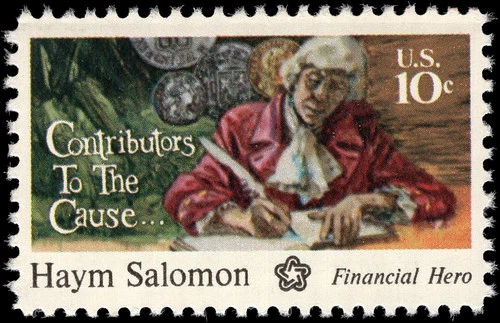
That same instinct—to be counted as full and contributing citizens, not exceptions—carried into the fight for independence itself. Haym Salomon, a Polish-born Jewish immigrant working as a broker in Philadelphia, became one of the Revolution’s most vital financiers. Twice imprisoned by the British, Salomon went on to personally finance a substantial share of the war effort, extending loans to the Continental Congress and to officers including Robert Morris. Salomon raised and lent hundreds of thousands of dollars, much of which was never repaid, and he died penniless in 1785. In 1975, the U.S. Postal Service honored him with a 10-cent stamp in its “Contributors to the Cause” bicentennial series—long overdue recognition for a debt the young nation owed this Jewish patriot.
The Civil War: A Nation (and Its Jewish Communities) Divided
During the American Civil War, the Jewish population in the United States was estimated to be about 150,000, or roughly 0.5% of the total national population. The majority (125,000-130,000) lived in the Northern United States, with 7,000-8,400 serving in the Union Army. Of the 25,000 or so Jewish people living in the South, a full 10 to 15% served in the Confederate Army.
The anti-Jewish sentiments we associate primarily with WWII were already brewing in the United States and elsewhere (and had been for centuries already). The Jewish population in the United States had boomed over the last couple of decades as Jewish people escaped poverty and discrimination in Germany and Central Europe, making their way to the United States in search of prosperity and inclusion. However, Jewish immigrants were regarded with suspicion, particularly in the North.
In 1862, Union General Ulysses S. Grant attempted to expel all Jews from his military district. His General Order 11 was given to end the black market of Southern cotton, which he believed was run by Jewish traders. As it turned out, Grant’s own father was one of the perpetrators heavily involved in the black market trading. Lincoln revoked the order as soon as he became aware of it, but the damage was done.
And yet, despite the discrimination on both sides of the Mason-Dixon line, Jews fought for both the Union and the Confederacy in numbers proportional to—and occasionally exceeding—their percentage in the general population. Not only that, but several Jewish soldiers achieved the rank of General, and at least six Jewish Union soldiers received the Medal of Honor.
The Indian Wars
The record didn’t pause between the Civil War and WWI. In 1868, Simon Suhler, a Bavarian-born Jewish immigrant who had already served in the Civil War, enlisted in the 8th US Cavalry under the assumed name Charles Gardner—a common practice among Jewish soldiers of the era seeking to serve without their faith becoming an obstacle or a target. Fighting the Apache in the Arizona Territory that year, Suhler distinguished himself in combat and was awarded the Medal of Honor—the only Jewish Medal of Honor recipient for service in the Indian Wars. He died in 1895, his true identity and heroism largely forgotten, buried under his alias. It wasn’t until 1988, when a descendant traced his story, that a corrected headstone bearing his real name, his Medal of Honor citation, and a Star of David was placed at his grave in the San Antonio National Cemetery—decades before organizations like Operation Benjamin began the modern work of finding and correcting the graves of other Jewish American servicemen buried under the wrong faith’s marker.
WWI: The Myth vs. the Math
We’ll come back to the United States momentarily, because Jewish participation in the US Military during WWI was equally—if not more—prevalent than it was during the Civil War. But first, let’s look at how the “shirker” trope was spreading across the pond.
After all, the myth didn't originate in a vacuum. It was carefully cultivated, and nowhere more deliberately than in Germany, where anti-Jewish nationalists spent huge amounts of energy insisting that Jewish citizens were dodging their responsibility to serve. The German military's own Judenzählung or Jewish Census was designed to confirm accusations of the lack of patriotism among German Jews; the census, however, soundly disproved the accusations.
The data showed that German Jews were serving—and dying—at rates consistent with, and in many cases exceeding, their share of the German population. Rather than publish findings that demolished their own premise, nationalist factions buried the results. It was left to Jewish veterans themselves to get the truth into the public record.
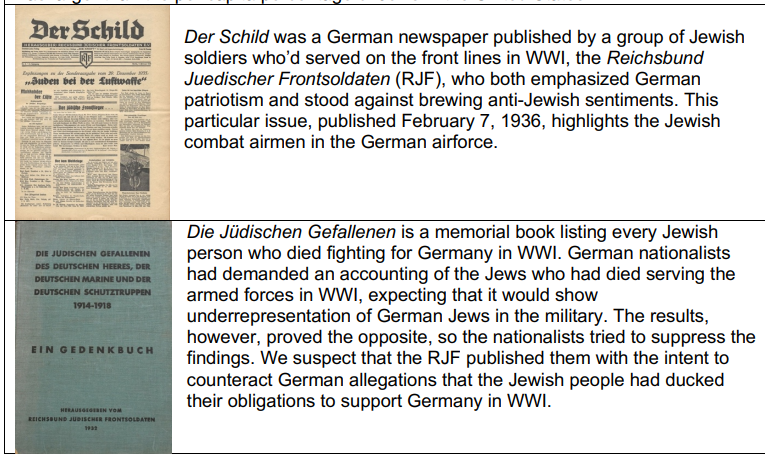
Of course, the Nazis continued to perpetuate the lie in Europe, but in the US, the numbers were telling the same stories.
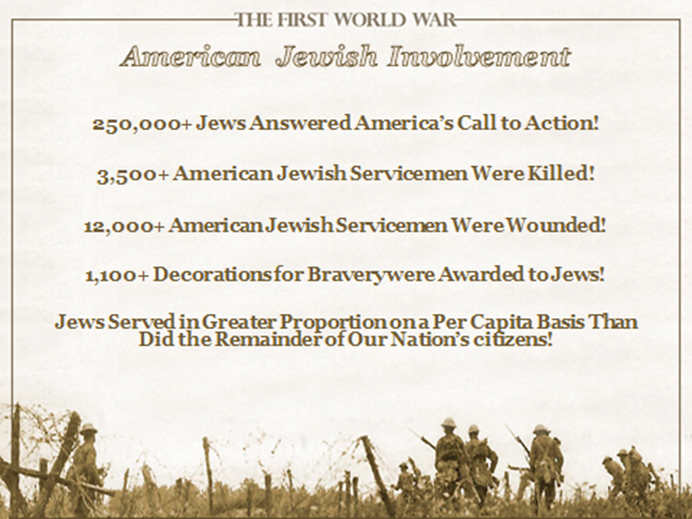
When the United States entered the war in 1917, the American Jewish population had risen to right around 3 million people, just under 3% of the total US population. Between 200,000 and 250,000 Jewish Americans (about40,000 of them volunteers) served in WWI—representing 4% to 5% of the American military forces.
The math is unambiguous. Jews were not shirking; rather, they were overrepresented in uniform, by a significant margin.

Jewish Americans also played pivotal roles in domestic politics and mobilization. For example, California Congressman Julius Kahn, serving as Chairman of the House Military Affairs Committee, was the primary architect of the Selective Service Act of 1917—the legislation that created the draft and made large-scale American military participation possible.
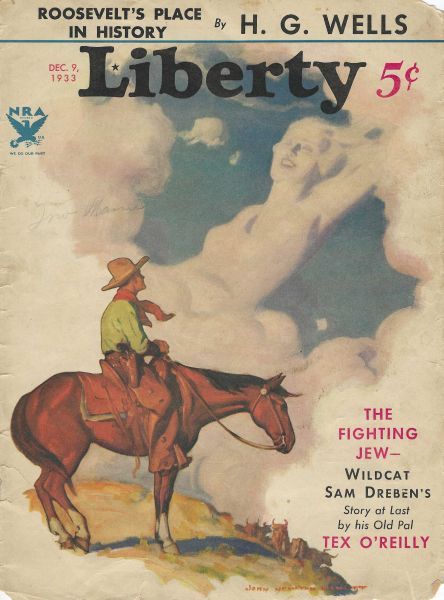
One soldier who embodied this era—and how far Jewish service actually stretched—was Samuel Dreben, known to his fellow servicemen as “The Fighting Jew.” Born in the Russian Empire and forced to flee escalating anti-Jewish violence, Dreben enlisted in the U.S. Army within months of arriving in America in 1899, fighting in the Philippine-American War and the Boxer Rebellion before spending the following decade as a soldier of fortune across Central America and Mexico—including a stint riding with Pancho Villa before breaking with him to join General John J. Pershing. When World War I came, Dreben served with the 141st Infantry, 36th Division, leading a charge that captured four German machine-gun positions and earning him the Distinguished Service Cross, France’s Croix de Guerre and Médaille Militaire, and the Italian War Cross—one of the most decorated American soldiers of the war. His story ran as a six-part serial in Liberty Magazine beginning in December 1933, at a moment when rising antisemitism made his record a deliberate rebuttal to the very “shirker” myth this collection was built to dismantle.
WWII: A Personal Fight
By the time the United States entered World War II, the Jewish population had grown to between 4.7 and 5.2 million—roughly 3.5% to 3.8%of the total American population. And yet, once again, American Jews constituted nearly 4% of US Military personnel. In fact, nearly half of all eligible Jewish men between the ages of 18 and 44 put on a uniform.
Yet again, Jews were overrepresented in the American military relative to their share of the population. And on the home front, too, American Jews actively engaged in supporting the Allied war effort while trying to mobilize assistance for European relatives trapped under Nazi occupation.
But the numbers alone don't capture the significance of Jewish American participation in WWII. These soldiers weren't just fighting for their country. They were fighting for their families. As American Jewish men shipped out to Europe and the Pacific, their relatives across the Atlantic were living under Nazi occupation—persecuted, displaced, and increasingly understood to be the targets of mass murder. For Jewish American servicemen, this was not an abstraction. Even if the full extent of the horror was not yet understood, this war was personal in a way it simply wasn't for most of their fellow soldiers.
My uncle Gerard "Jerry" Degenstein, of Yonkers, New York, was one of those soldiers. Jerry served with the U.S. Army's 26th Infantry Division and was killed in action on November 16, 1944—just days after his twentieth birthday—while fighting in France. A sergeant later told Jerry's parents (my grandparents) that he had died while volunteering to rescue wounded comrades; the jeep he and a medic were in came under enemy fire and was struck by a shell. He was posthumously awarded the Purple Heart and the Bronze Star for valor.
Among the personal effects inventoried after his death were four photographs, a book of Jewish scriptures, a Jewish prayer book, and a Jewish calendar.

Jerry's story—a twenty-year-old kid from New York, carrying his faith into combat, dying in an act of selfless courage on foreign soil—is the reason this collection exists. But it’s not unique, either. Jerry was one of 550,000 Jewish Americans who served honorably at every level of the military.
Not every story from this era is one of combat. Dr. Benjamin Pers was a 37-year-old Bronx internist with an established private practice and a hospital appointment at Morrisania City Hospital when the war reached America’s shores—old enough and established enough that he didn’t have to go. But he did anyway, because he felt it was his duty to his country. Commissioned into the Army Medical Corps in early 1943, he served as a medical officer across the European-African-Middle Eastern theater for three years. His story is a reminder that Jewish service in WWII wasn’t limited to the battlefield—it included the men who set aside settled, comfortable lives because they’d volunteered to, not because anyone made them.
Three Jewish US Army soldiers received the Medal of Honor: PFC Raymond Zussman, Sgt. William G. Fournier, and 1st Lt. Jack J. Pendleton. And in one of the most overlooked sacrificial acts of the war, Rabbi Alexander D. Goode—one of four military chaplains aboard the USAT Dorchester when it was struck by a German torpedo in February 1943—removed his own life jacket and gave it to a soldier who had none. His three fellow chaplains, a Catholic priest, a Methodist minister, and a Dutch Reformed minister, did the same, and none survived. Rabbi Goode went down with the ship, 31 years old, sacrificing himself so that others could live.

I don’t know about you, but that’s not what I picture when I picture a shirker.
The Record Speaks
The "shirker" lie was never really about evidence. The German military's own Judenzählung disproved it before it even took root. But the lie persisted because it was never meant to be true. It was meant to be useful.
What it could not do was erase the record. Jewish Americans showed up. They volunteered. They led. They carried prayer books into combat and drove jeeps into enemy fire. They gave up their life jackets.
That record is exactly what the Philipson-Warech Jewish Heritage Collection exists to preserve: The Uncle Jerrys, the Bernie and Louis Philipsons, the Joseph Warechs, and the Rabbi Goodes. The Alex Sesonskes, the Marvin Markowitzs, and the many others whose stories are waiting to be told. The collection is a treasure trove of material from the soldiers whose names never made the history books but whose letters, portraits, scrapbooks, and medals survive to tell their stories.