
Postcards of The Dreyfus Affair

The Dreyfus Affair (1894–1906) was a political and judicial scandal that exposed deep fractures within French society at the turn of the twentieth century. Captain Alfred Dreyfus, a Jewish artillery officer in the French Army, was arrested in 1894 and falsely convicted of high treason after being accused of passing military secrets to Germany. The evidence against him was weak, later shown to include forged documents and serious judicial misconduct, yet he was sentenced to life imprisonment and sent to Devil’s Island under brutal conditions.
Dreyfus’s conviction was shaped by long-standing antisemitic and nationalist attitudes that cast Jews as outsiders and questioned their loyalty to the French nation. These prejudices made him a convenient scapegoat at a moment when the army sought to protect its authority and reassure a divided public. When evidence later emerged identifying another officer, Ferdinand Walsin Esterhazy, as the true culprit, military leaders suppressed the truth rather than admit error.
The affair divided France into opposing camps. Dreyfusards demanded justice, due process, and equal rights under the law, while anti-Dreyfusards defended the verdict in the name of national honor, often framing antisemitism as patriotism. Although Dreyfus was eventually exonerated in 1906, the case left lasting scars. Few officials were held accountable, and the prejudices that had fueled the injustice remained embedded in public life.
Today, historians view the Dreyfus Affair as an early warning sign—one that revealed how prejudice could distort democratic institutions and how the failure to confront injustice could have far-reaching consequences.
Important Moments
Highlights from the Collection
The key players in the Dreyfus Affair, featured on this never-mailed 1898 French postcard.
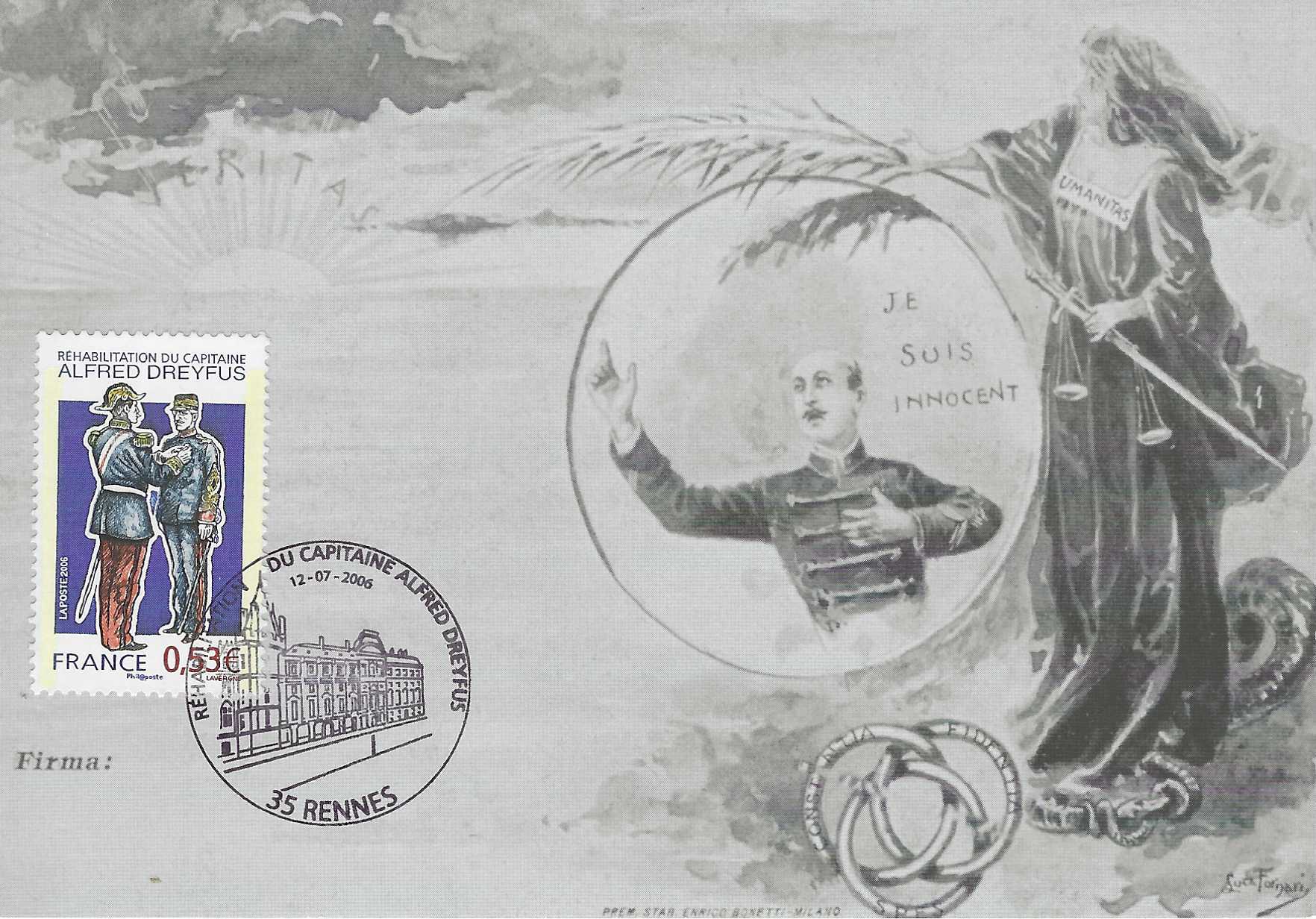
This first-day-of-issue cover for France’s 2006 stamp commemorating Alfred Dreyfus features the officer rightfully declaring his innocence during his sentencing.

This postcard, produced in Berlin during the height of the Dreyfus Affair, features Emile Zola escorting Dreyfus from Devil’s Island.

This postcards, produced in Berlin during the height of the Dreyfus Affair, features Esterhazy being sent to Devil’s island while Dreyfus looks on from the side of ”La Liberte.”
.png)
This French postcard, produced in 1898, features a grotesque representation of the Dreyfus Affair, with anti-Jewish French journalist Edouard Drumont roasting a nude, caricatured Alfred Dreyfus on a spit.

Jules Guérin was another prominent anti-Dreyfusard. The founder and leader of the Anti-Semetic League of France and editor of the weekly French paper L’Antjuif, Guérin was the driver behind many anti-Dreyfus protests and movements that took place during the affair.

A postcard produced during the affair, featuring the handwriting of both Esterhazy, the true criminal, and Dreyfus, the scapegoat.

7-9 in a series of 12 postcards telling the full story of the Dreyfus Affair.

10-12 in a series of 12 postcards telling the full story of the Dreyfus Affair.
