

A promotional poster featuring Joseph Greenstein, AKA “The Mighty Atom.” Despite being only 5’4” and about 140 pounds, Greenstein was a renowned strongman for 5 decades in the 20th century.
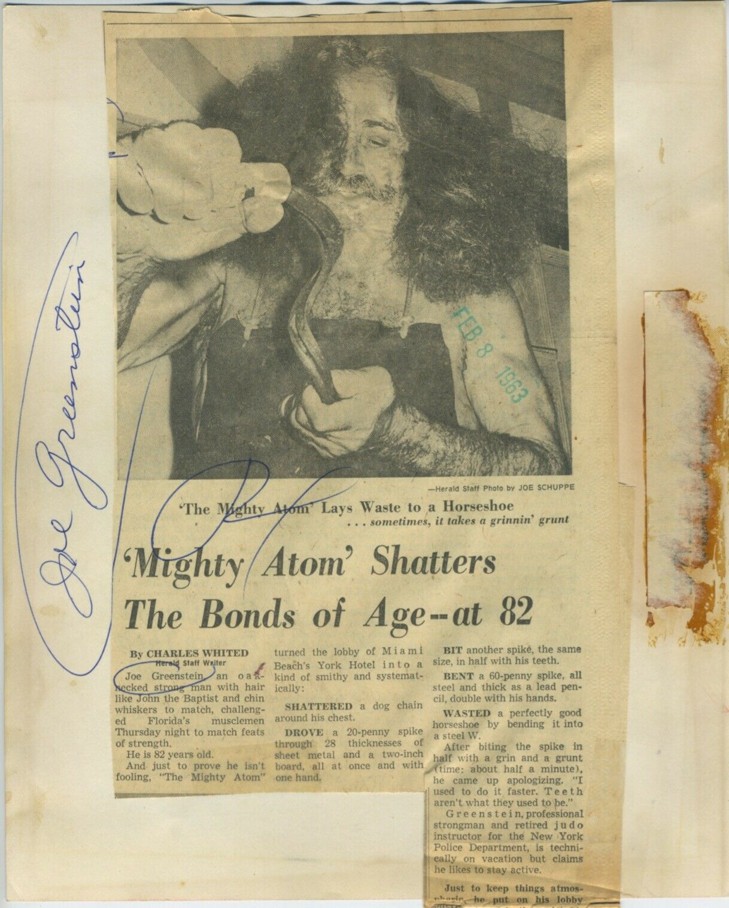
A 1975 clipping from the Miami Herald, describing Greenstein (82) as “an oak-necked strongman with hair like John the Baptist and chin whiskers to match.”

Greenstein performed until well into his 80s. Breaking stakes with his teeth and bending horseshoes with his bare hands.

The back of this original wire photo is stamped July 17, 1967, and the caption reads, “Joseph Greenstein bends a horseshoe during a demonstration at North Miami Beach City Hall.” He was 74.
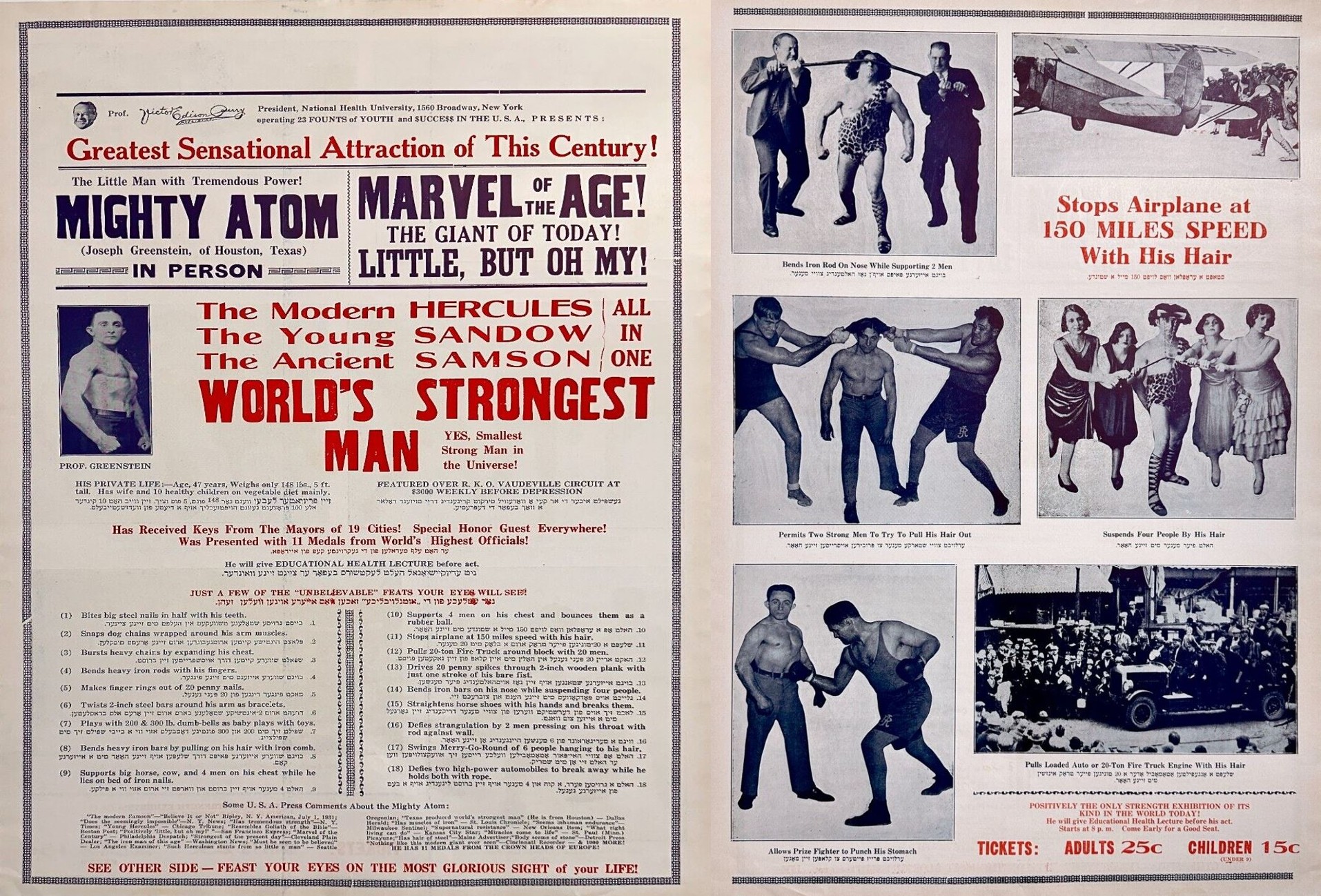
A promotional flyer for a Joe Greenstein “Mighty Atom” show that took place in about 1940. The front touts him as the smallest strongman in the universe, while the back features some of his greatest feats, including stopping an airplane at 150 MPH with only his hair. Ouch. Note ticket prices: 25 cents for adults and 15 cents for kids.

A Yiddish paper advertisement promoting a Joe Greenstein show at New York’s Clinton Theater (now defunct).
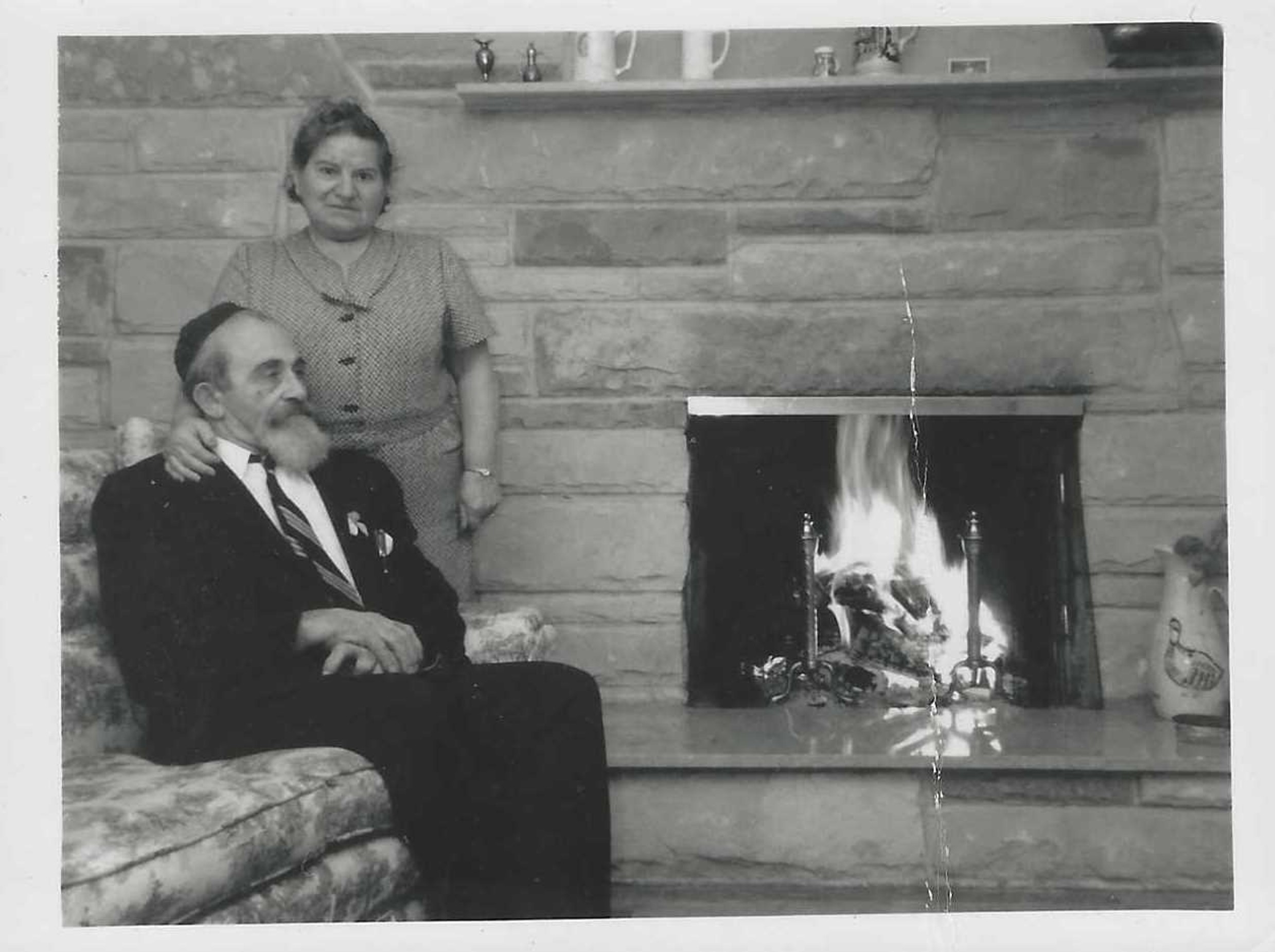
Greenstein poses with his wife, Leah. The couple, childhood sweethearts, married in Poland and had 10 children before immigrating to the United States in approximately 1914.

The December 23, 1960 issue of Israeli newspaper Haaretz features an article about Joseph Greenstein

Greenstein poses with a Hebrew newspaper identifying him as “The Jewish Hero.” The paper is dated November 1960, but the large “80” probably refers to his age. If you’re noticing that the math doesn’t quite work there, you’re not wrong. Greenstein had a tendency to exaggerate his age to make his strength seem even more impressive than it already was. He would’ve been a mere 67 in 1960.

Greenstein poses in an exhibition booth with pro wrestler Happy Humphrey.

Greenstein capitalized on his fame by adding healthcare products to his brand. Pep-O-Lax was an “herbal regulator” (read: laxative) intended to clean the colon. Greenstein’s Pep-O-Lax, sold at markets and fairs from the 1940s through ’70s, was marketed to relieve constipation and “boost vigor.” This intact box is a rare find!

A wrapper from a bar of Atom’s Supreme Soap, made with coconut oil, lemon, and castile. This was another of Joe Greenstein’s holistic health products.

Martin “The Blimp” Levy (1905-1961) is known as one of the first “giants” in professional wrestling. Levy was born and raised in Boston, and after high school he started working as the fat man at the Coney Island side show. He was discovered there by a wrestling promoter, and he wrestled professionally from 1933 through 1951. This original wire photo was taken in September 1938. The caption on the back reads, “If there is anything new in sport, this is it. It is Martin Levy, Boston wrestler, who makes the scales groan out loud at 625 pounds. He has been wrestling for five years and never has been thrown—which is not surprising.

A promotional photo of Blimp Levy, noting his weight at 642 pounds.

Levy once told the Washington Post that some mornings he ate a dozen eggs for breakfast (though sometimes he’d only eat two), and some evenings he’d eat six pounds of steak (though sometimes only one).

Despite his size, Levy was surprisingly agile. Records show he was able to high-kick a tin can, hung six feet off the ground, while standing—a feat many more apparently athletic wrestlers couldn’t achieve.
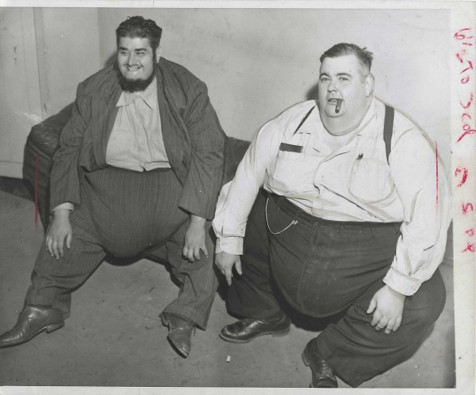
Pictured here are Levy and Thomas “Tiny” Wickam, who served as Levy’s corroborating witness in family court when Levy fought his ex-wife Juanita Thomas’s alimony claims.
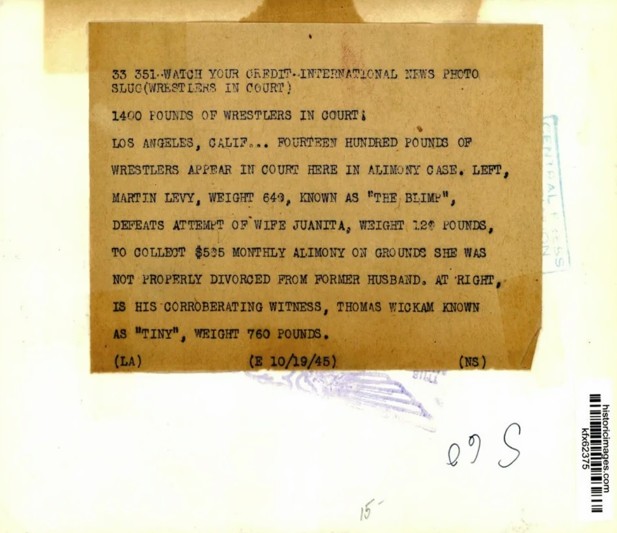
The caption on this wire photo outlines the domestic drama Levy found himself in with wife Juanita Thomas. He later found out that, though she had separated from her previous husband, she had never obtained a divorce. Because she was still married to her former husband at the time of her marriage to Levy, Thomas was unable to successfully claim $525/month in alimony. He would go on to marry Charlotte Jones, 18, in Dallas in 1946.
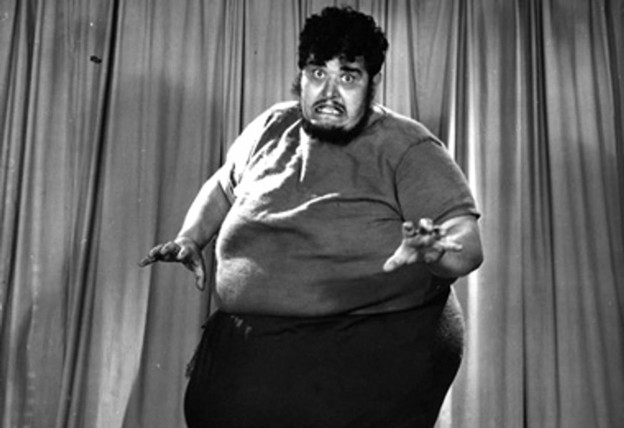
A promotional photo of Blimp Levy. His wrestling career ended in 1951 as his health began to decline, but he continued to make promotional appearances until his death in 1961.
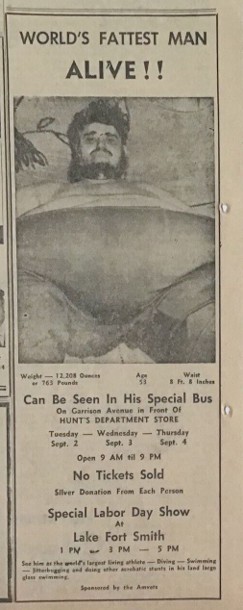
A newspaper ad advertising an opportunity to see Levy (“world’s fattest man alive!!”) in his special bus in front of Hunt’s department store in between his aquatic demonstrations.
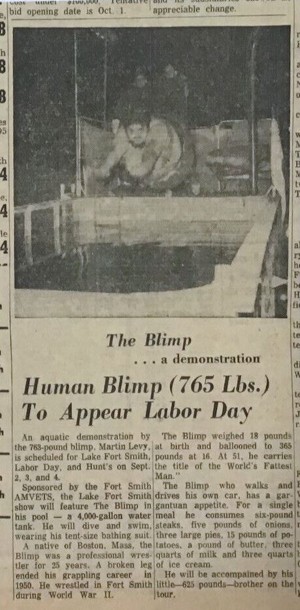
A newspaper article promoting Blimp Levy’s Labor Day aquatic demonstration. This was after a broken leg ended his wrestling career, but Levy still drew crowds. In this case, by diving and swimming in a 4,000-gallon water tank “wearing his tent-size bathing suit.”
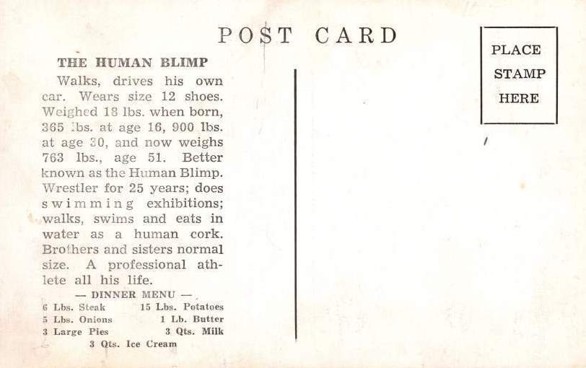
The back of this Levy postcard chronicles Levy’s size throughout his life—starting with 18 pounds at birth. The caption notes his siblings are “normal” size.

An unmailed postcard of Blimp Levy, capturing his weight at 763 pounds. (Reports say it was hard to gauge his exact weight, as he exceeded the limits of regular scales.
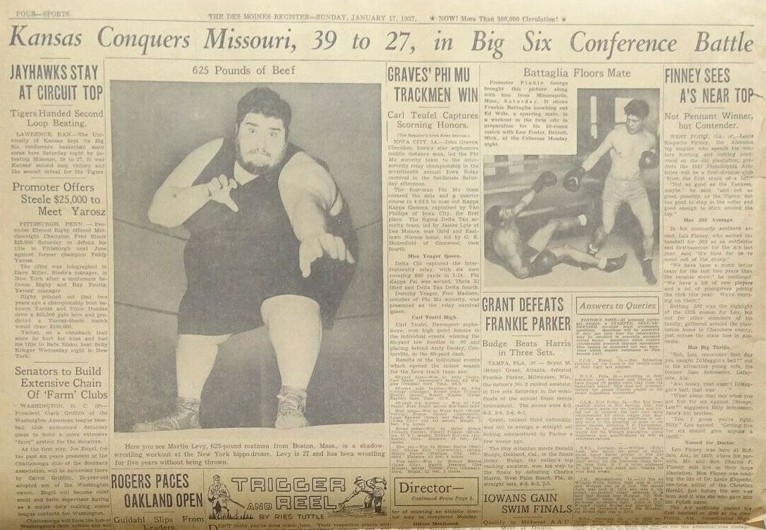
The January 17, 1937 issue of the Des Moines Sunday Register features a photo of Blimp Levy, “625 Pounds of Beef,” noting that even after five years of wrestling, he’d never been thrown.

Levy was featured in the October 1936 issue of Time Magazine, in an article disparaging the current state of pro-wrestling. “Once a dignified and honest sport, professional wrestling currently amounts to something between a side show and a racket. Main object of wrestling promoters is to discover human monstrosities.”

A production photo from The Great Circus Mystery, featuring “screen’s strongest man” Joe Bonomo lifting a 250-pound cannon overhead with one hand.
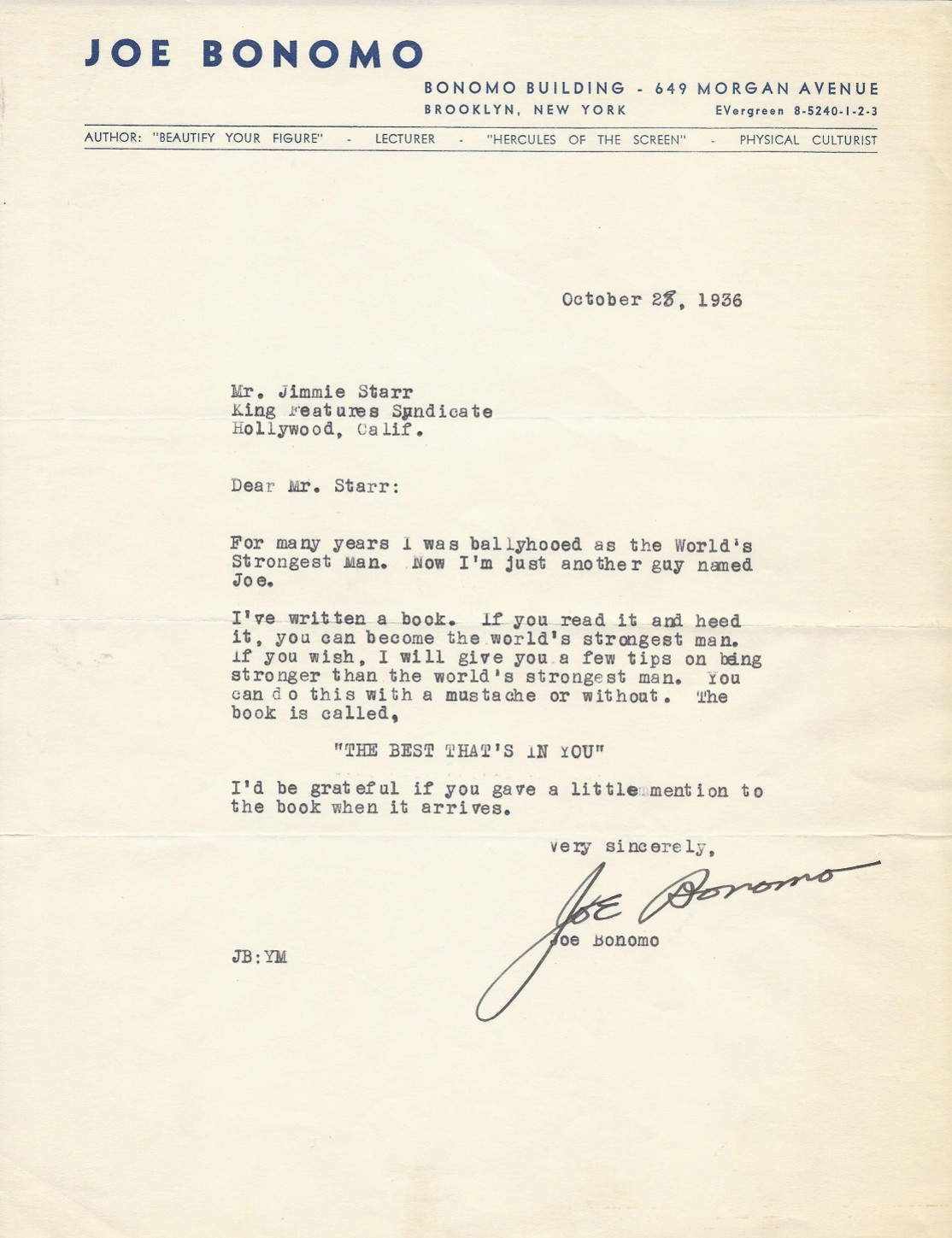
In 1936, Bonomo wrote a physical health book called The Best That’s In You. In this letter, he asks LA Herald-Express film columnist Jimmy Starr to read and review the book.

The back cover of this Bonomo banner features a full-page ad for Bonomo’s “handy pocket manuals,” 64-page booklets on any number of health/beauty topics, each sold for 25 cents.

The Bonomo Banner was a periodical published by the Bonomo Institute of Physical Culture, featuring health news and tips along with promotions for Bonomo’s initiatives and publications.

The interior of this Bonomo banner promotes a course promising women 40+ pounds of weight loss in 14 weeks, a seven-week “slim and trim reducing ritual,” and an order form for other Bonomo products.
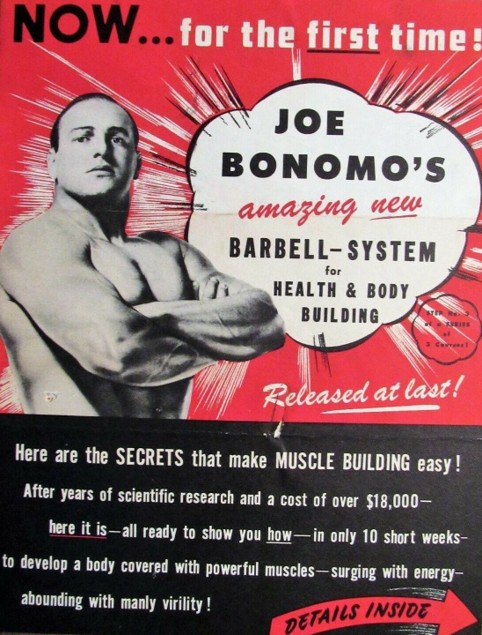
Part of his mail-order empire, Joe Bonomo’s Amazing New Barbell System for Health and Body Building was a comprehensive guide on weight training, promising to build muscle, energy, and “manly virility” in just ten weeks. This is the front cover of a pamphlet promoting the system.

The interior of the pamphlet promoting Bonomo’s Barbell System promises buyers “A muscle-covered SUPER-MAN physicque—amazing strength, and astounding energy” for just $5.
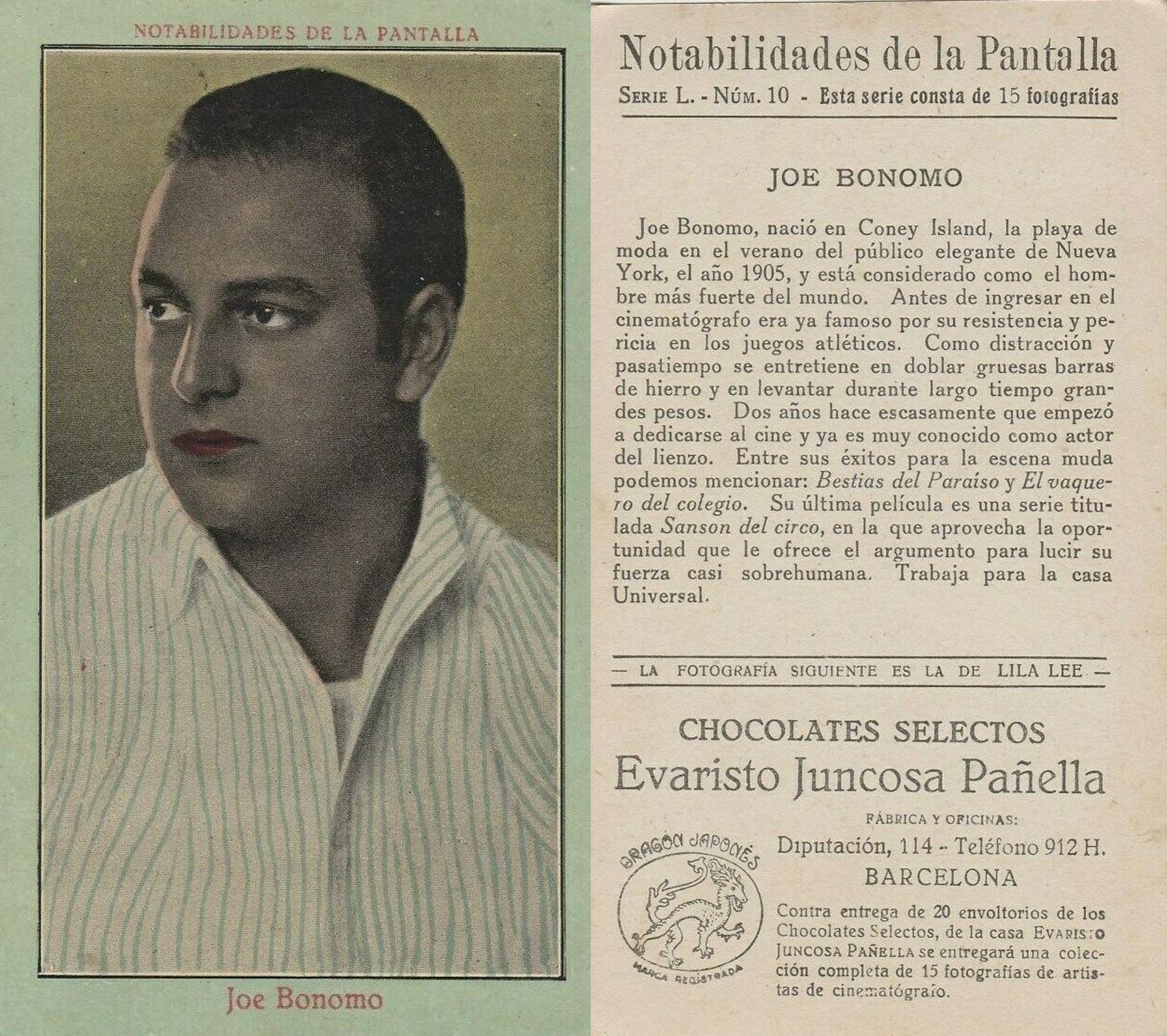
A collectible card produced in Barcelona as part of a series featuring “Notables of the Screen.” Select Chocolate fans could obtain the full set of 15 cards by sending in 20 chocolate bar wrappers.

A promotional image from the 1925 silent film serial The Great Circus Mystery, starring Joe Bonomo and Louise Lorraine.

A promotional shot from the silent film series The Great Circus Mystery. Bonomo was an in-demand silent film star, but when “talkies” rolled around, his Brooklyn accent ended his acting career.

: A promotional poster advertising chapter 4 of The Great Circus Mystery, the silent serial featuring “The World’s Strongest Man” Joe Bonomo.

Joe Bonomo, Louise Lorraine, and Robert Graves on the set of Universal’s The Great Circus Mystery.
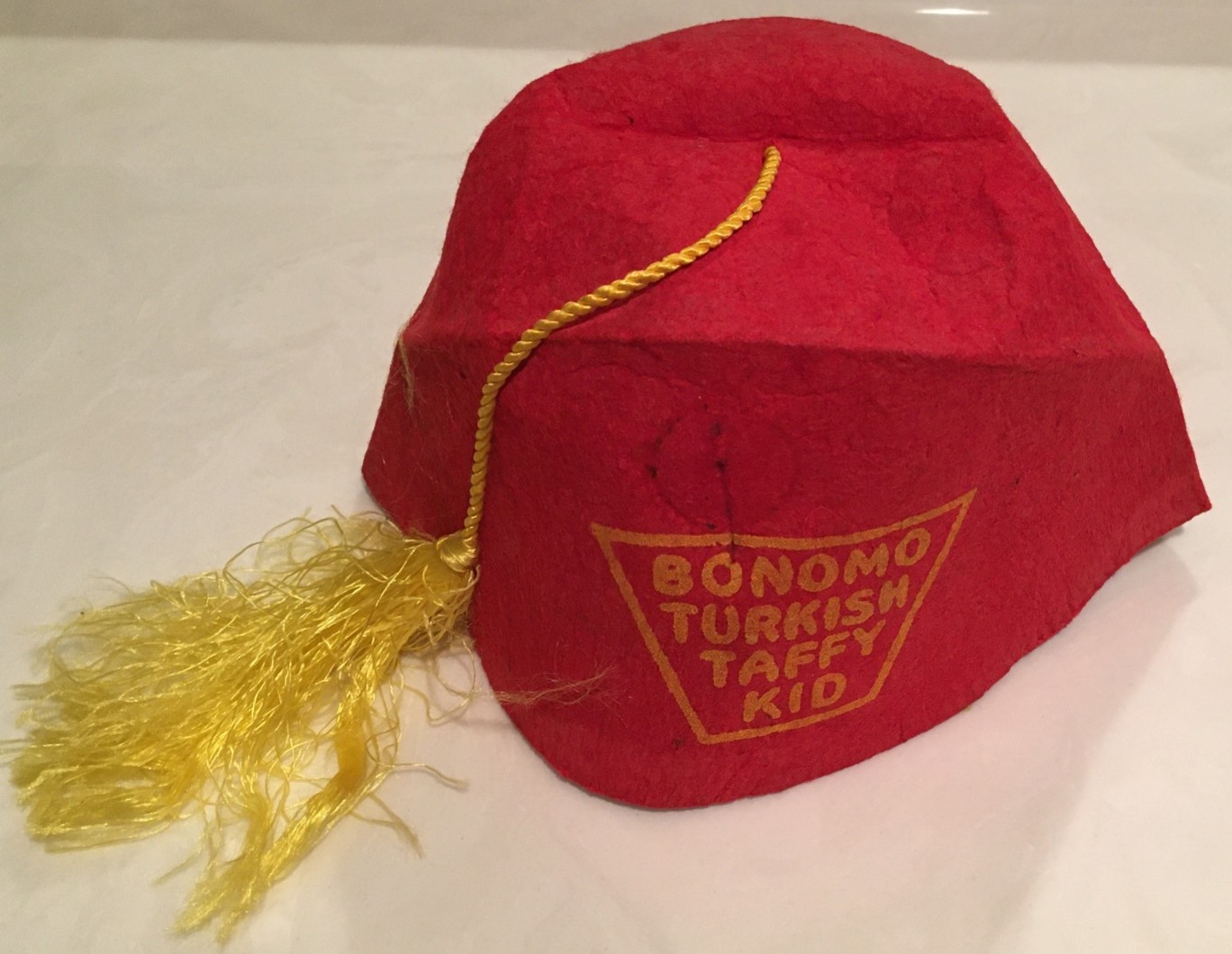
A Collectible fez distributed to promote Bonomo Turkish Taffy.

A promotional still from Universal Pictures’ 1925 film serial Perils of the Wild. Starring Joe Bonomo and Margaret Quimby and directed by Francis Ford, Perils was the first film adaptation of The Swiss Family Robinson.
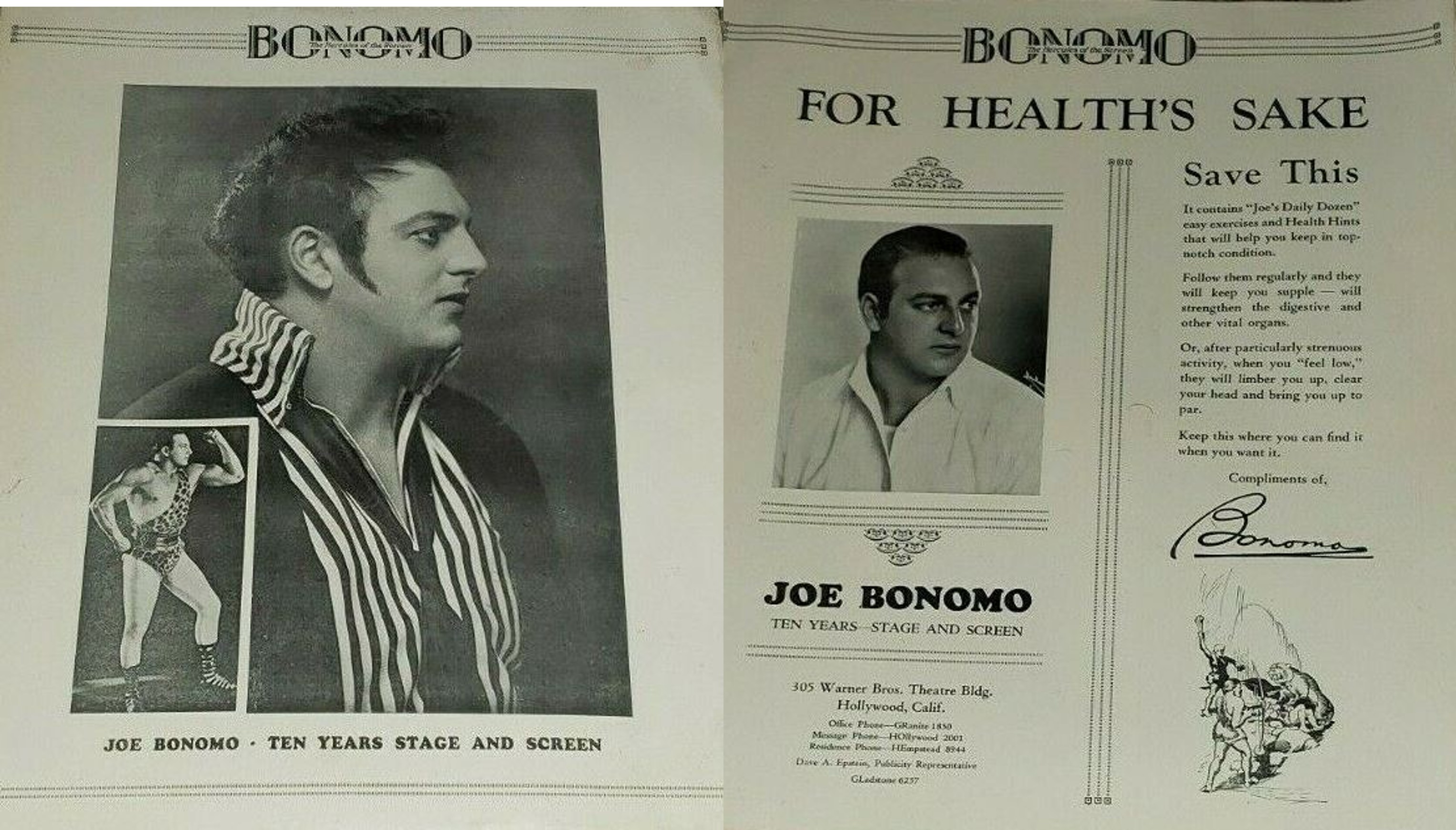
For Health’s Sake (Cover). This pamphlet featured Joe Bonomo’s health and fitness tips, promising to keep readers in top-notch condition by strengthening “the digestive and other vital organs.”

For Health's Sake (Interior). Bonomo’s health hints include, “Avoid sick people, unless it is your duty to care for them,” “Keep clean—physically, mentally, and morally,” and more. And the daily dozen are a series of exercises intended for readers to do each day to stay in tip-top shape.
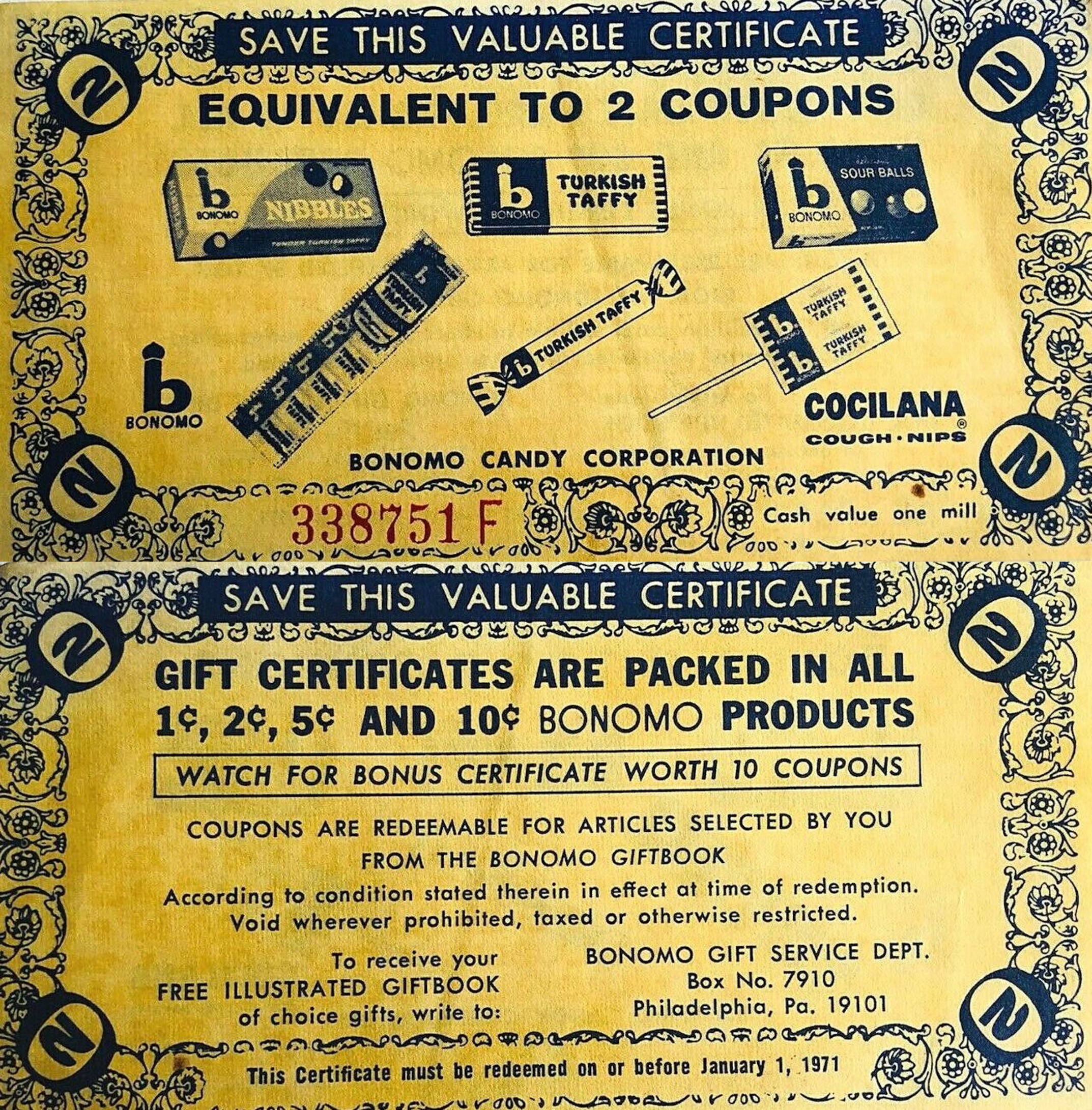
These gift certificates were packed into Bonomo products and redeemable for items in the Bonomo catalog.

Bonomo founded the Bonomo Institute of Physical Culture, which published physical culture, health, and fitness books and pamphlets in all realms of physical health. This is a small collection of letters, photos, and other ephemera from the institute.
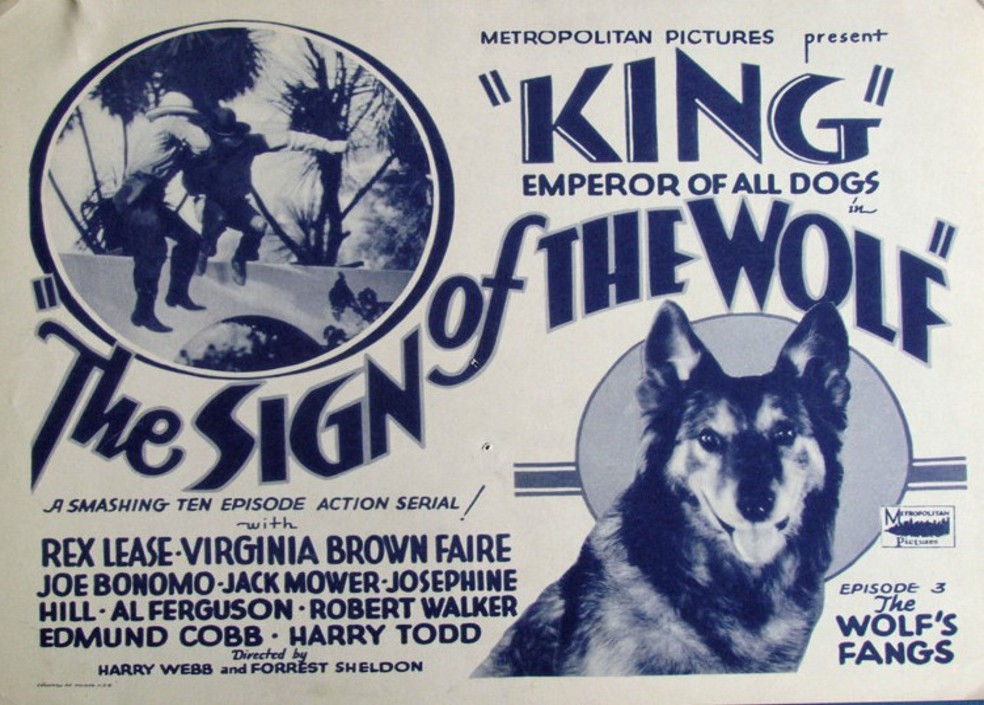
A promotional poster for episode 3 of Metropolitan Pictures 1931 ten-episode action serial, “The Sign of the Wolf,” featuring Joe Bonomo alongside canine silent film star King, often billed as “Emperor of All Dogs.”

The Bonomo Institute of Physical Culture offered several correspondence courses on bodybuilding and physical fitness. In this image from one of the courses, diving champion Bobbie Kashade demonstrates an exercise from Lesson 9.
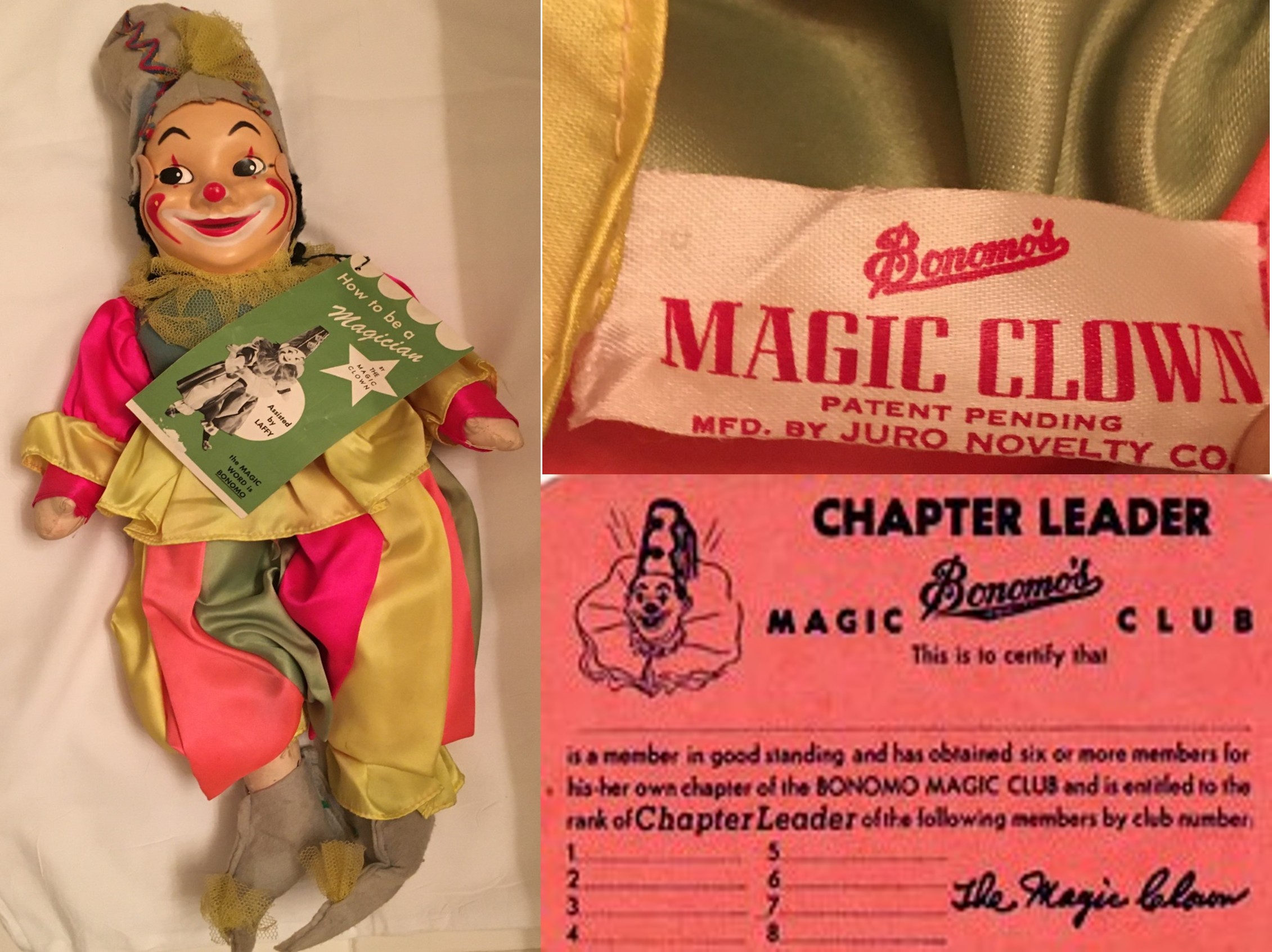
Dolls, instruction manuals, and club membership cards…the Bonomo Magic Clown campaign is an early, iconic example of interactive marketing through which kids became loyal to a brand through membership, swag, and even show appearances.

As part of Bonomo Magic Clown promotion, Bonomo launched a contest that encouraged viewers to send in Turkish Taffy wrappers in exchange for a chance to win one of 25 grand prizes each week.
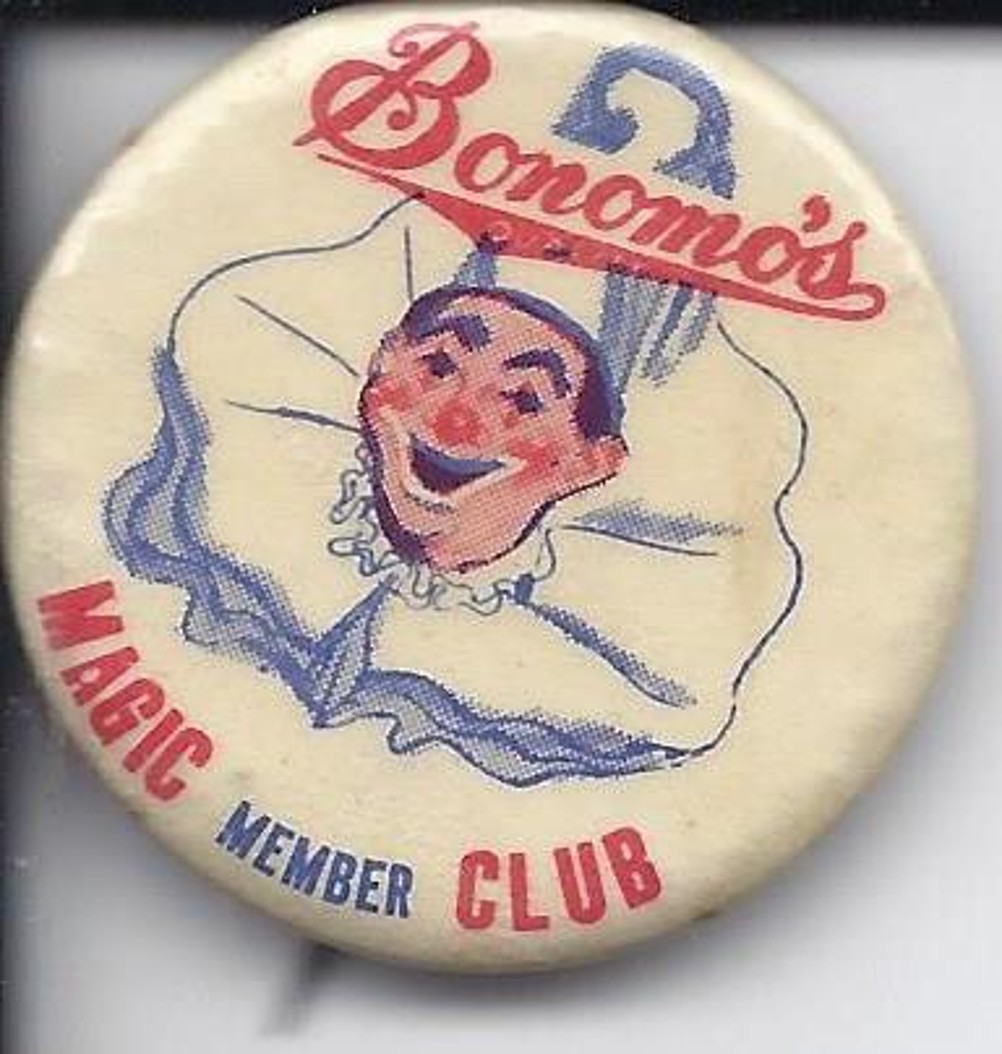
Bonomo Turkish Taffy sponsored the show “The Magic Clown” in the 1950s, and their Magic Clown Club was an interactive marketing campaign for the candy company.

These promotional “magic sets” were distributed as part of the Bonomo an Magic Clown partnership. The Magic Clown, which ran on NBC from 1949-1954, was one of the first nationally broadcast children’s shows—and it was little more than an infomercial to sell Turkish Taffy. Children could purchase these kits at candy counters or send in taffy wrappers to receive them by mail.

More exercises from one of Bonomo’s correspondence courses about developing the “perfect body.”
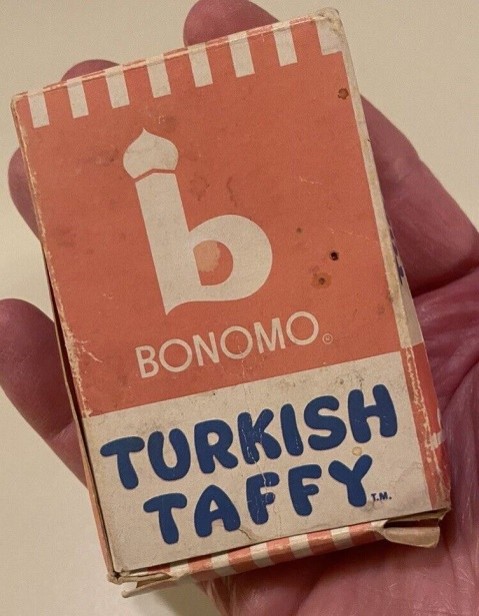
A box of Turkish Taffy “nibbles.” These bite-size pieces often used as Duncan Yo-Yo consolation prizes.

A Vintage glass slide used to promote the 1925 silent film serial Perils of the Wild, starring Joe Bonomo and Margaret Quimby.
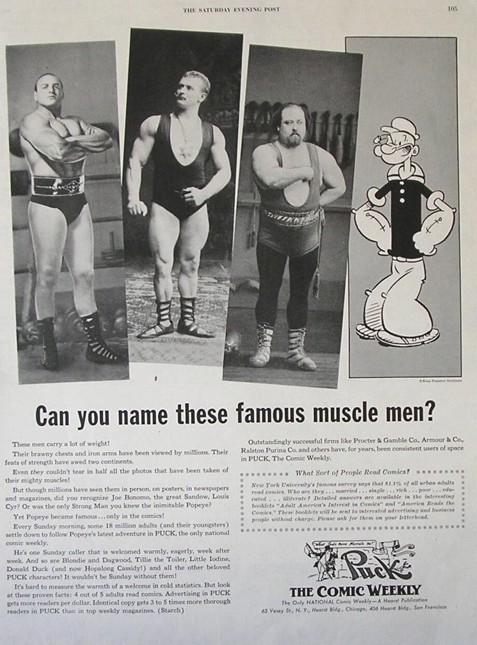
This advertisement for “Puck: The Comic Weekly” (the print home of Popeye the Sailor Man) positions Popeye next to famous muscle men including Joe Bonomo (left).
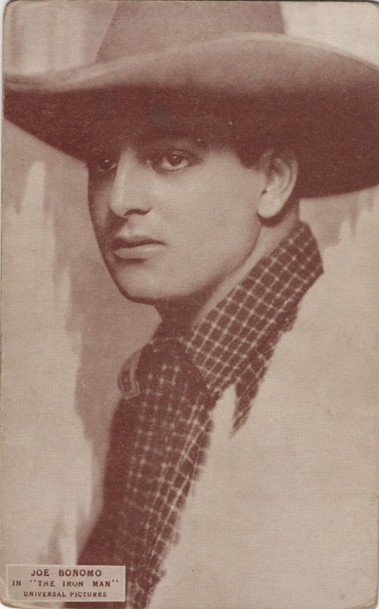
A postcard featuring Joe Bonomo in Universal Pictures’ 1924 film “The Iron Man.”
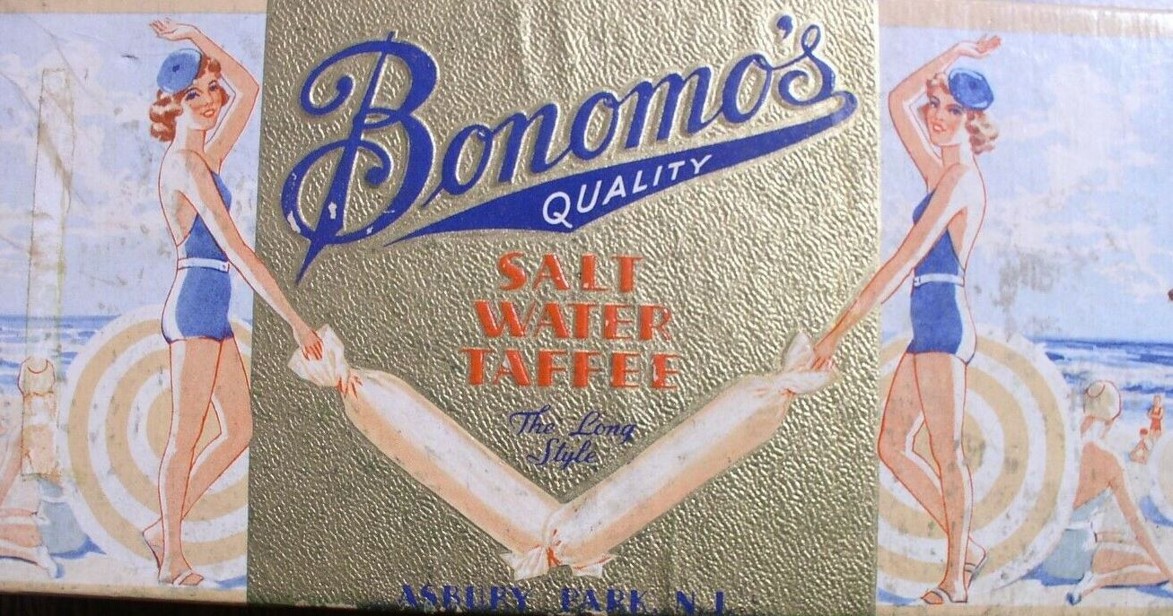
A Bonomo’s salt water taffy box from Asbury Park, NJ.

An advertisement in a May 1925 edition of “Kinematograph Weekly” promoting Universal Pictures’ silent film serials, including Joe Bonomo’s Samson of the Circus (also called The Great Circus Mystery).
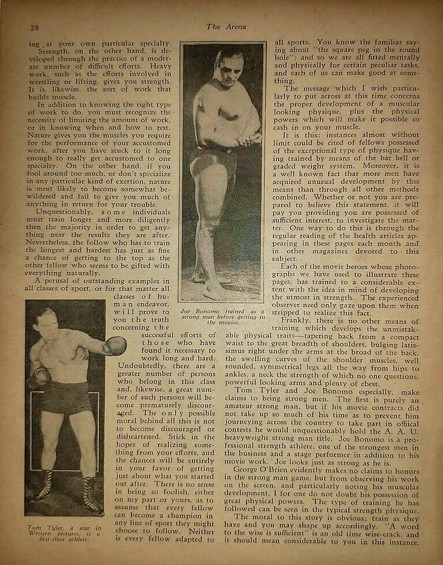
A page from “The Arena,” a 1920s physical culture magazine, featuring an article about Joe Bonomo’s career as strongman and stunt double.

A Hercules Pep Bar wrapper, from a “high-energy candy” Bonomo Candy Company produced in the mid-20th century. As Joe Bonobo’s fame grew, so did his parents’ candy company. Turkish Taffy was their signature product
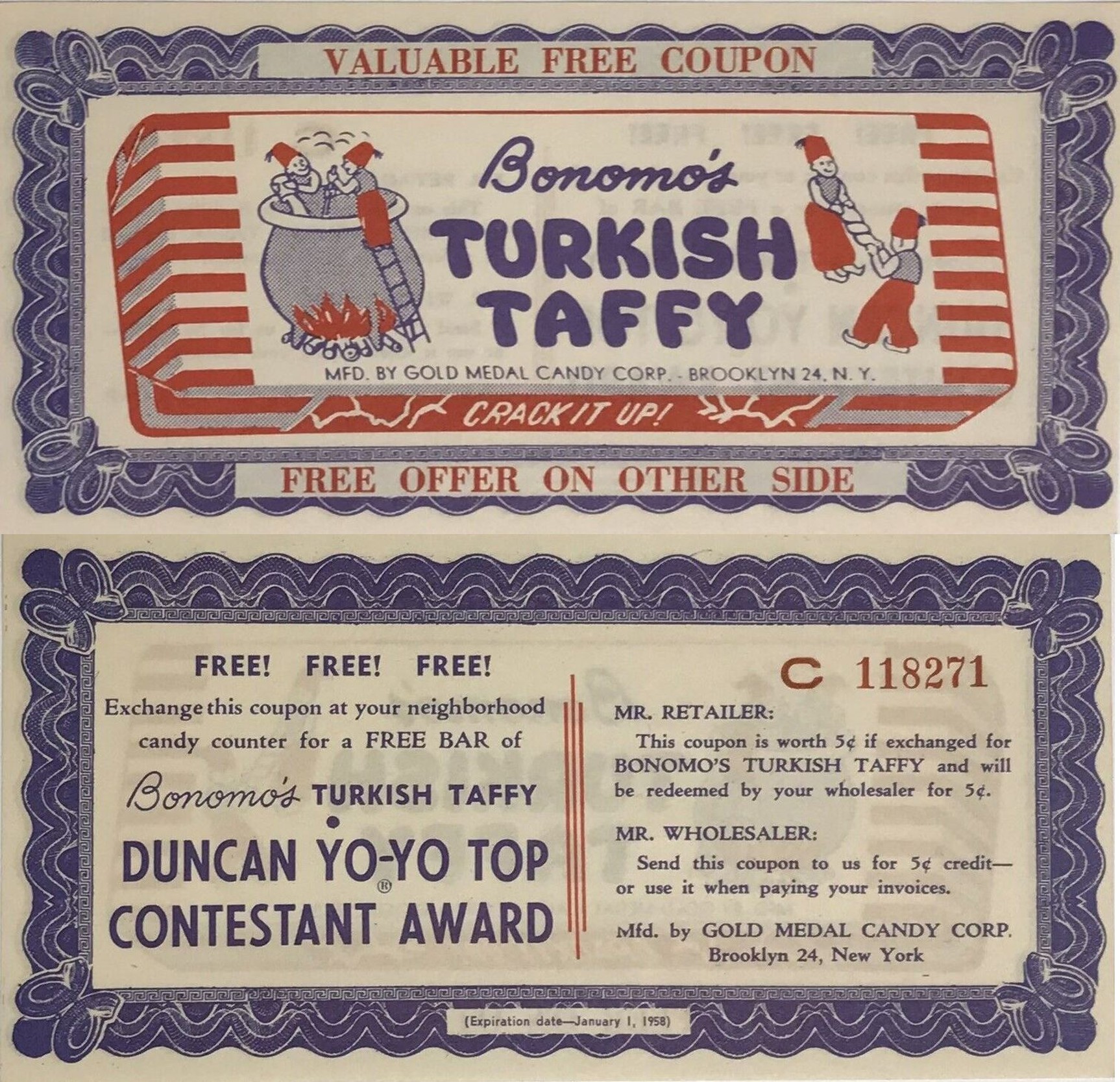
Bonomo Candy was a major sponsor of Duncan yo-yo contests, often held at toy stores or parks. Participants were regularly given these coupons for full 5-cent bars as participation prizes.
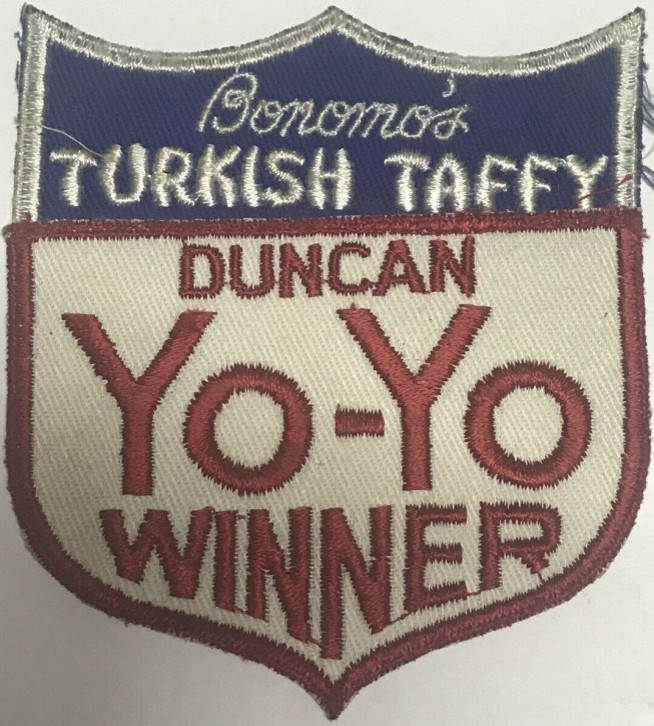
Dunkin Yo-Yo high-performers and winners received Bonomo-branded patches (and regional winners might receive sweater vests with the patches sewn on). These patches were highly coveted by schoolchildren in the ’50s and ‘60s.
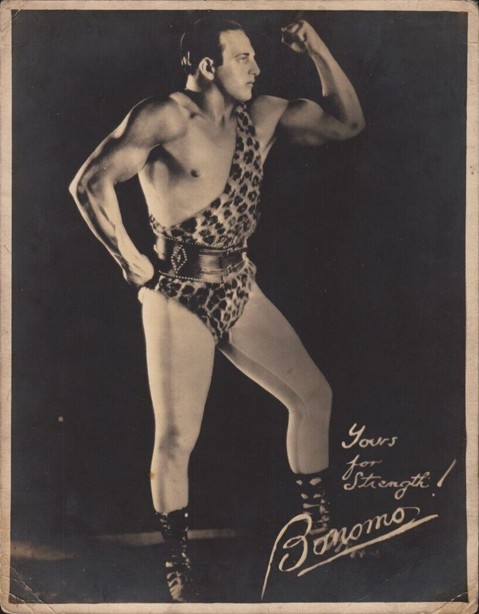
Joe Bonomo, born in Brooklyn to Turkish immigrants, learned showmanship at Coney Island, where his parents’ Bonomo’s Confections shop was located. As a strongman, he had a successful career as a Hollywood stuntman and silent film actor. As his popularity grew, he leveraged his notoriety into a booming mail-order business promoting health and fitness—all while promoting his parents’ candy company, too.
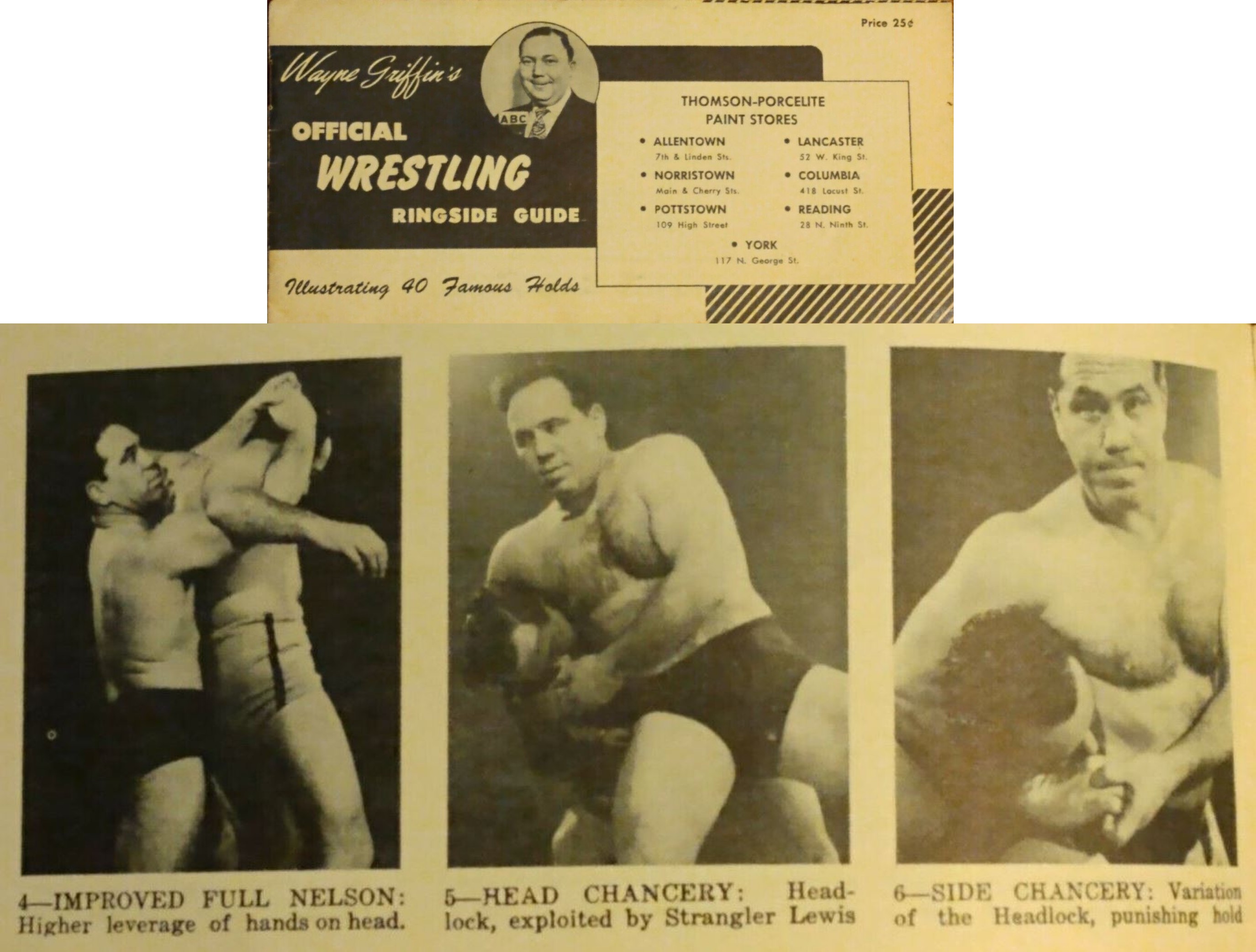
Wayne Griffin’s Official Wrestling Ringside Guide illustrated 40 holds for fans to study, including three of Ruffy Silverstein’s signature holds. Griffin was a well-known wrestling announcer active during the 1940s and ’50s.

A promotional mailer advertising a match between Don Eagle and Ruffy Silverstein.

An obituary for Ruffy Silverstein, who was diagnosed with Lou Gehrig’s disease in 1977 and died April 5, 1980. He had retired from wrestling twenty years prior and taught high school athletics in Chicago.
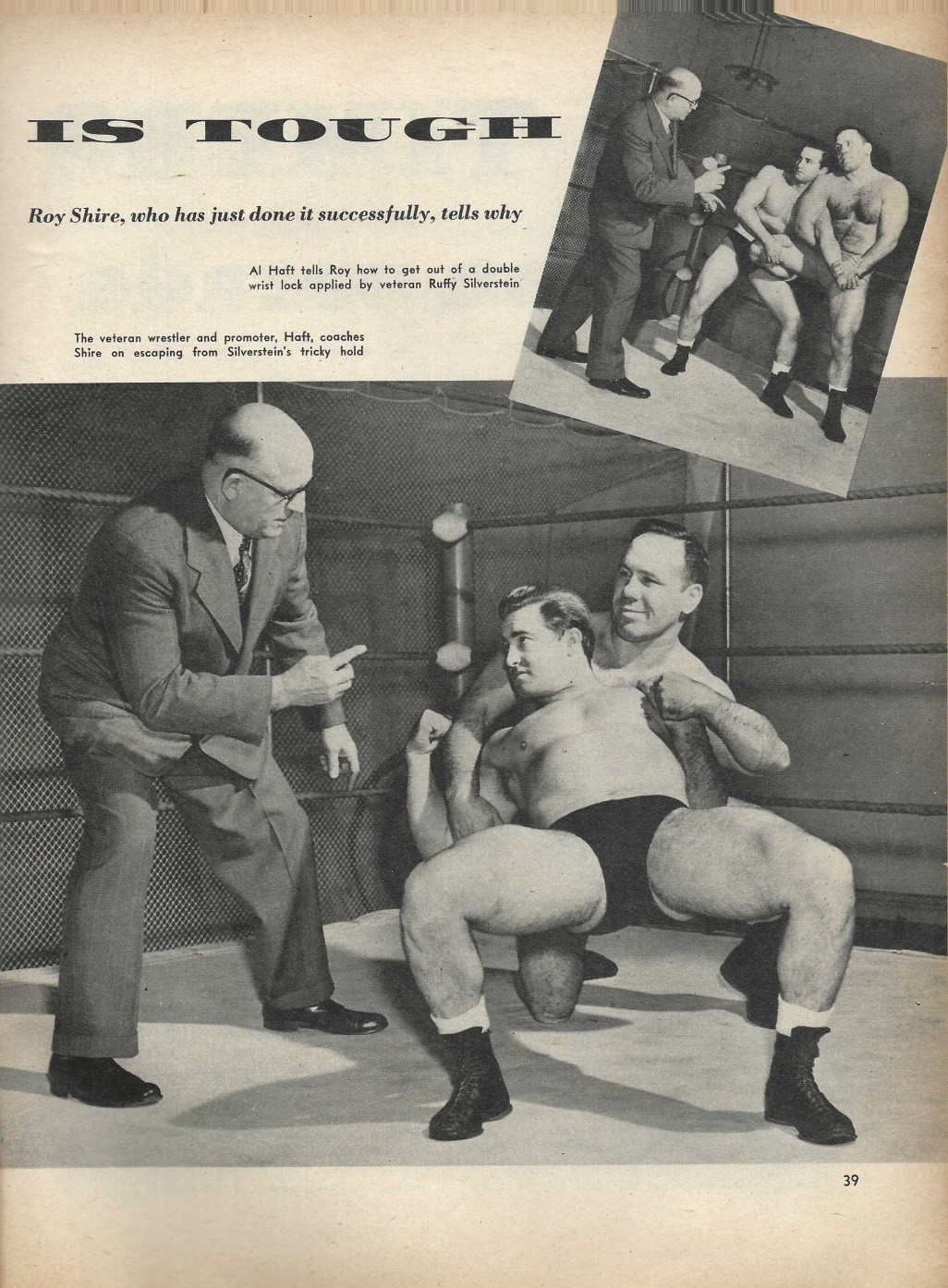
The August 1951 issue of “Official Wrestling” includes a photo of pro wrestler Roy Shire learning to escape one of Ruffy Silverstein’s “tricky holds.”
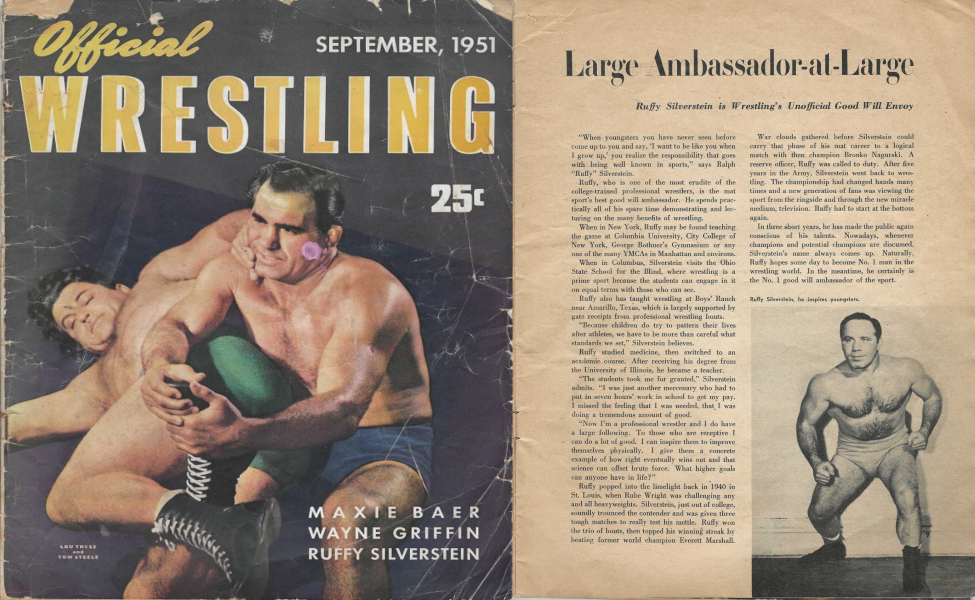
The September 1951 issue of “Official Wrestling” magazine includes a feature on Ruffy Silverstein. The article touts Silverstein as “Wrestling’s Unofficial Good Will Envoy,” quoting him as saying, “Because children do try to pattern their lives after athletes, we have to be more than careful what standards we set.”

A program for the third annual “Polio Wrestling Show,” which took place in 1954 to raise money for March of Dimes.
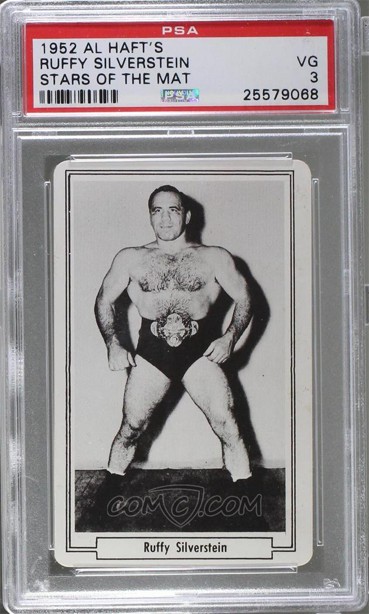
A Ruffy Silverstein trading card from 1952 Al Haft's Sports Stars of the Mat series. Silverstein was considered one of the last vestiges of “traditional” wrestling as the sport was becoming more popular and more sensational.
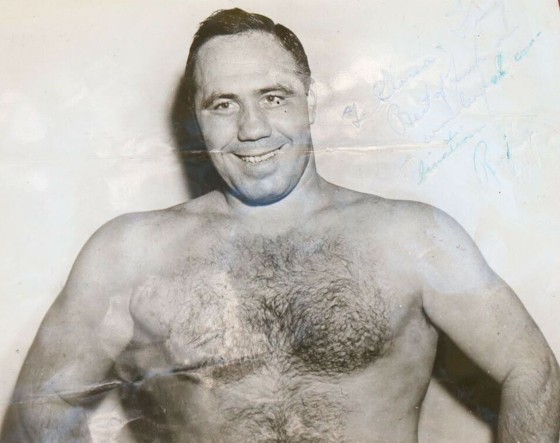
Ralph “Ruffy” Silverstein was an American wrestler from Chicago. His amateur career was impressive—Two-time Big 10 Champion (1935, ‘36), NCAA Champion (1936), All-American (1935), and membership on the 1936 US Olympic Team. (He was one of many Jewish athletes who boycotted the “Nazi Olympics,” however.) He served in the US Military during WWII and then returned to a long and successful pro wrestling career after an honorable discharge.

A signed promotional photo of Ruffy Silverstein. His signature wrestling move was the “Falling Arm Drag.”
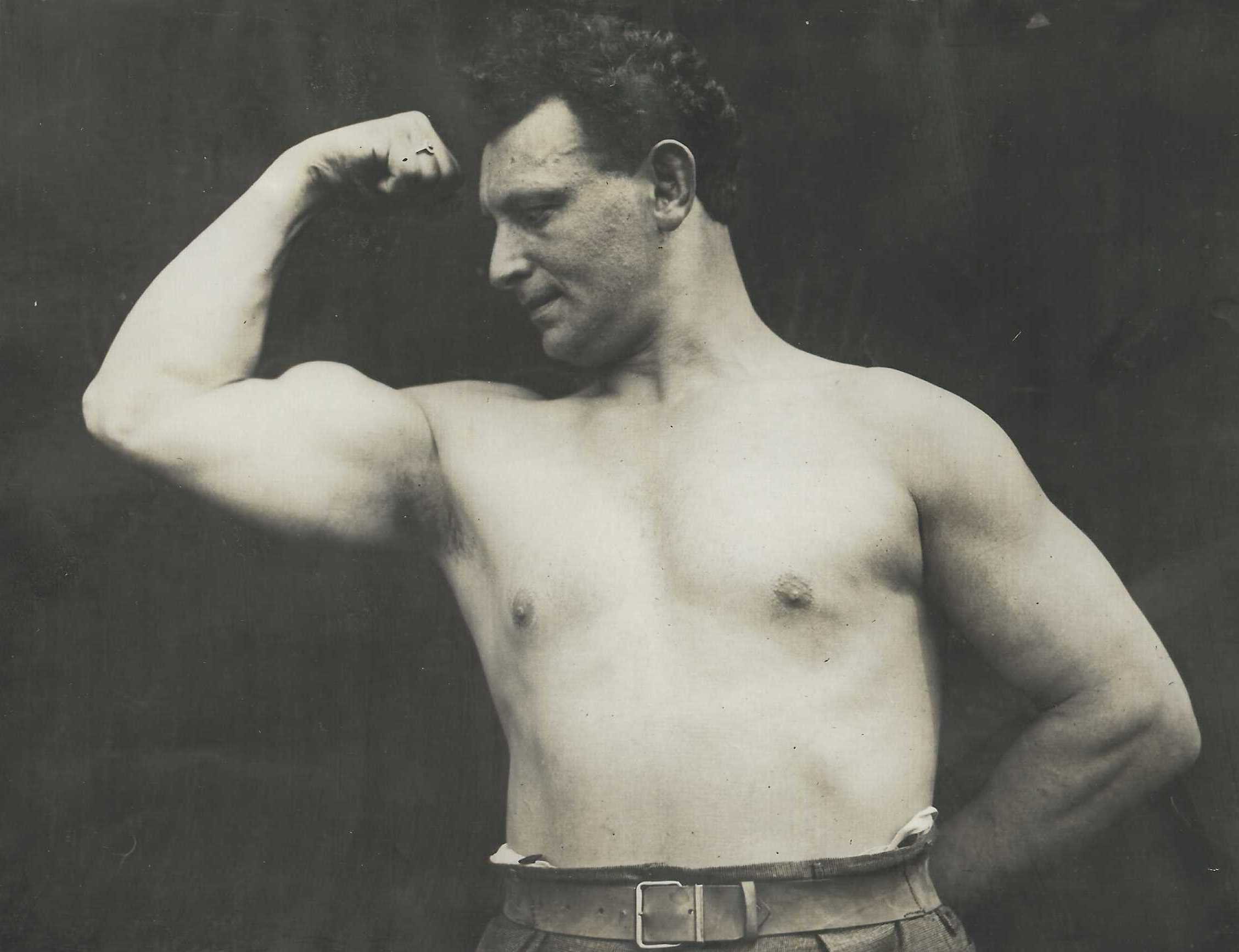
Zishe Siegmund Breitbart was a Polish-born vaudeville strongman, known as the “Strongest Man in the World” during the 1920s. Today, he is considered a hero of Jewish folklore. This original wire photo is dated August 28, 1923.

The caption on the back of this 1923 photo reads, “Zymunt Breitbart, Polish strongman whose phenomenal muscular development is a testimonial to the truth of the theory that physical characteristics are entailed in families, has just arrived in the US to fill an engagement on the Vaudeville stage. That Breitbart’s herculean strength is congenital rather than acquired is proven by his sedentary tastes as well as his family records. He would infinitely rather browse through is 2,000 volume library than engage in outdoor recreation. Photo shows his marvelous muscular development.”

Breitbart bends a long, sturdy-looking iron bar over his head with one hand and very little apparent effort. 1923 wire photo.
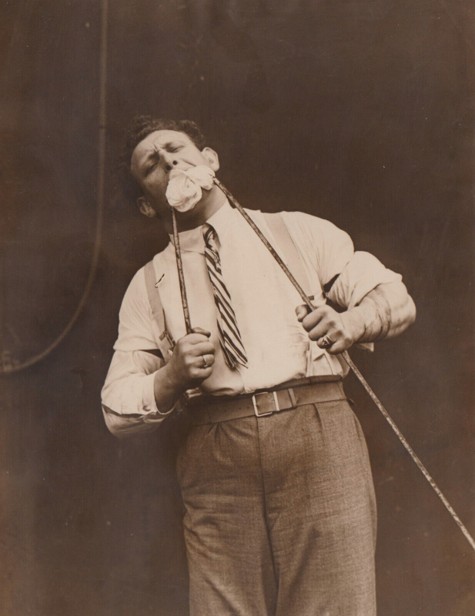
Breitbart bends a hefty piece of wire between his teeth in this 1923 wire photo.
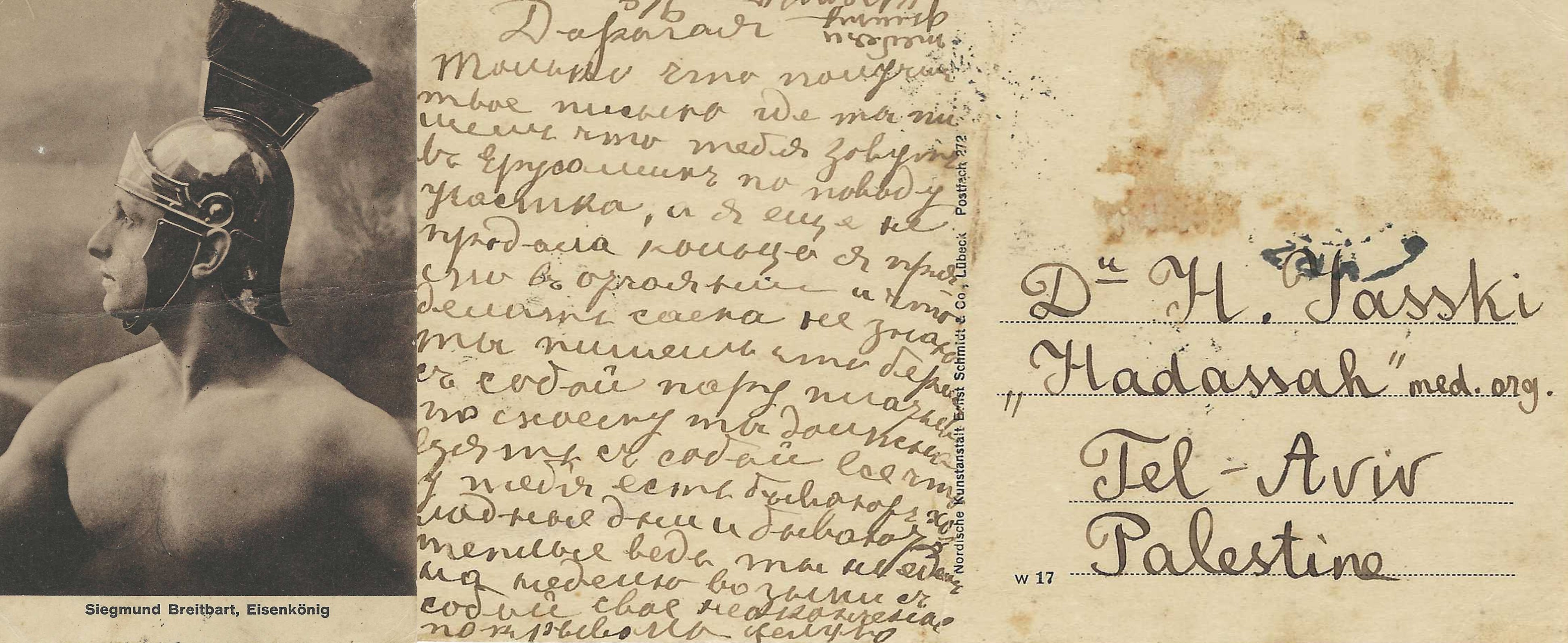
A postcard featuring Breitbart, “Iron King,” in a costume helmet, likely part of his stage performances or Vaudeville acts. . Though the postcard is not dated as far as I can tell, the fact that the address is Tel-Aviv, Palestine indicates it was sent during the British mandate—between 1920 and 1948.
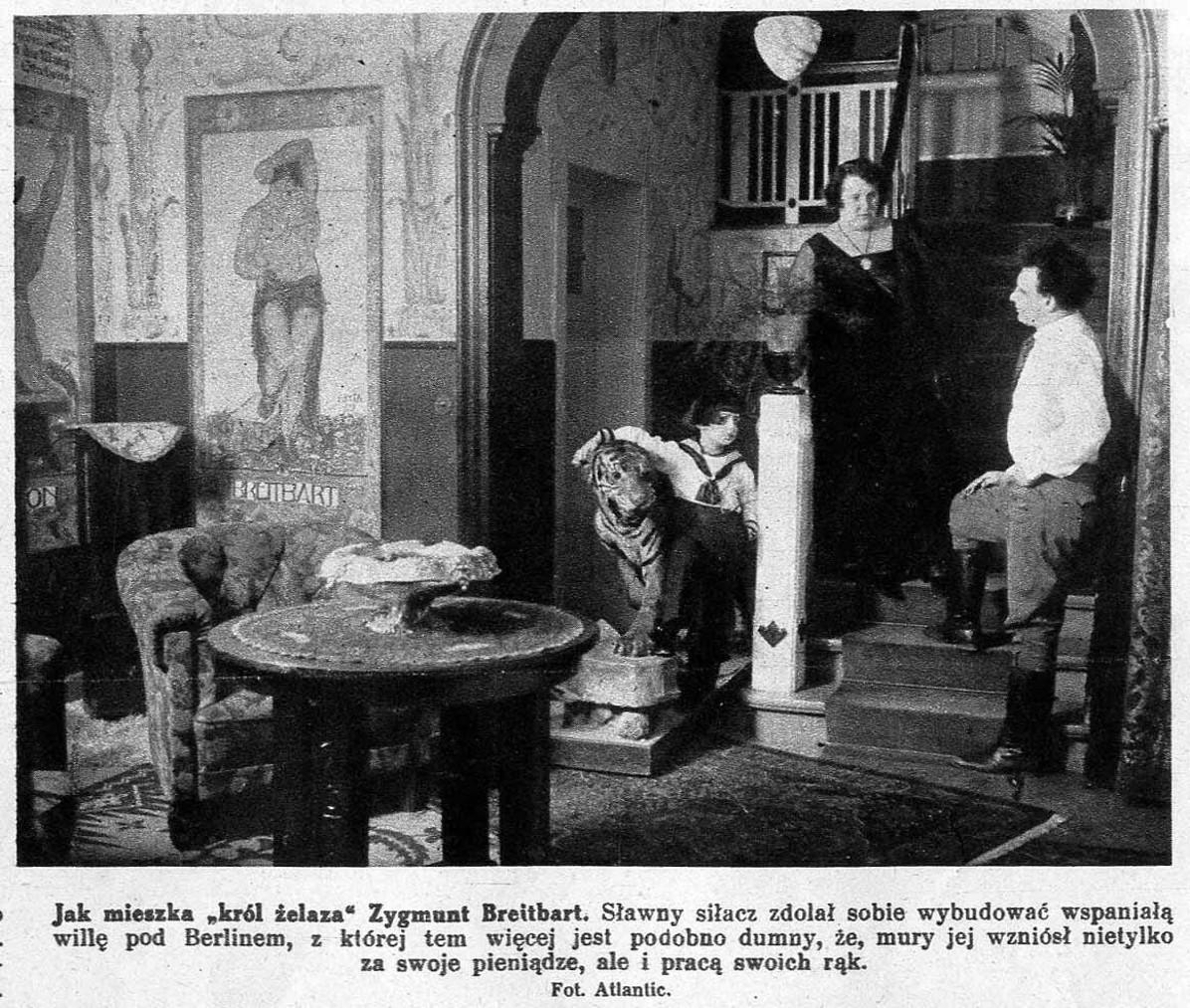
A feature on Breitbart’s Berlin home inside the Illustrated Daily Courier. The caption reads, roughly translated, “How the ‘Iron King’ Zygmunt Breitbart lives. The famous strongman has built himself a magnificent villa near Berlin, of which he is reportedly all the prouder because he built its walls not only with his own money, but also with his own hands.”

An issue of of the Ilustrowany Kuryer Codzienny (Illustrated Daily Courier), a major Polish newspaper published between 1910 and 1939. The front-page story covers the funeral of first German president Friedrich Ebert, but the interior includes a feature on Zishe Breitbart.
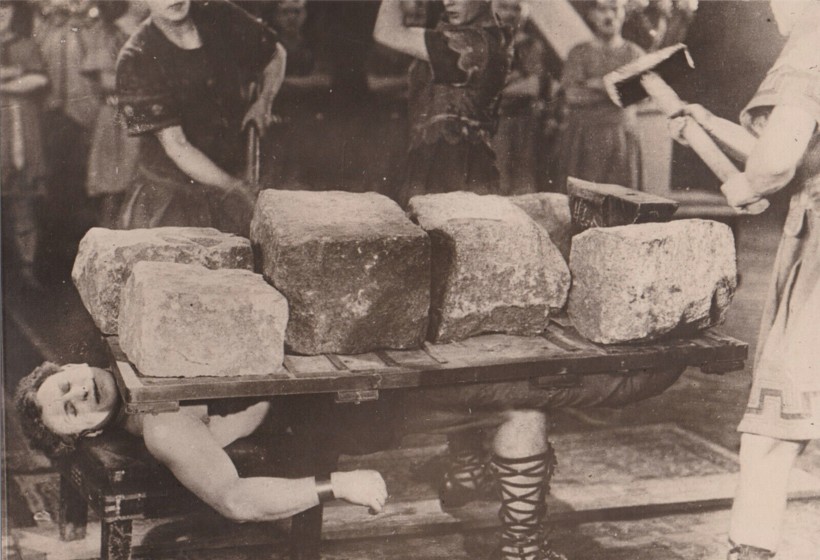
This wire photo, dated September 30, 1923, features Breitbart in one of his performances, resisting the weight of several ridiculously heavy-looking stones.
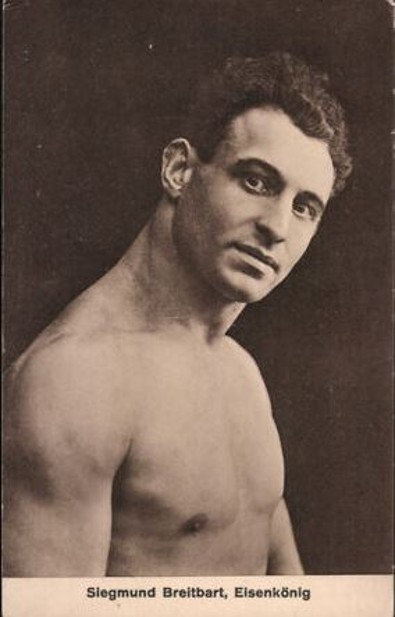
An unmailed postcard featuring Breitbart, “The Iron King.”

An original photograph, with credit on the back to a photography studio in New York, highlighting Breitbart’s monstrous bicep.

In this illustration, Breitbart lies on the ground and supports the weight of a car on his chest. In his acts, he was known to do this with cars carrying up to ten people. Other unimaginable feats included pulling wagons (also full of people) with his teeth, lifting a baby elephant, and holding a locomotive wheel in his teeth with three men suspended from it.

An original photo of Breitbart pulling a vehicle, clearly loaded to capacity with passengers, using only his teeth.
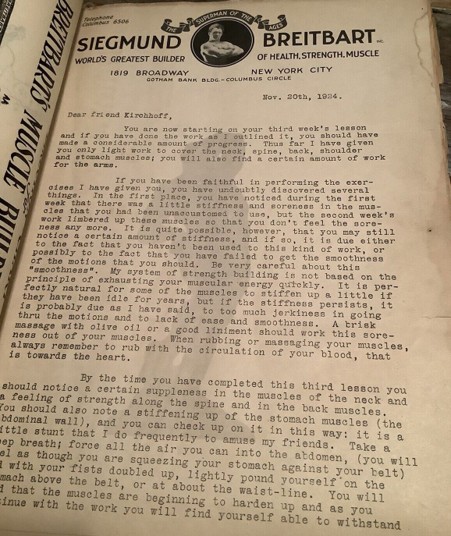
Breitbart extended his brand by creating a mail-order muscle-development course, empowering his students to work toward strongman status, themselves.

Breitbart’s correspondence course focused on bodyweight exercises and an exclusive “Breitbart Apparatus.” The resistance equipment was intended to strengthen muscle and bone while simulating Breitbart’s own steel bending efforts.

The caption on this memorial card reads, “Zishe Breitbart’s operation in Berlin.” After he contracted blood poisoning, records say the strongman underwent 10 operations, including amputation. However, the infection proved too severe and he died 8 weeks later. The back of the card reads, “In memory of the world-famous Jewish hero Zishe Breitbart. Born in Strykow (Poland) in the year 1887 / Deceased in Berlin October 1925.”
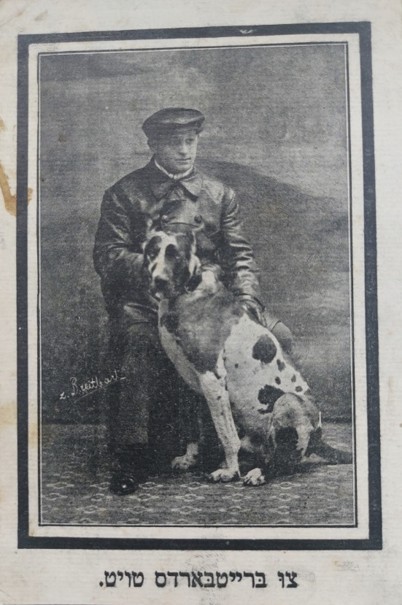
This memorial postcard features Breitbart with a Great Dane (a dog whose stature mirrors the strongman’s). The Yiddish caption on the bottom reads, “Upon Breitbart’s Death.” In 1925 the “Iron King” drove a rusty spike through 5 one-inch oak boards using only his bare hands. Unfortunately, the spike kept going and pierced his knee, as well. He contracted blood poisoning and died at 42 years old.
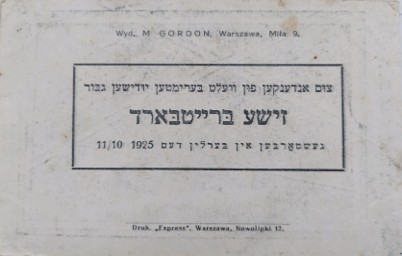
The back of the memorial card reads, “In memory of the world-famous Jewish hero, Zishe Breitbart. Died in Berlin on 11/10 1925.” Newspapers reported that thousands attended his funeral, venerating him as a Jewish hero.

Another memorial card honoring Breitbart, this one picturing him in full performance regalia.
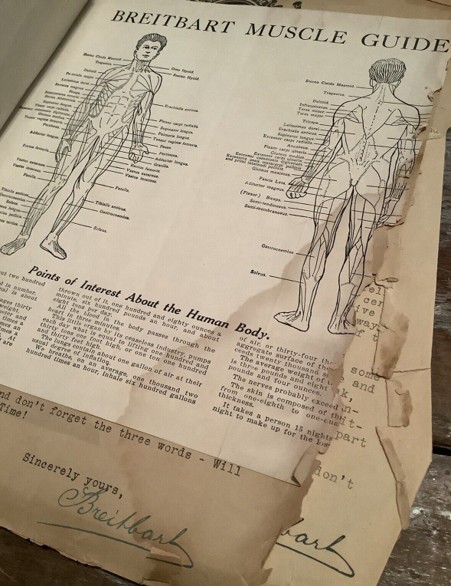
At the center of Breitbart’s correspondence course was his book, Muscular Power, which provided readers with general information about the muscular system as well as insights into Breitbart’s own exercise and eating regimens.

"Breitbart’s arm breaks muscle meter." A collectible related to the strongman’s health correspondence course.
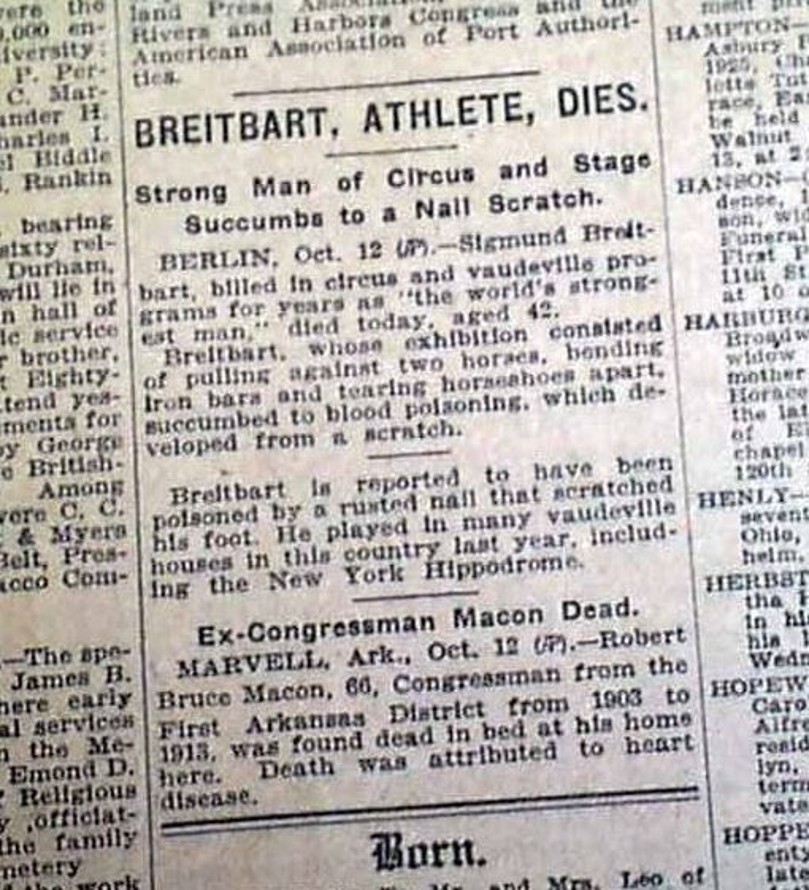
Breitbart’s obituary, published October 12, 1925.

In 2010, author and educator Robert Rubinstein, of Eugene, Oregon, published a picture book biography of Zishe Breitbart.

Joe Bonomo Original Promotional Photo circa 1925