
%20-%20Sarah%20Welch.webp)
The 11th Armored Division, nicknamed “Thunderbolt,” liberated Austria’s Mauthausen and Gusen concentration camps in May of 1945, freeing thousands of prisoners. This thirty-two page softcover book tells the story of the rescue — and it also sheds additional light on the unspeakable atrocities the troops witnessed in the camps.
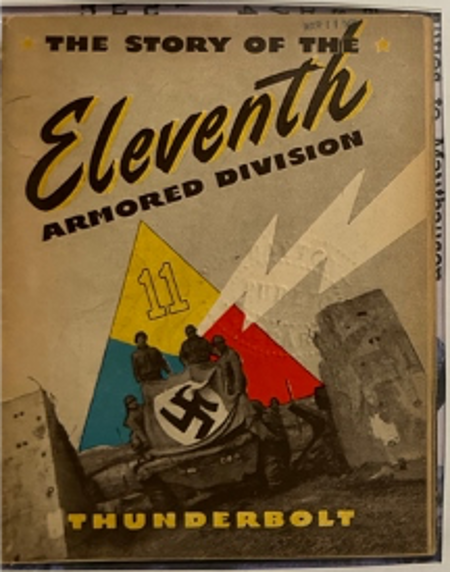
The 11th Armored Division, nicknamed “Thunderbolt,” liberated Austria’s Mauthausen and Gusen concentration camps in May of 1945, freeing thousands of prisoners. This thirty-two page softcover book tells the story of the rescue — and it also sheds additional light on the unspeakable atrocities the troops witnessed in the camps.
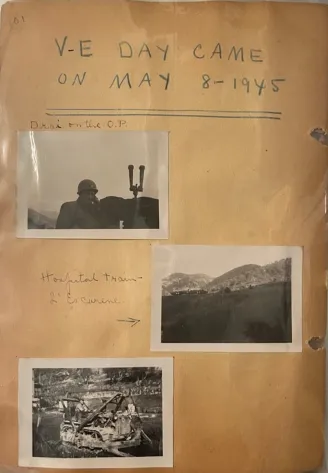
Excerpts from a scrapbook created by a Jewish American soldier named Alex Sesonske. His uncensored scrapbook, which includes everything from training camp photos to letters from his relatives to a poem his mom wrote, mocking his mustache, is one of the most complete accounts available of the GI experience during WWII. Though Sesonske doesn’t name the camp where these photos are taken, we can infer from his caption, “…taken at a Concentration Camp near Landsberg, Germany…” that they were of Kaufering, a subcamp of Dachau. He affixed them to his scrapbook in overlapping fashion, presumably to avoid shocking himself or anyone else with the gruesome images he’d saved.
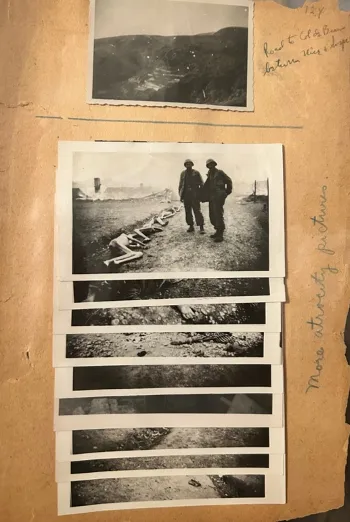
Excerpts from a scrapbook created by a Jewish American soldier named Alex Sesonske. His uncensored scrapbook, which includes everything from training camp photos to letters from his relatives to a poem his mom wrote, mocking his mustache, is one of the most complete accounts available of the GI experience during WWII. Though Sesonske doesn’t name the camp where these photos are taken, we can infer from his caption, “…taken at a Concentration Camp near Landsberg, Germany…” that they were of Kaufering, a subcamp of Dachau. He affixed them to his scrapbook in overlapping fashion, presumably to avoid shocking himself or anyone else with the gruesome images he’d saved.
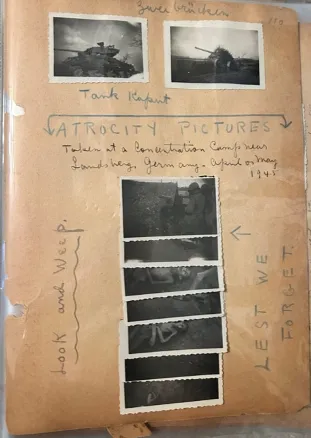
Excerpts from a scrapbook created by a Jewish American soldier named Alex Sesonske. His uncensored scrapbook, which includes everything from training camp photos to letters from his relatives to a poem his mom wrote, mocking his mustache, is one of the most complete accounts available of the GI experience during WWII. Though Sesonske doesn’t name the camp where these photos are taken, we can infer from his caption, “…taken at a Concentration Camp near Landsberg, Germany…” that they were of Kaufering, a subcamp of Dachau. He affixed them to his scrapbook in overlapping fashion, presumably to avoid shocking himself or anyone else with the gruesome images he’d saved.
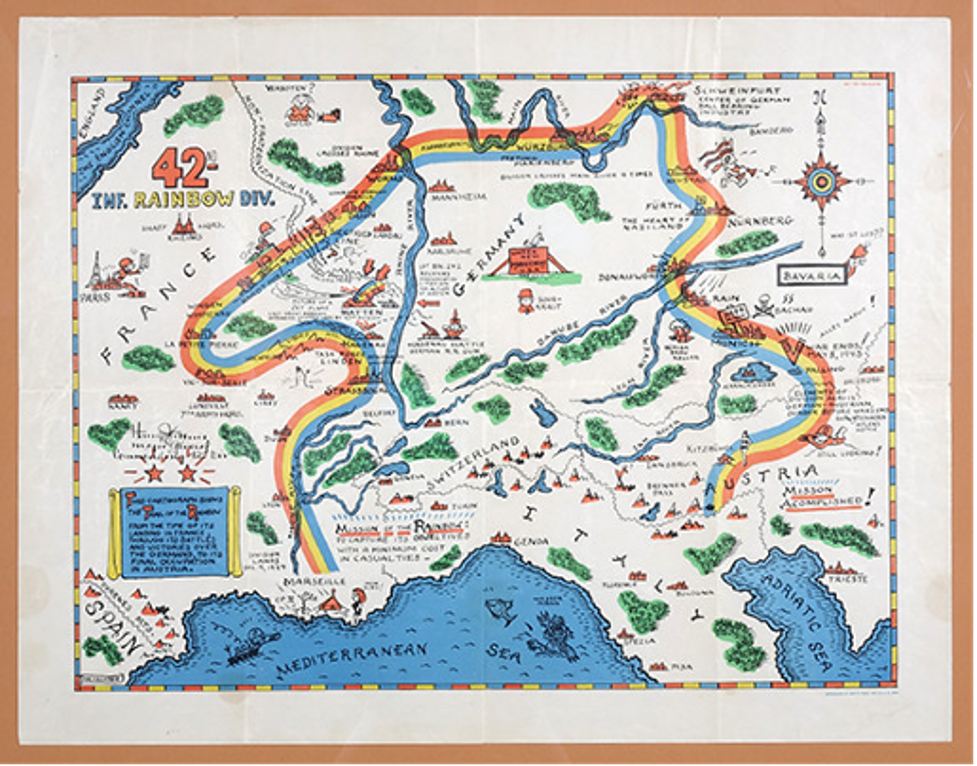
The Forty-Second Infantry Division of the US Army National Guard, nicknamed the “Rainbow Division” because it was comprised units from several states that didn’t have their own divisions, liberated Dachau, the longest-running concentration camp in Germany, on April 25, 1945. This map of their route from France into Germany was distributed to every member of the division to commemorate their success.

Though the Rainbow Division’s nickname predated its march into Germany, the prescient symbolism — echoing the Genesis story of God’s covenant to never again destroy the world — was not lost on the soldiers. This Shana Tova card (for the Jewish New Year, Rosh Hashanah) sent from 42nd Infantry Major General Harry Collins commemorates that covenant, expressing hope for peace in the new year — and the new era begun by the liberation of the concentration camps and the end of the war in Europe.

Though the Rainbow Division’s nickname predated its march into Germany, the prescient symbolism — echoing the Genesis story of God’s covenant to never again destroy the world — was not lost on the soldiers. This Shana Tova card (for the Jewish New Year, Rosh Hashanah) sent from 42nd Infantry Major General Harry Collins commemorates that covenant, expressing hope for peace in the new year — and the new era begun by the liberation of the concentration camps and the end of the war in Europe.
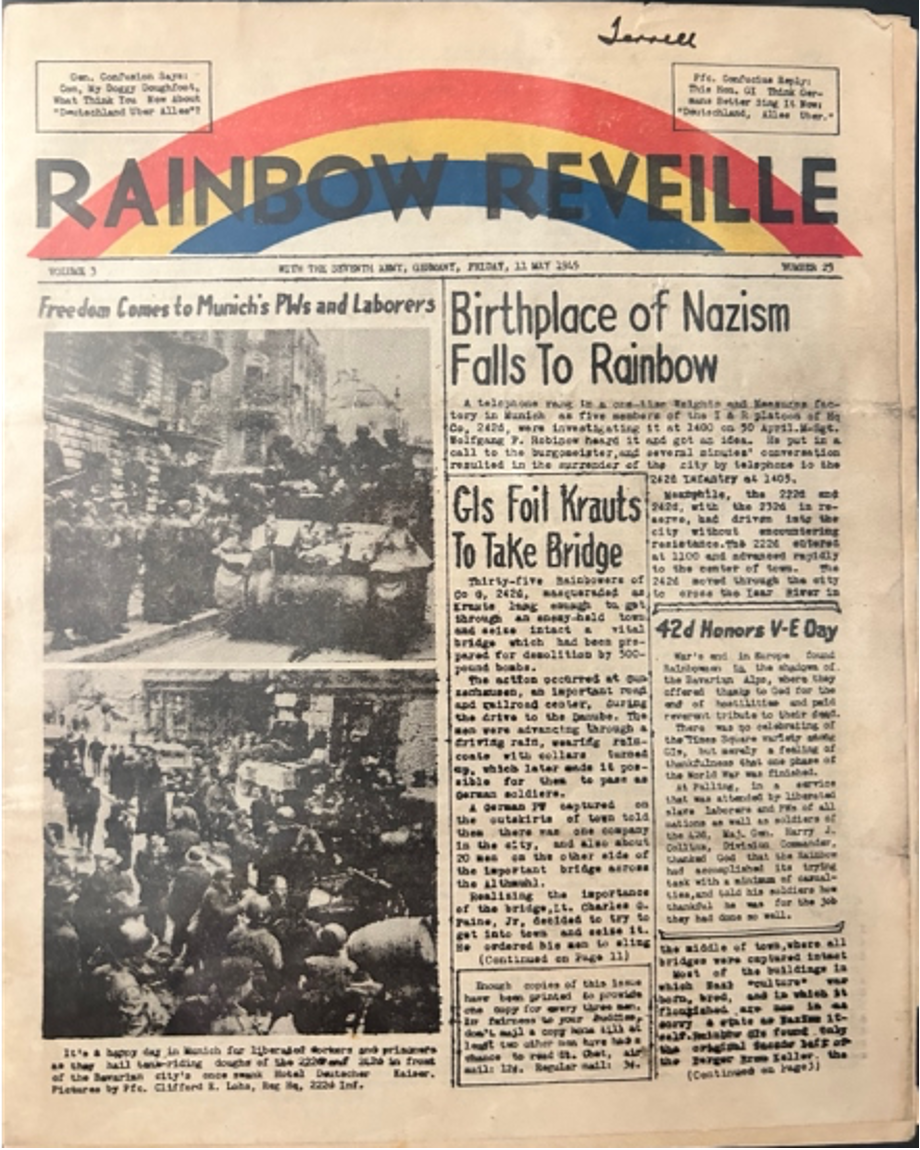
The May 11, 1945 edition of The Rainbow Reveille, the newsletter published by the forty-second, celebrates the end of the war in Europe, highlighting the Rainbow Division’s individual successes as well as VE Day, during which, the paper reports, “There was no celebrating of the Times Square variety among GIs, but merely a feeling of thankfulness that one phase of the World War was finished.”
%20-%20Sarah%20Welch.png)
The inside of the Rainbow Reveille newsletter offers a more somber look at the liberation of Dachau, including the history of the camp and the first photographs taken within its walls (taken by Reveille photographer Private First Class William R. Hazard).

Gregg's father, Bernard Philipson, standing in front of a tank somewhere in Europe.
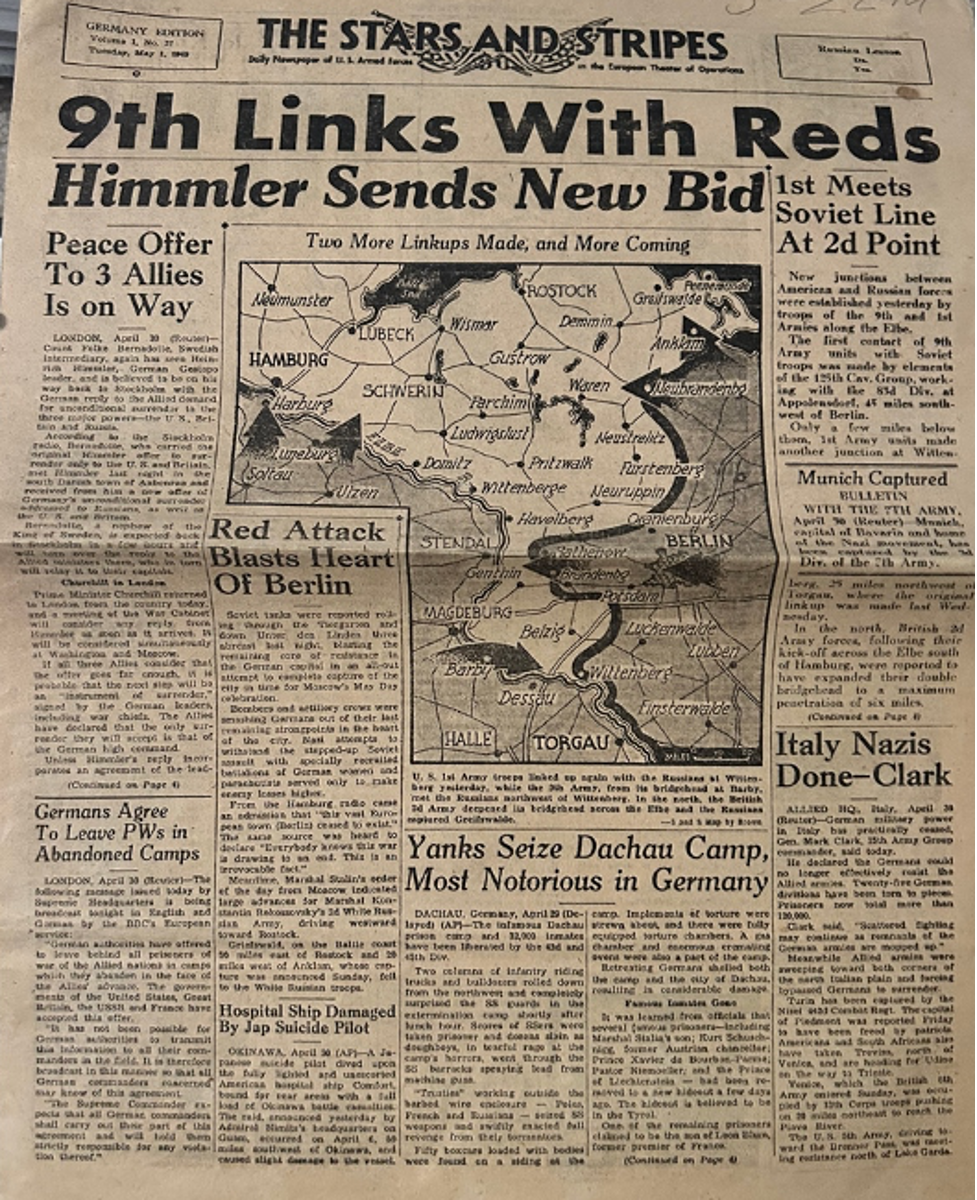
On May 1, 1945, just one week before VE Day, The Stars and Stripes, the US Armed Forces’ daily newspaper, celebrates the US seizure of Dachau, along with the capture of Munich by the US Army, Soviet attacks on Berlin, and the promise of an impending offer of surrender from Heinrich Himmler.

As Allied forces closed in, German leaders ordered that camps on the edge of their territories be forcibly evacuated and the prisoners moved to camps deeper in the Reich in order to cover up the Schutzstaffel's crimes. For example, in May of 1945, the SS was holding more than 7,000 prisoners from Neuengamme, Germany on two ships: a Kraft durch Freude luxury cruise ship (designed to hold just 800 or so passengers) called the Cap Arcona and a cargo ship called the Thielbeck. Tragically, on May 3, British troops, assuming the Cap Arcona and the Thielbeck carried German troops, bombed both ships. Both capsized, killing most of the prisoners aboard.