
%20-%20Sarah%20Welch.png)
(Interior) An American Nazi Party propaganda newsletter printed in the United States, April 10, 1941. This issue features an article by Nazi Germany’s minister of foreign affairs, Joachim von Ribbentrop, who would be hanged at Nuremburg after the war.
.webp)
Titan of industry Henry Ford was loudly anti-Jewish, as evidenced by his 1926 editorial in The Dearborn Independent, “What About the Jewish Question?”
.png)
Baltimore, 1939, a 14-year-old Jewish boy, Melvin Bridge, had an H (for “Hebrew”) carved into his neck by a group of students who had apparently created a “Junior Bund” patterned after Fritz Kuhn’s pro-Nazi group.
%20-%20Sarah%20Welch.png)
An American Nazi Party propaganda newsletter printed in the United States, April 10, 1941. This issue features an article by Nazi Germany’s minister of foreign affairs, Joachim von Ribbentrop, who would be hanged at Nuremburg after the war.
.png)
Charles Coughlin was a Catholic priest based in a suburb of Detroit. He was also vocally anti-Roosevelt (joining other leaders who nicknamed him “President Rosenfeld”), isolationist, and anti-Jewish. "Am I an Anti-Semite" is a collection of nine anti-Jewish addresses Coughlin had broadcast on his radio show between November 1938 and January 1939.
.png)
Anti-Jewish industry titan Henry Ford wrote two volumes of anti-Jewish essays, The International Jew: The World’s Foremost Problem and Jewish Activities in the United States, both also published by The Dearborn Independent. Ford’s essays were based in part on a fictional series called The Protocols of the Elders of Zion, published in Russia in 1903 and still used by radical Islamic groups today. The essays blame Jews for all that is wrong in society and accuse them of a conspiracy to take over the world. The Protocols were a cornerstone of the Nazis’ propaganda initiatives in the ’20s and ’30s — the party published more than twenty editions of the book, and many schools used it to indoctrinate students, as well.
%20-%20Sarah%20Welch%20(1).png)
(Reverse) Baltimore, 1939, a 14-year-old Jewish boy, Melvin Bridge, had an H (for “Hebrew”) carved into his neck by a group of students who had apparently created a “Junior Bund” patterned after Fritz Kuhn’s pro-Nazi group.
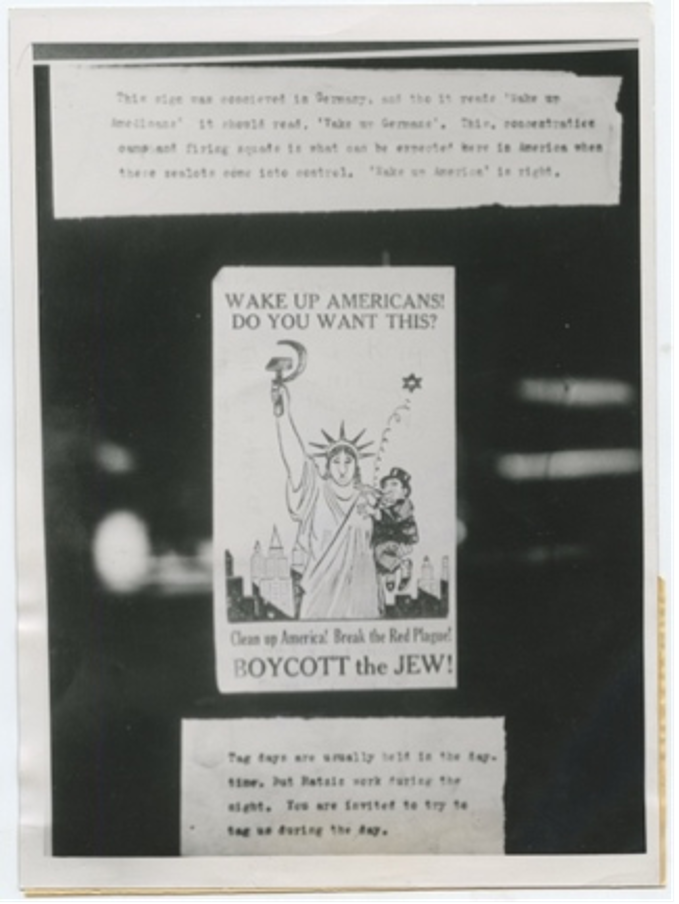
This “Boycott the Jew” sign could be found on a store window in Portland, Oregon in 1938, shortly before Kristallnacht. Referred to in English as “Night of the Broken Glass,” Kristallnacht took place on November 9 and 10, 1938 when the Nazis called for a series of pogroms (waves of organized violence) against the Jewish people throughout Germany, Austria, and the Sudetenland. The name, “Kristallnacht,” refers to the shattered glass lining the streets in the wake of the massacres, which targeted synagogues, Jewish homes, and Jewish-owned businesses, killing scores of German and Austrian Jews.
%20-%20Sarah%20Welch.png)
The German Bund was a pro-Nazi, anti-Jewish organization of Germans in the United States. Seen here is their leader, Fritz Kuhn, speaking in Milford, New Jersey. It is estimated that the Bund had 25,000 members, and they were active in spreading anti-Jewish propaganda through rallies, publications, and Hitler Youth-style camps for children, one of which, Camp Siegfried, was on Long Island.
.png)
This weekly tabloid founded in Detroit by anti-Jewish isolationist Father Charles Coughlin in 1936, churned out primarily anti-Jewish propaganda and hatred.
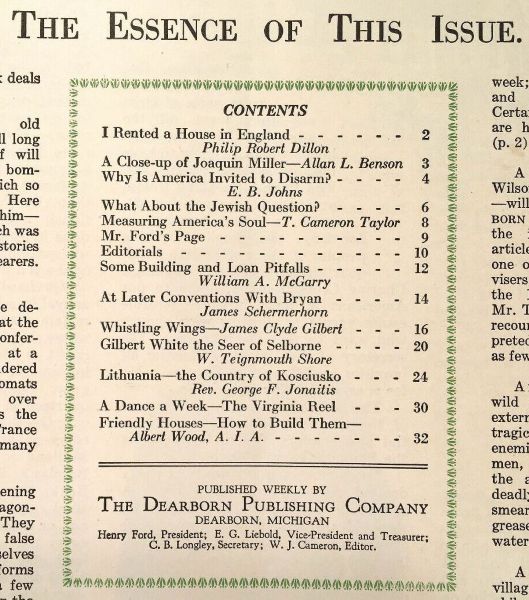
A typical table of contents from the weekly magazine, The Dearborn Independent, published by Henry Ford and featuring regular anti-Jewish propaganda, such as the article on page 6 of this issue: “What About the Jewish Question?”
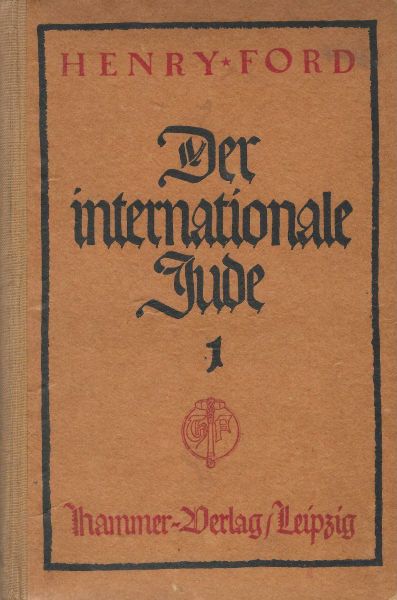
A German edition of Henry Ford’s anti-Jewish book, The International Jew.
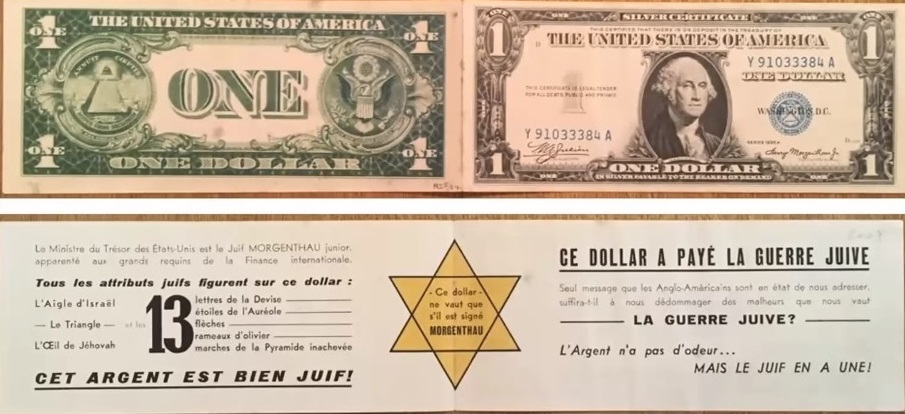
Fake US currency printed in 1943 as anti-Jewish propaganda playing into the trope that Jews were bankrolling WWII.