
When people picture Nazi propaganda, they tend to think of rallies, posters and newsreels. But the Party's real genius was reach. They understood how “going viral” worked before Social Media was even a glimmer in anyone’s eye. It spread its despicable messaging and values through every channel, reaching its audience wherever they were, including the bookshelf.
In an earlier post about how the Nazis infiltrated every aspect of German life, we looked at how they indoctrinated even children through grotesque coloring books and storybooks like The Poisonous Mushroom and Trust No Fox in the Meadow. This post looks at another book—featuring the same caricatures, and cartoonish style and leaning on the same tropes. Only this one’s for adults.
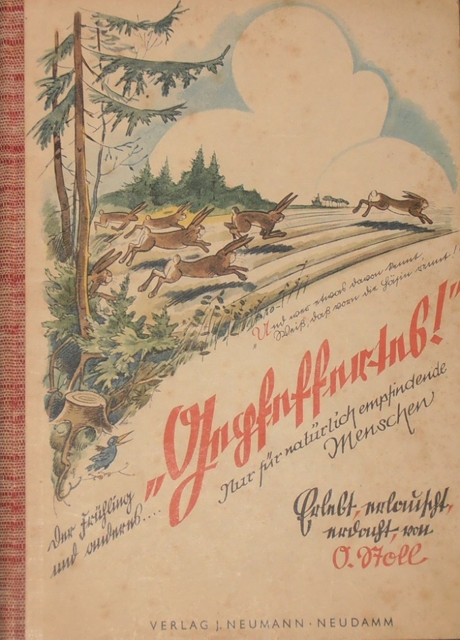
A Gift Book for Hunters
Der Frühling und anderes… "Gepfeffertes!" (Spring and Other Spicy Stories!) was written by Otto Stoll and published in 1940 by Verlag J. Neumann. The colorful drawings are credited to H. Heyne, and the text is printed in Sütterlin script. The cover, with its hares bounding across a field at the forest's edge, looks like any other gift book for a German outdoorsman. The subtitle promises it is "Only for Healthy Minded People."
It’s important to emphasize that this was not a Party pamphlet or a der Stürmer product but a consumer-facing trade book. Neumann was an established publisher of hunting and nature books—the kind you’d find in hunting cabins and on sportsmans’ office shelves. Most of the book is just what it looks like: bawdy, frivolous verse about nature, hunting, and romance. Two of its nine stories, though, are anti-Jewish hate stories, dropped in like just another joke.
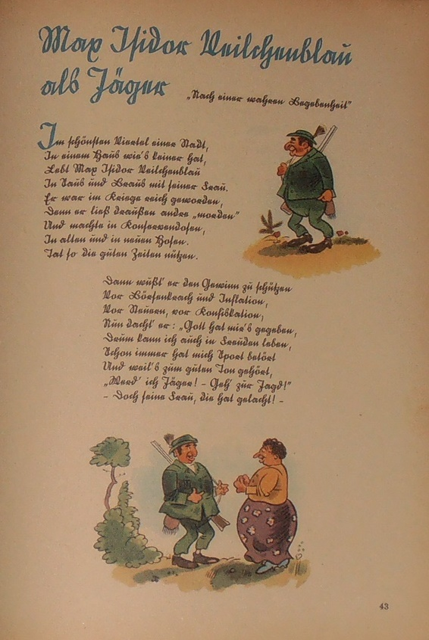
Max Isidor Veilchenblau as a Hunter
The longest story in the book is “Max Isidor Veilchenblau als Jäger” (“Max Isidor Veilchenblau as a Hunter”), subtitled "Based on a True Event."
From the title alone—before we even get to the grotesque caricatures in the illustrations—we know the story is anti-Jewish. The first name Isidor was widely used by the Nazis as a hateful name for Jewish people. The Weimar era Berlin Jewish police deputy leader, Bernhard Weiss, was only called Isidor by the Nazi leader Joseph Goebbels. By 1940, any German reader knew exactly what that name meant.
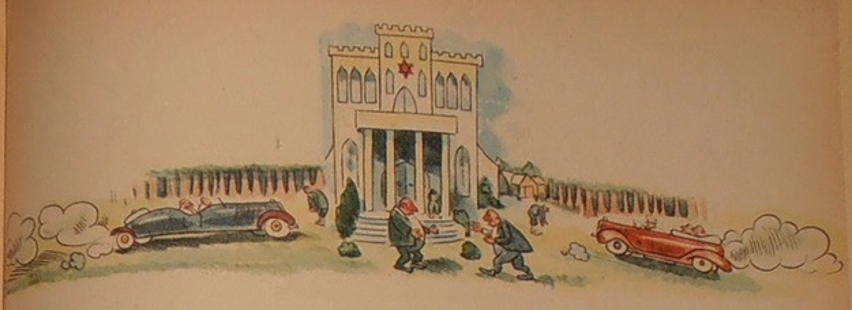
The story runs through nearly every antisemitic stereotype the regime promoted. Isidor got rich during the Great War while "others" did the dying. He shielded his fortune from the stock-market crash, inflation and taxes. Now he decides to take up hunting because it's fashionable. He leases a grand hunting ground, but the modest lodge isn't flashy enough for him or his wife, Rosalinde, whose lines are written in a mocking Yiddish accent. So he builds a gaudy modern one, drawn as a domed temple topped with a Star of David, and fills the woods with his "comrades."
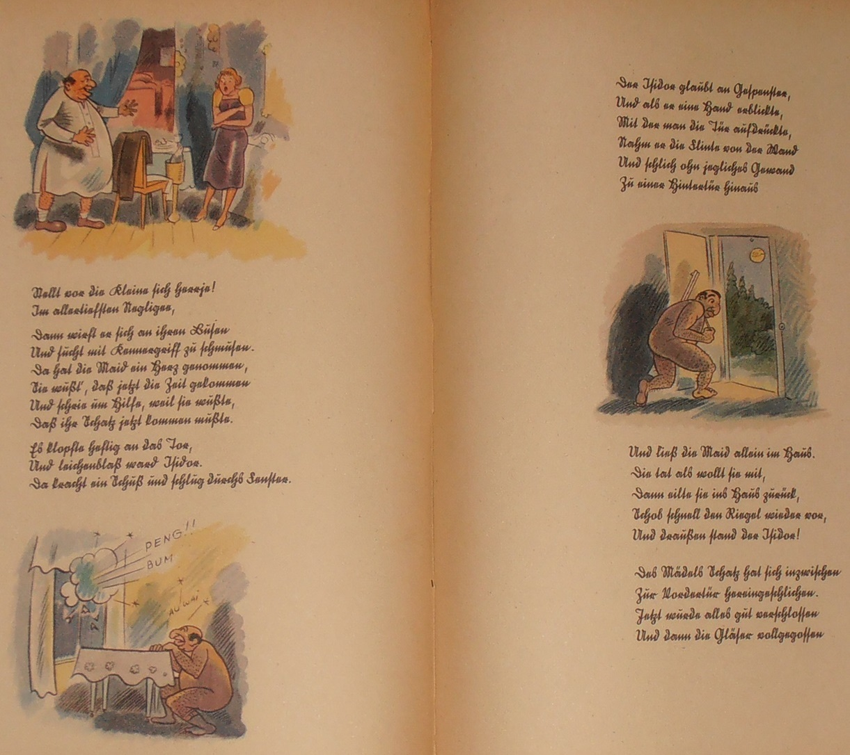
The twist is, he can't shoot. He carries his rifle around only to look the part. What he is really hunting, the verses tell us, is young women. He lures a blonde country girl to the lodge with champagne and caviar and strips down to his nightshirt. She screams for help. Her sweetheart, a poacher, fires a shot through the window. Isidor, a coward who "believes in ghosts," grabs his gun and runs out the back door stark naked. The girl bolts the door behind him, and the poacher strolls in the front to eat Isidor's food and drink his wine. Then the couple calls Rosalinde to report "burglars" at the lodge. She arrives with two police officers and the dog, who finds her husband cowering naked in the bushes. Isidor begs forgiveness under the officer's flashlight, and the police just smile.
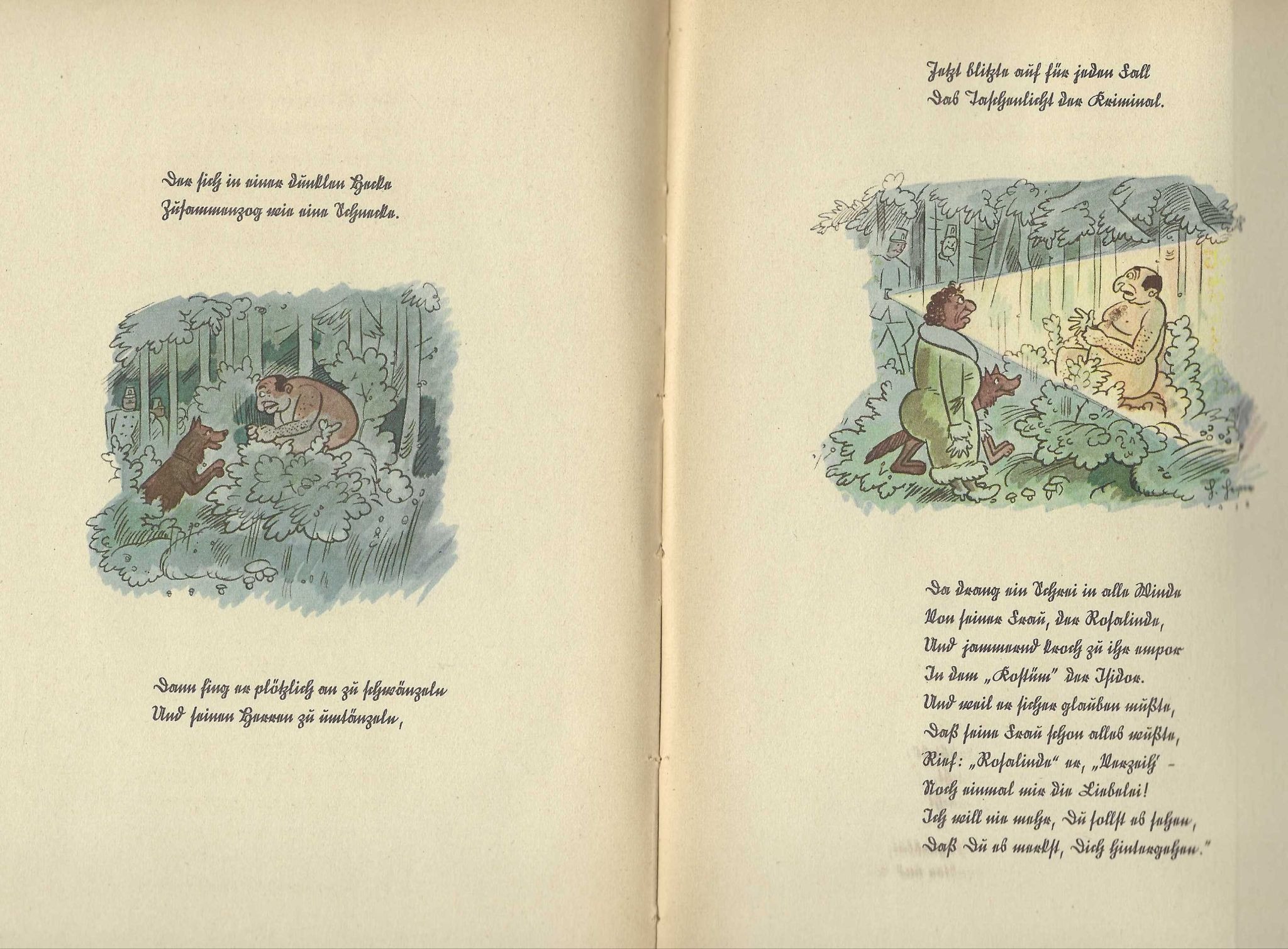
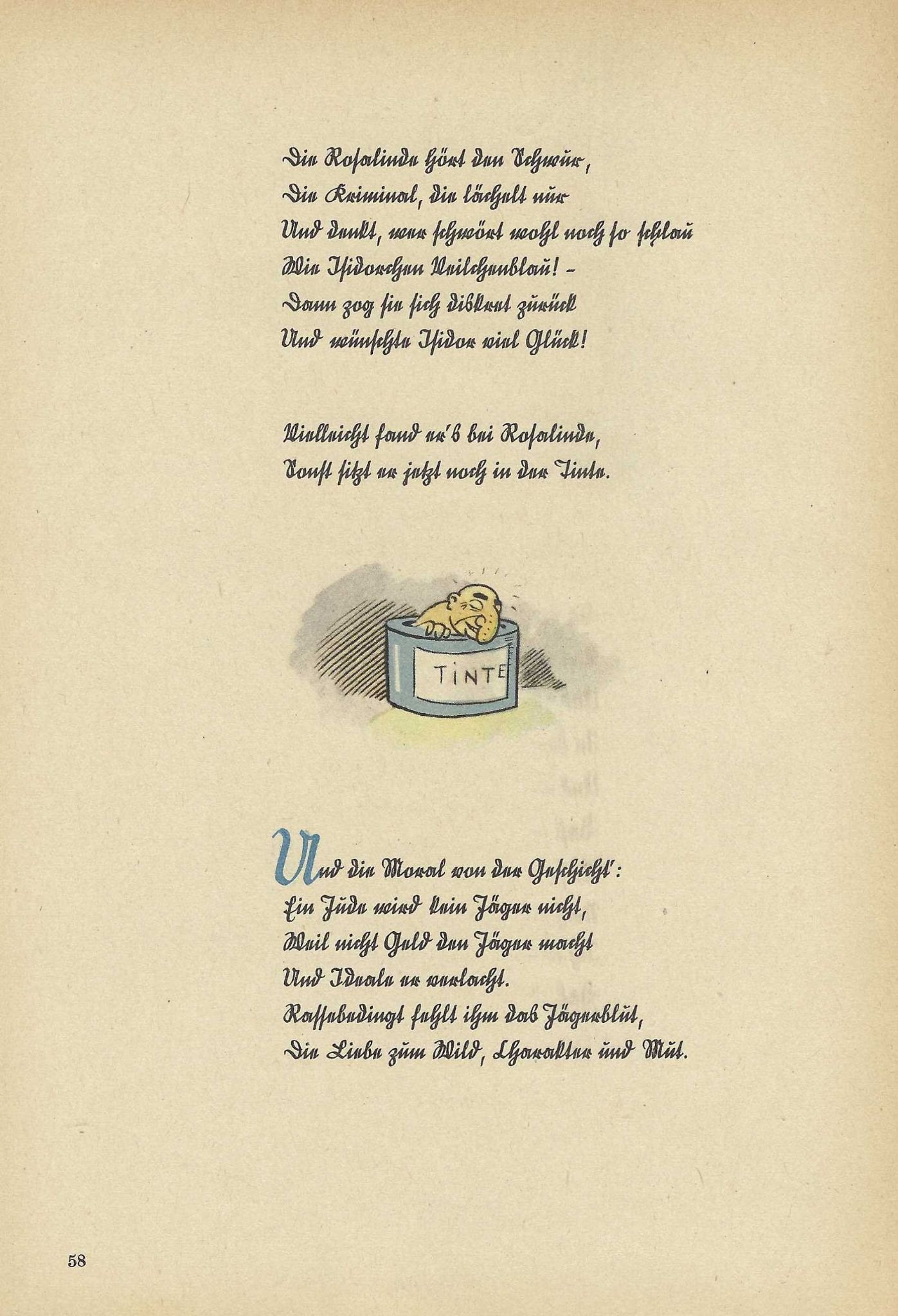
The closing "moral" leaves no room for misreading:
And the moral of the story:
A Jew will never be a hunter,
Because money does not make the hunter
And he laughs at ideals.
By his race he lacks the hunter's blood,
Love of game, character and courage.
Of course, by 1940, nothing in this "true event" could have happened. When Hermann Göring reorganized German hunting under the Deutsche Jägerschaft in 1934, Jews were shut out of membership even if they owned hunting land. The day after Kristallnacht in November 1938, a decree barred Jews from owning any weapons at all. The wealthy Jewish landowner with his rifle and his leased forest was a fantasy. The real Jews of Germany had already been disarmed, pushed out of their professions, and stripped of their businesses and property.
That fantasy was the point. The story takes people who had been made powerless and paints them as predators: rich, lecherous, cowardly, and a threat to German women. Meanwhile the real lawbreaker, the poacher, is the hero, and the police are in on the laugh. The message was that anything done to Isidor was deserved, and funny.
The Same Caricature, a Grown-Up Audience
Put this book next to The Poisonous Mushroom and Trust No Fox, and the family resemblance is obvious.
Trust No Fox in the Green Meadow and No Jew on His Oath (1936) was written by Elvira Bauer, an 18-year-old kindergarten teacher, and published by Julius Streicher's Stürmer-Verlag. Children read the book as young as six, and it was wildly popular.
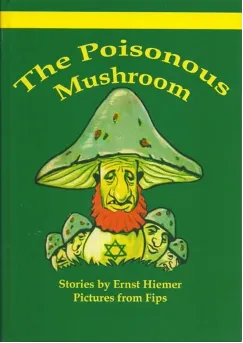
The Poisonous Mushroom (1938), written by Ernst Hiemer and illustrated by Streicher's star cartoonist "Fips," taught children to fear and distrust Jews. The United States Holocaust Memorial Museum holds a copy picked up by an American soldier in 1945 that still bears a stamp from a German school library.
All three books use the same bald, hook-nosed, hairy, middle-aged Jewish man, and all three teach the same lesson: Jews are dishonest, greedy, cowardly and dangerous, and they can never truly belong.
The difference is the audience. The Stürmer books were openly propaganda, made for the classroom. Spring and Other Spicy Things! made no such claims. It came from a mainstream publisher, was sold as light entertainment for grown men, and was printed in the same year the regime began deporting German Jews from Baden to camps in France. A child raised on Trust No Fox in 1936 could be laughing at Isidor by 1940. The propaganda didn't stop at childhood. It grew up alongside its readers.
Sick Jokes Never Die
What makes this history so disturbing is that it isn’t just history. English translations of The Poisonous Mushroom are still printed today, including a 2020 trade paperback that markets the book's "historical importance" and full-color Fips artwork. That same year, Amazon removed an English edition only after a complaint from the UK's Holocaust Educational Trust, while English translations of Trust No Fox and other Streicher works stayed listed. My own collection includes copies published as recently as 2025 (currently on display at the Holocaust Museum Houston, along with other Nazi propaganda from our collection).
But here’s the thing about marketing the book based on its “historical importance,” while completely preserving its original text, images, and format: Without the context that collections like ours exist to provide, a reprint isn't a historical document. It's just the very same book, doing the very same job, for a new audience.
Explore more: The Poisonous Mushroom: Anti-Jewish Propaganda for Kids · From the Hitler Youth to the KdF: How the Nazi Platform Infiltrated Every Aspect of German Culture