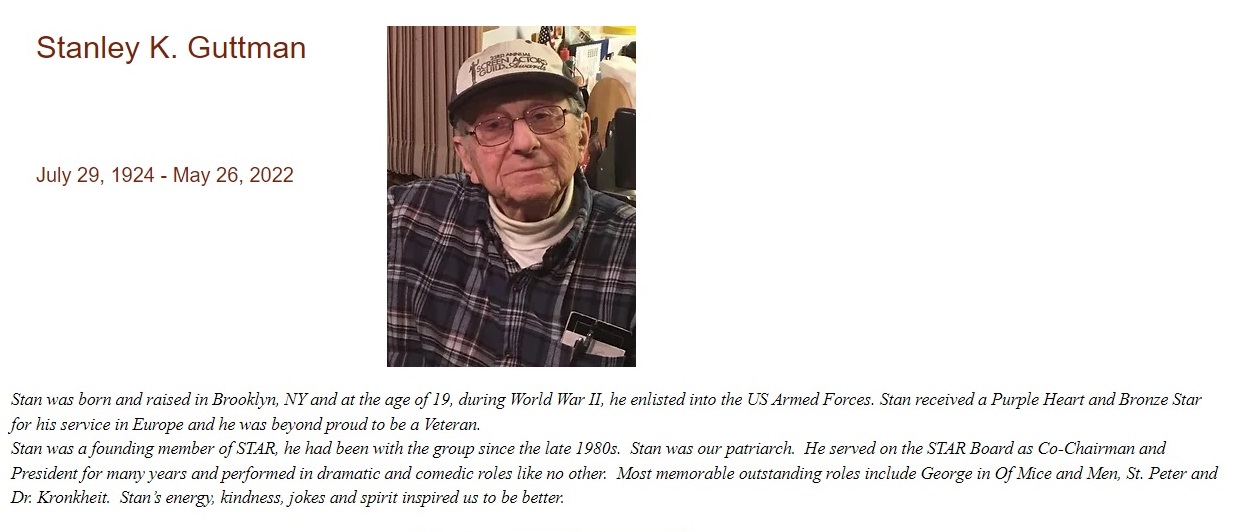
A story of two Jewish American WWII soldiers, friends from Brooklyn, and the letters they wrote home. Or, more simply, a story about two boys and their moms.
The Guttman Collection is one of my favorite examples of how collecting and preserving artifacts can really personalize elements of history we often only see sensationalized in textbooks and blockbuster films.
Without the personal memorabilia that gives us a peek into their inner lives, Stanley Guttman and Stanley Schachne would be remembered only as two of the thousands of young men who fought for the United States in WWII. If they were remembered at all.
But thanks to a not-small collection of V-Mail Stanley Guttman’s mother left behind—along with her son’s diaries and other personal effects—we know a whole lot more about both of them.
The Two Stanleys…
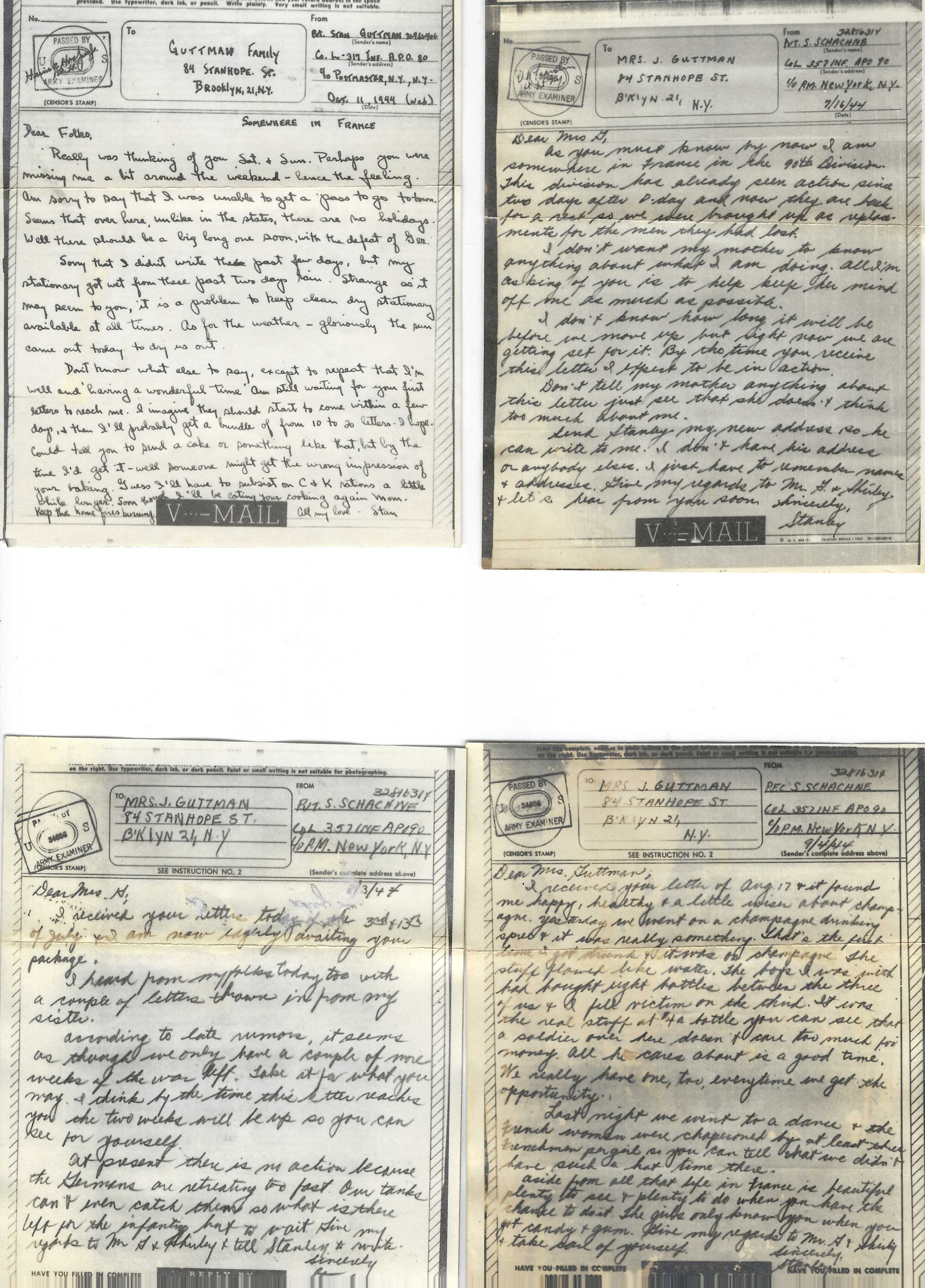
Stanley Schachne lived at 91 Stockholm Street. Stanley Guttman lived at 84 Stanhope Street. In the Bushwick section of Brooklyn, that's a five-minute walk—close enough that their mothers, Mrs. A. Schachne and Mrs. J. Guttman, clearly knew each other well before either boy enlisted. By the summer of 1944, both Stanleys had joined the 357th Infantry Regiment, 90th Infantry Division. We know this from the return addresses on the letters both Stanleys wrote to Mrs. Guttman while they were overseas. We also know from those return addresses that at some point Stanley G. was moved to a different company, though we don’t know why.
…and their moms
Shortly after arriving in France, Stanley S. wrote a letter to Mrs. Guttman, dated July 16, 1944. It’s not really about him, though—it’s about his mom:
"I don't want my mother to know anything about what I am doing. All I'm asking of you is to help keep her mind off me as much as possible... Don't tell my mother anything about this letter, just see that she doesn't think too much about me."
We don’t know how much Stanley Schachne wrote to his own mother, though presumably he did. But, concerned about her well-being, he sent most of his hews—particularly the tough stuff—to Mrs. G. so that she could filter it for Mrs. S.
Mrs. Guttman, in return, kept tabs on Mrs. Schachne around the neighborhood and reported back. In one letter Mrs. G. told Stanley she'd seen his mother "quite often" and that "she is looking very good…feels much better now." To me, it reads less like a favor from one neighbor to another and more like one mother looking after two sons who’d gone off to war.
Through the rest of the summer, Schanche’s letters to "Mrs. G" have the performative good cheer of a young soldier trying to sound unbothered. He complains about needing stationery, along with a toothbrush and tooth powder, because he'd "lost all my toilet articles through no fault of my own." He describes wresting a town from German control and being rewarded with real champagne. "Not the imitation stuff,” he writes. “I mean the real stuff." By September he's passing along rumors that the war might be over in a matter of weeks, with the appropriate soldier's caveat: "Take it for what you may." One letter recounts a chaperoned dance with French women, watched over by "at least three Frenchmen per girl," and the general verdict that "life in France is beautiful—plenty to see and plenty to do when you have the chance to do it."
Guttman’s Diary
Stanley Guttman remained stateside for several months after Scachne shipped out, as we know from Mrs. Guttman's Rosh Hashanah letter to Schachne, dated Thursday, September 21, 1944: "I suppose your mother wrote you that Stanley has left the states. At present we haven't a permanent address. We have a long wait now for his first letter." Two days later, a letter arrived at the Guttman household from the ship's chaplain, Frank Newman, confirming that Guttman's transport had "arrived safely at its destination overseas," and that he'd attended a religious service before departing and asked the chaplain to write home on his behalf.
Guttman's own first letters home have the wide-eyed quality of a young man seeing Europe for the first time under strange circumstances. A late September letter describes a stopover in Paris, the Eiffel Tower, the Arc de Triomphe, and a taste of cognac strong enough that he "almost hit the ceiling." By October 11, the tone has settled into more of a routine: waiting for the first bundle of mail to catch up with him, living on rations, and hoping he’d be eating his mother’s cooking again before too long.
Guttman kept a diary that fall, inside a 1944 Jewish Welfare Board Jewish Calendar for Soldiers and Sailors. His day-by-day notes, written in pencil, are terse in the particular way of someone who is exhausted and unsure of what tomorrow will bring.
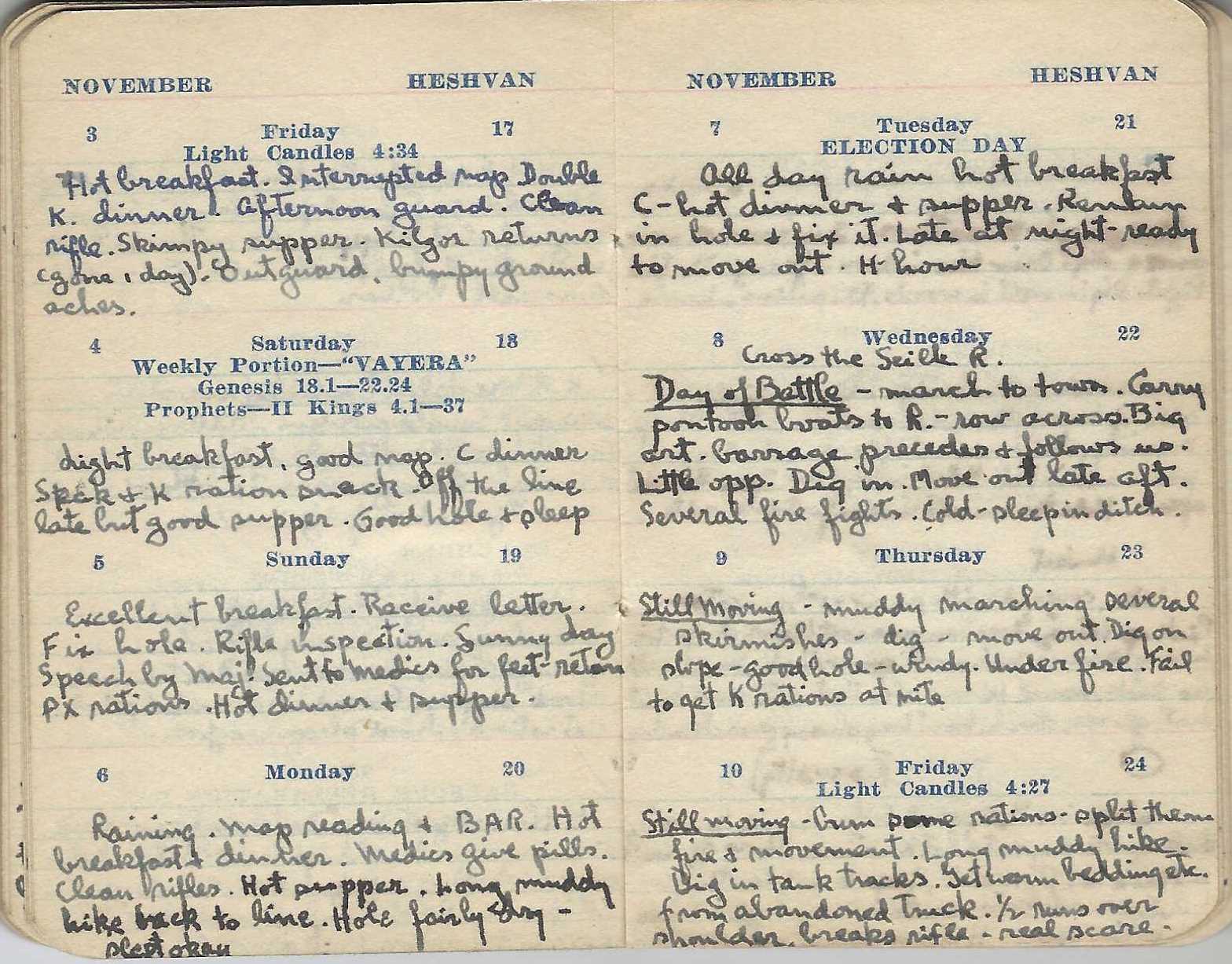
The 90th Division's push through Lorraine that November was brutal, and the diary tracks it almost hour by hour:
Nov. 8, "Day of Battle": Cross the Seille R. ...march to towns. Carry pontoon boats to R. — row across. Big art. barrage precedes and follows us. Little opp. Dig in. Move out late aft. Several fire fights. Cold, sleep in ditch.
The days that follow are a blur of marching, digging in, short skirmishes, and cold — "under fire," "muddy marching," "long hike back to line." Then, on November 14 — the date is circled in the diary and marked simply, "Casualty" —
Wake in H₂O filled hole. ½ mile to Capt. Harlinger to dry out — hot K rations. Shoe off, can't put back on. Bn. aid, jeep to collecting station, ambulance to evac hosp. … Hot supper & wet sweats.
The next day: "Little sleep despite pills — feet hurt, chills — hot breakfast & dinner then shipped by litter in ambulance to distrib. center — Toul."
Everything Stanley G. noted here is a textbook description of trench foot, the cold-and-wet injury that crippled tens of thousands of GIs during that Lorraine autumn. (Tellingly, the family also kept a period newspaper clipping headlined "Fighting Trench Foot" among Stanley's things.)
Two weeks later, the Guttman family got word from Western Union via a telegram, addressed to Stanley's father, arriving at 4:31 in the afternoon on November 29, 1944:
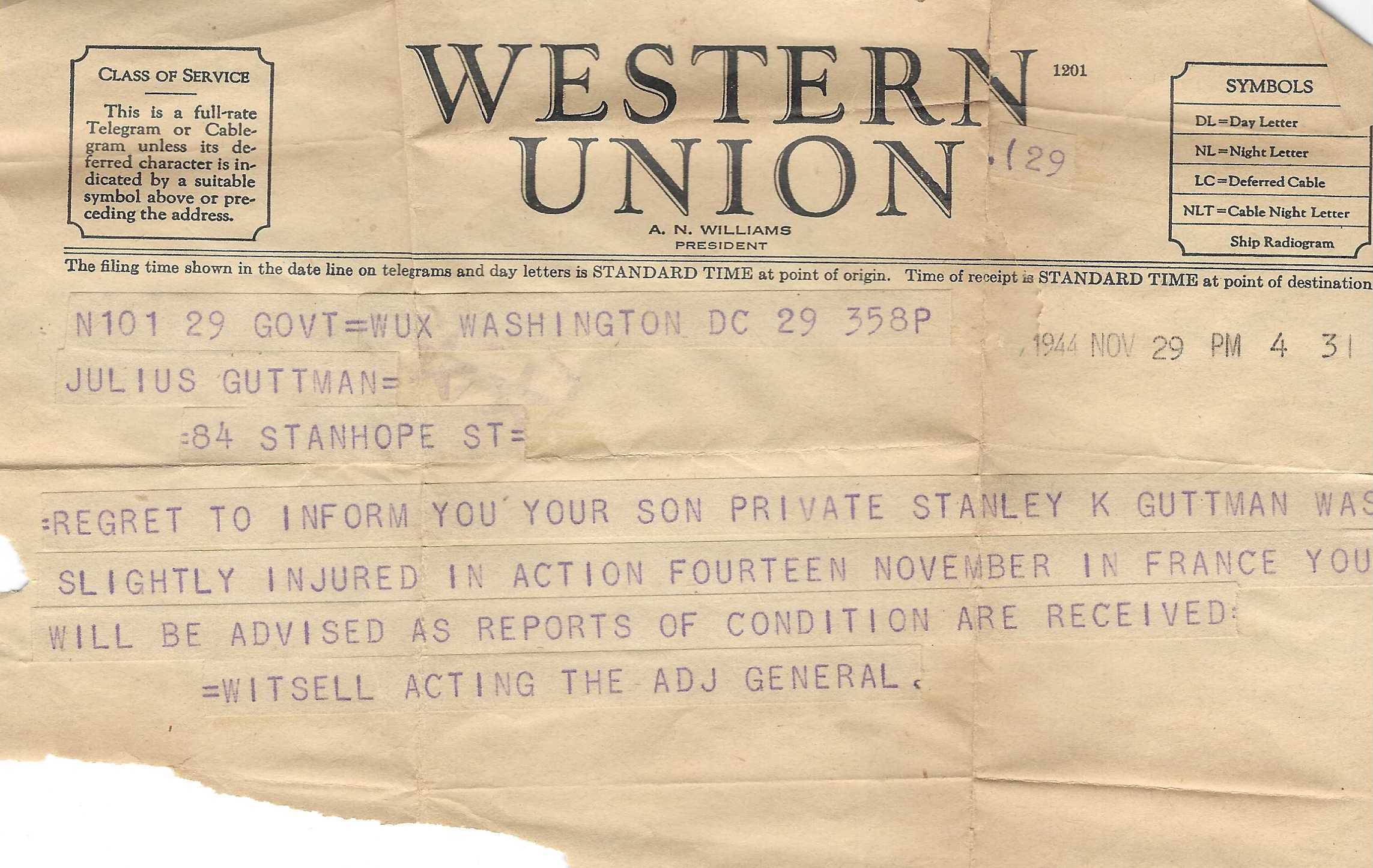
Maybe better that they didn’t learn until after Thanskgiving.
Schachne’s Last Letter
Shortly after Guttman’s injury, Schachne, who was still pushing toward the German border with the 357th, wrote what would turn out to be his final letter to Mrs. Guttman — unhurried, a little wistful, giving no sign that anything was about to change:
December 5, 1944
I've written Stanley as soon as I received his address but as to date I have not received any answer. Don't worry about him being lonesome. Life isn't so bad as you may think — I've been over here fighting for 5 months & my moments of loneliness can be counted on one hand…I missed the pass to Paris by a couple of hours but I intend to be on the next one if God permits. I want to wish you all a Happy Hanukah & that I'm hoping that one of these days the war will end & we'll all be united in peace & happiness…don't worry too much about Stanley, he'll be all right.
Stanley.
The next day, December 6, the 357th Infantry crossed the Saar River and assaulted the fortified German towns of Pachten and Dillingen, the leading edge of the Siegfried Line. German Tiger tanks counterattacked, and on December 7, 1944, Pfc. Stanley Schachne was declared Missing in Action near Pachten. Within days, the German breakthrough in the Ardennes—the opening of the Battle of the Bulge—forced the 357th to withdraw from the Saar bridgehead entirely, and recovery of the regiment's dead became impossible in the chaos.
His remains were never found and in January 1945 he was classified as killed in action. He's memorialized today on the Walls of the Missing at the Lorraine American Cemetery in Saint-Avold, France, and was posthumously awarded the Bronze Star and the Purple Heart with two Oak Leaf Clusters.
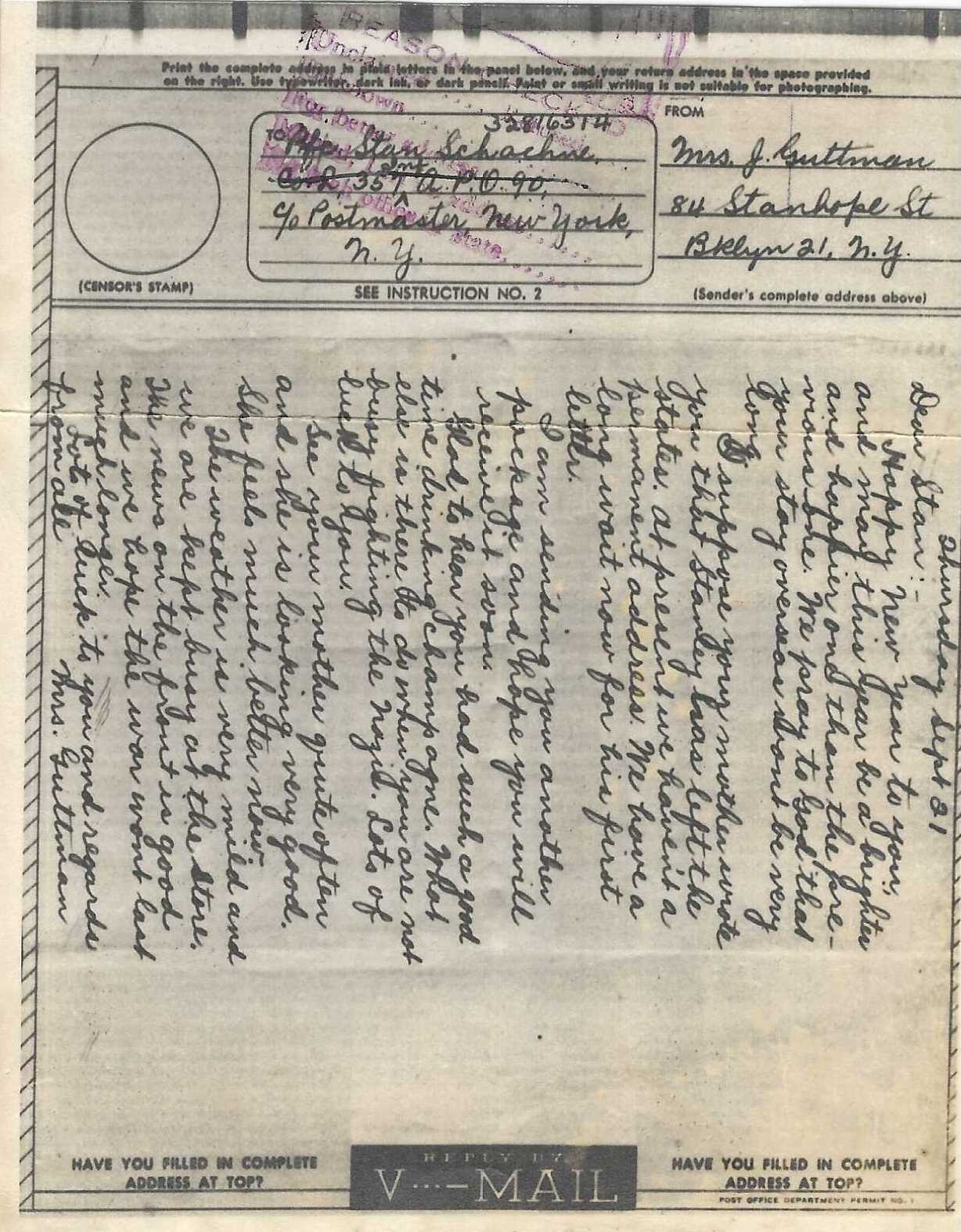
We don’t have the telegram the military sent to the Schachne family, but we do have V-mail Mrs. Guttman had addressed to "Pfc. Stan Schachne, Col. 357, APO 90" before the news of his death had reached her. The letter was returned to her, his name and unit crossed through and stamped by an Army censor. If she hadn’t already heard the news from Mrs. S., that returned letter likely told her the whole story.
Why the Stanleys’ Stories Matter
When I look at these materials, I think a lot about the old, “It takes a village…” saying, and I’m grateful that Stanley S. and his mom had Mrs. Guttman as part of their village. She clearly brought great comfort to Stanley while he was overseas, and I can only imagine the comfort she brought Mrs. Schachne in the aftermath.
More importantly, perhaps, collections like these remind us that, at the heart of every moment in history—no matter how sensational or how mundane—are human beings. And only by spotlighting and sharing that humanity can we stop ourselves from bringing history’s transgressions into the present.