
I bought a small lot of 1944 issues of Signal magazine off eBay for one reason: As I scanned through the listing, I realized one of the interior pages of one of the magazines had a drawing I recognized. It's a fierce image of a partisan fighter, cropped close to hide the fact that, in the original, this fighter was doing away with two Nazi soldiers.
I knew what was missing because I'd seen the image before. It was the work of Arthur Szyk, the Polish-Jewish artist who spent the war using his massive drawing talent to destroy the Third Reich. Finding his art inside a German Army propaganda magazine is one of the more darkly funny discoveries I’ve made in all my years of collecting.

Signal was the Wehrmacht's glossy, multilingual propaganda magazine—never sold inside Germany itself but printed in dozens of languages and distributed across occupied and neutral countries to sell the war to outside audiences. The mid-March 1944 issue ran a feature by Giselher Wirsing titled "Romantik der Bosnischen Wälder?"—"Romanticism of the Bosnian Forests?"—a profile of the still-mysterious Partisan commander known to the Allies only as "General Tito." Illustrating it was the drawing of Tito overpowering two Nazi soldiers.

I didn't have to look far to find where it came from—I already had the source in my collection. Three months earlier, on December 18, 1943, the American magazine Liberty had run its own Tito profile—"General Tito: Mystery Warrior of the Balkans," by Juliet Bridgman and Allen Roberts—with a full-page cartoon credited to Arthur Szyk. Josip Broz Tito was portrayed in Allied media as a shadowy, elusive resistance figure leading a fierce guerrilla war against Axis occupation forces in Yugoslavia, and Szyk had followed that trend.
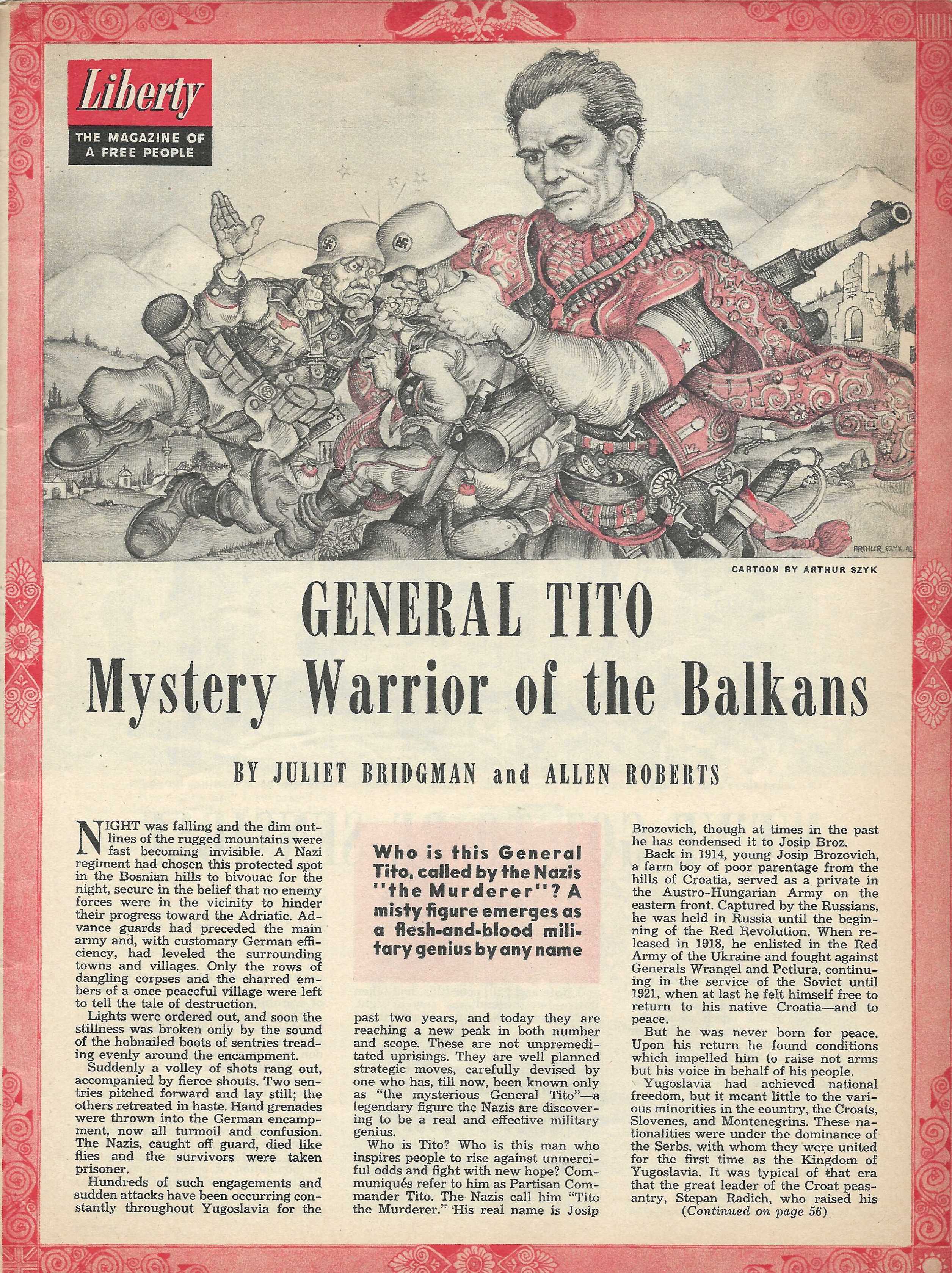
Signal's editors had simply lifted it. My friend and fellow collector Thorsten, who lives in Germany and is an authority on German WWII history, has joined me in many a collectors’ rabbit hole. He suspects using this particular image was a strategic choice. Signal was aimed at readers who would have already seen Allied coverage of Tito, and reusing a familiar image was a cheap way to trigger recognition. Still, whether anyone on the German side realized who the original artist was is up for debate.
Szyk called himself a "soldier in art," and he more than earned the title. He spent the war using his intricate, miniaturist style skewering Hitler, Mussolini, and Hirohito and championing Allied resistance figures, Tito included. That his own image, made in service of that cause, ended up doing propaganda work for the Wehrmacht is the kind of dark irony that makes for a good chuckle—a much-needed bit of comedic relief afterhours immersed in this horrifying chapter in Jewish history.
View the Arthur Szyk collection here.