
Liberation of the Concentration Camps
As Soviet, American, and British forces moved further into Germany and German-occupied territories, they began to encounter the concentration camps — and the evidence of mass murder therein. Auschwitz, liberated by the Soviets on January 27, 1945, was the first camp to fall. As the death camps were cleared out and the survivors removed to safety, there was plenty to celebrate, and the joy was contagious as this grotesque chapter of history drew to a close.
The liberation of the concentration camps was, of course, a cause for celebration: the killing was almost over, and the Fürher was dead. However, the Nazis had been so meticulous about hiding the extent of the atrocities they were committing at their “death mills” that liberation was the first time outsiders saw what was truly happening to Jews and other political scapegoats in Germany and German-occupied Poland and Austria. As such, the victory of liberation was undermined by the bone-deep shock of discovering the truth. And as for the survivors, well, anything resembling normalcy was still a long way off.
Important Moments
Highlights from the Collection
%20-%20Sarah%20Welch.webp)
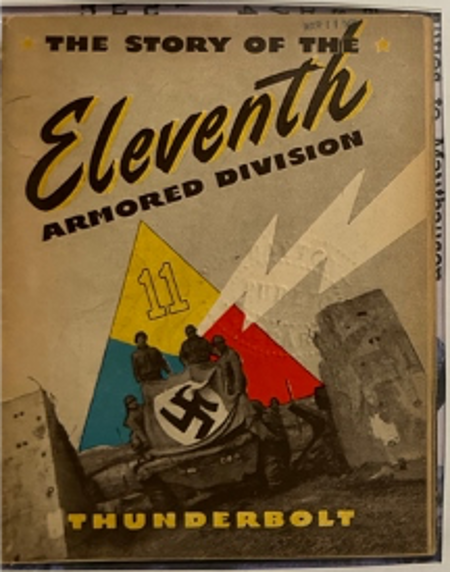
The 11th Armored Division, nicknamed “Thunderbolt,” liberated Austria’s Mauthausen and Gusen concentration camps in May of 1945, freeing thousands of prisoners. This thirty-two page softcover book tells the story of the rescue — and it also sheds additional light on the unspeakable atrocities the troops witnessed in the camps.
The 11th Armored Division, nicknamed “Thunderbolt,” liberated Austria’s Mauthausen and Gusen concentration camps in May of 1945, freeing thousands of prisoners. This thirty-two page softcover book tells the story of the rescue — and it also sheds additional light on the unspeakable atrocities the troops witnessed in the camps.
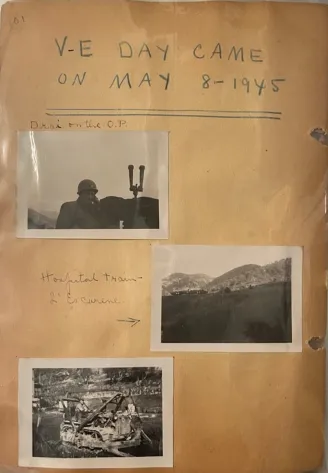
Excerpts from a scrapbook created by a Jewish American soldier named Alex Sesonske. His uncensored scrapbook, which includes everything from training camp photos to letters from his relatives to a poem his mom wrote, mocking his mustache, is one of the most complete accounts available of the GI experience during WWII. Though Sesonske doesn’t name the camp where these photos are taken, we can infer from his caption, “…taken at a Concentration Camp near Landsberg, Germany…” that they were of Kaufering, a subcamp of Dachau. He affixed them to his scrapbook in overlapping fashion, presumably to avoid shocking himself or anyone else with the gruesome images he’d saved.
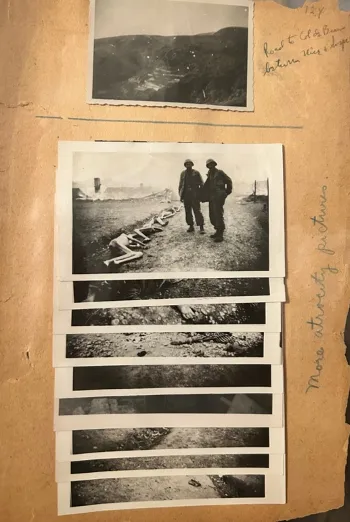
Excerpts from a scrapbook created by a Jewish American soldier named Alex Sesonske. His uncensored scrapbook, which includes everything from training camp photos to letters from his relatives to a poem his mom wrote, mocking his mustache, is one of the most complete accounts available of the GI experience during WWII. Though Sesonske doesn’t name the camp where these photos are taken, we can infer from his caption, “…taken at a Concentration Camp near Landsberg, Germany…” that they were of Kaufering, a subcamp of Dachau. He affixed them to his scrapbook in overlapping fashion, presumably to avoid shocking himself or anyone else with the gruesome images he’d saved.
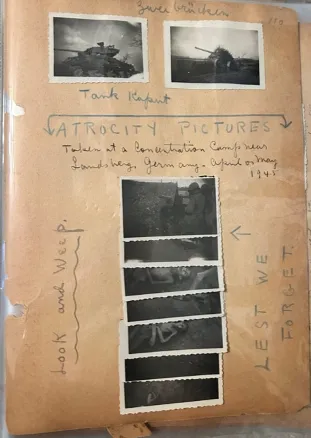
Excerpts from a scrapbook created by a Jewish American soldier named Alex Sesonske. His uncensored scrapbook, which includes everything from training camp photos to letters from his relatives to a poem his mom wrote, mocking his mustache, is one of the most complete accounts available of the GI experience during WWII. Though Sesonske doesn’t name the camp where these photos are taken, we can infer from his caption, “…taken at a Concentration Camp near Landsberg, Germany…” that they were of Kaufering, a subcamp of Dachau. He affixed them to his scrapbook in overlapping fashion, presumably to avoid shocking himself or anyone else with the gruesome images he’d saved.
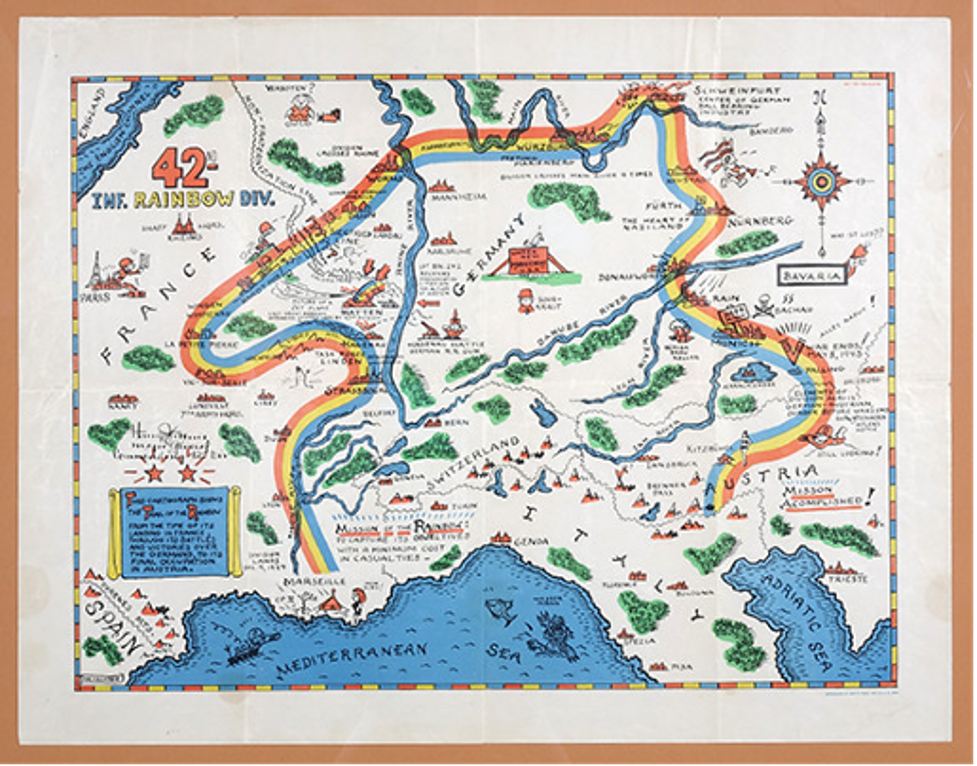
The Forty-Second Infantry Division of the US Army National Guard, nicknamed the “Rainbow Division” because it was comprised units from several states that didn’t have their own divisions, liberated Dachau, the longest-running concentration camp in Germany, on April 25, 1945. This map of their route from France into Germany was distributed to every member of the division to commemorate their success.

Though the Rainbow Division’s nickname predated its march into Germany, the prescient symbolism — echoing the Genesis story of God’s covenant to never again destroy the world — was not lost on the soldiers. This Shana Tova card (for the Jewish New Year, Rosh Hashanah) sent from 42nd Infantry Major General Harry Collins commemorates that covenant, expressing hope for peace in the new year — and the new era begun by the liberation of the concentration camps and the end of the war in Europe.
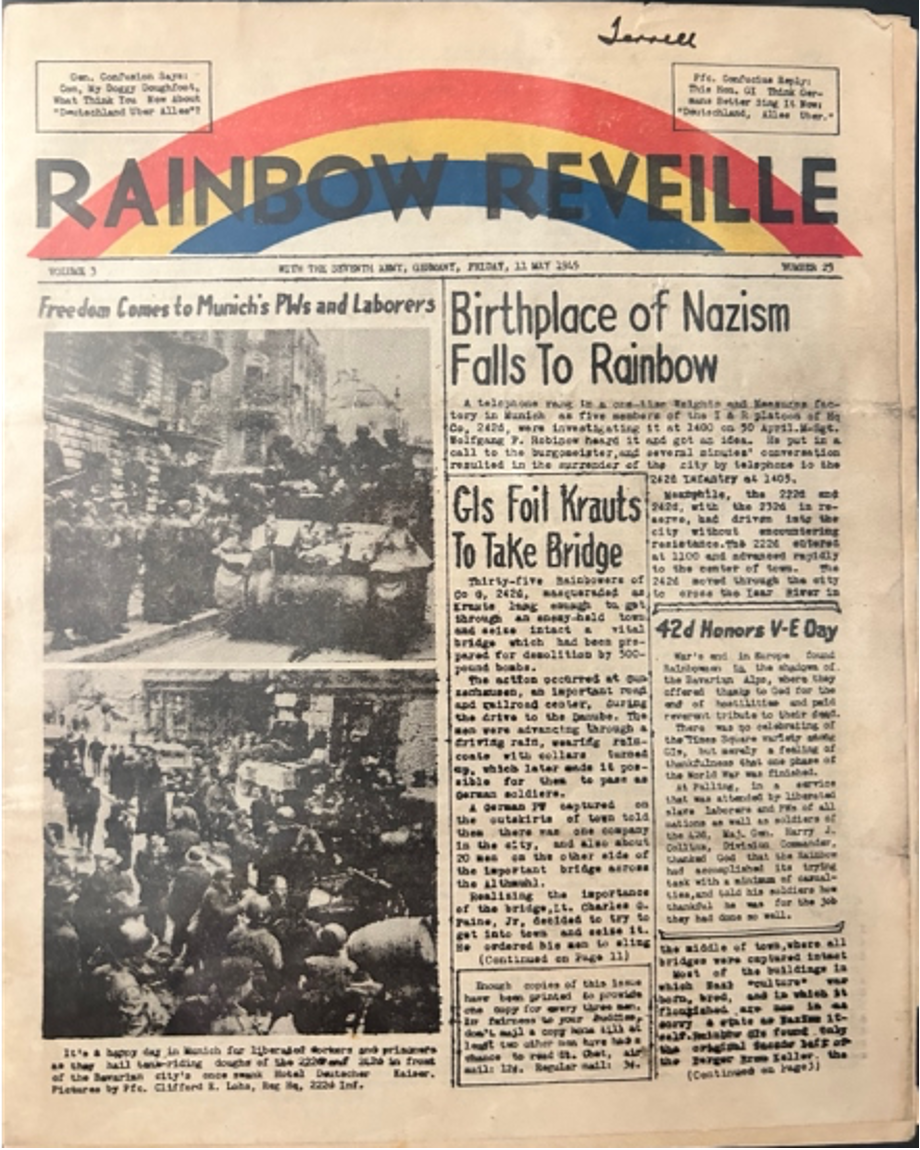
The May 11, 1945 edition of The Rainbow Reveille, the newsletter published by the forty-second, celebrates the end of the war in Europe, highlighting the Rainbow Division’s individual successes as well as VE Day, during which, the paper reports, “There was no celebrating of the Times Square variety among GIs, but merely a feeling of thankfulness that one phase of the World War was finished.”

Though the Rainbow Division’s nickname predated its march into Germany, the prescient symbolism — echoing the Genesis story of God’s covenant to never again destroy the world — was not lost on the soldiers. This Shana Tova card (for the Jewish New Year, Rosh Hashanah) sent from 42nd Infantry Major General Harry Collins commemorates that covenant, expressing hope for peace in the new year — and the new era begun by the liberation of the concentration camps and the end of the war in Europe.
